DuPage County movers for all 19 towns, from Naperville to Elmhurst
Rail-line bungalows, I-88 office campuses and 1970s split-levels: how moves differ across DuPage, town by town, from one licensed Plainfield mover.
- 19 DuPage towns
- Licensed ILCC 73744 MC-C
- One household per truck
- Free in-home estimates
Who moves homes across DuPage County, and how is a DuPage move priced?
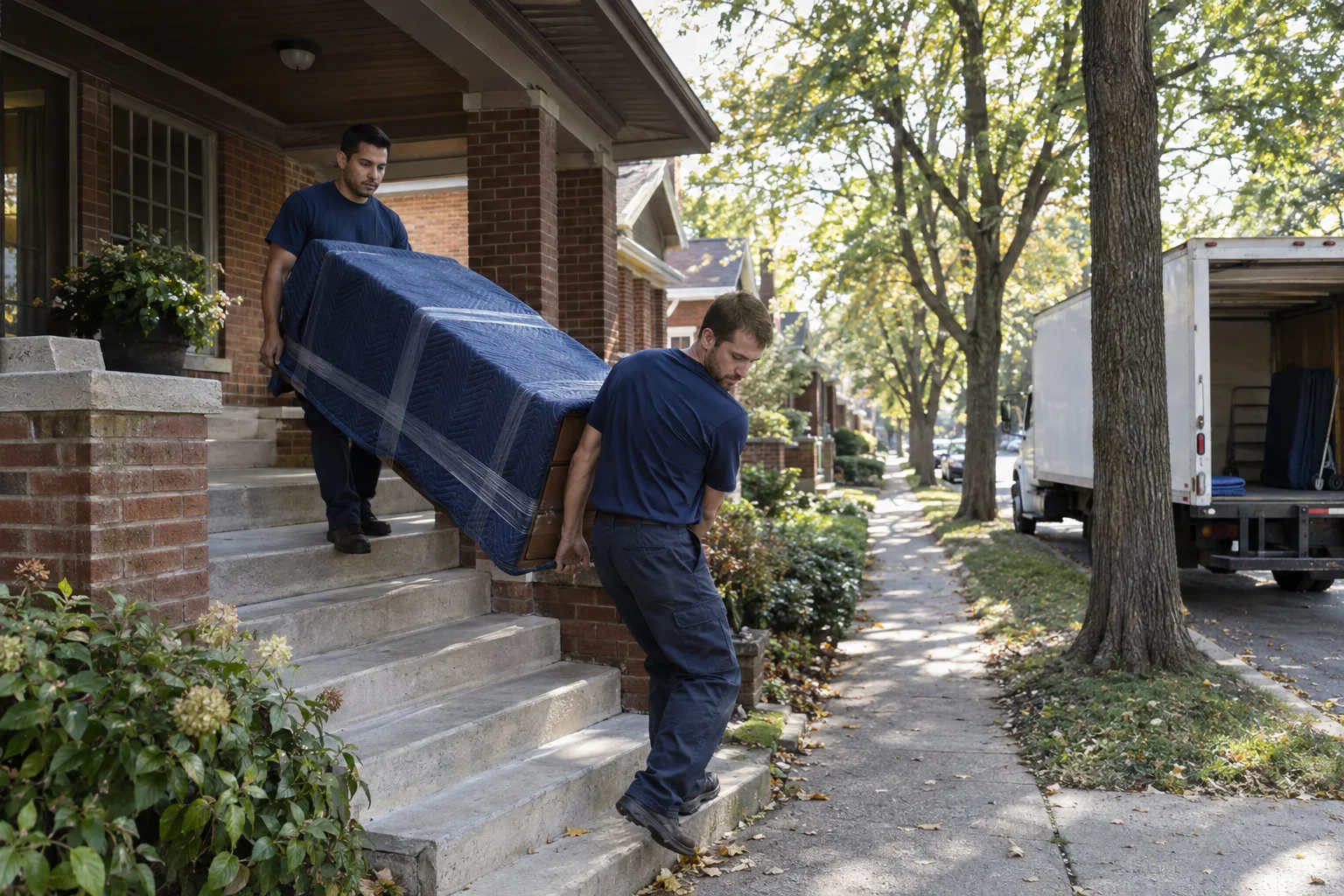
Amenity Moving & Storage, the licensed Illinois mover behind Local Moving Specialists, moves households in all 19 DuPage towns on this site from its Plainfield warehouse, about 5 straight-line miles from Naperville and 20 from Elmhurst. Because a move inside DuPage stays within the collar counties, Illinois Commerce Commission rules allow billing by crew size and hours, so your price is set at a free in-home estimate.
Get your free moving quote
Tell us where and when. Amenity’s Plainfield office replies directly.
On this page
What DuPage's housing means for moving day
DuPage packs more households into less land than Will or Kane, and that density shapes how a move here gets planned. The county covers about 328 square miles of land in the Census Bureau’s 2024 Gazetteer, yet the American Community Survey (ACS) for 2020 to 2024 counts 930,024 residents in 350,758 households. That is roughly 2,840 people per square mile, more than three times Will County’s density.
Density shows up in the building mix. Detached houses are still the most common home, but 12.5 percent of DuPage housing units sit in buildings with 20 or more units, against 3.3 percent in Will and 5.7 percent in Kane. The same county produces elevator-and-loading-dock moves in towns like Westmont and Lisle and full-house loads in places like Hinsdale, where 81.9 percent of homes are detached.
| Measure (ACS 2020-2024) | DuPage County | What it means for a move |
|---|---|---|
| Owner-occupied homes | 73.1% | Most jobs are full-house loads with garages, basements and attics to clear |
| Townhomes and other attached homes | 11.8% | Shared driveways and association rules on trucks and containers |
| Homes in buildings of 20+ units | 12.5% | Elevator reservations, loading docks and building move-in rules |
| Homes built before 1960 | 17.7% | Narrow stairways, small doorways and older basement steps |
| Homes built 1960 to 1979 | 35.8% | The largest age band in the county: ranches, split-levels and early townhome complexes |
| Residents 65 and older | 17.3% | Downsizing and senior moves, often from a long-held house |
| Households that moved in 2020 or later | 22.1% | About one household in five is in its first few years at its address |
| Lived in a different home one year earlier | 10.3% | 4.6% from elsewhere in DuPage, 3.7% from another Illinois county, 1.3% from another state |
The residence figures tell you what kind of moves DuPage produces. Most residents who changed homes in the past year came from inside the county or from another Illinois county; only 1.3 percent arrived from another state. Short local moves dominate, which is why the Illinois Commerce Commission’s billing rules for the collar counties matter more to most DuPage households than interstate paperwork does.
How far DuPage towns are from the Plainfield warehouse
Two DuPage towns sit within 10 straight-line miles of Amenity’s warehouse at 10028 Mandel St, and only Elmhurst lies beyond 20. Because the building is at Plainfield’s north edge, DuPage’s southwest corner is close by, while the Cook County line marks the far side of a crew’s day.
| Straight-line miles | DuPage towns on this site | Planning note |
|---|---|---|
| Under 10 | Naperville (5.3), Warrenville (8.8) | Shortest run from the warehouse, handy when a move pairs with storage |
| 10 to 15 | Lisle (10.2), Woodridge (10.5), Wheaton (12.9), Downers Grove (13.1), Winfield (13.2), West Chicago (13.5), Darien (13.7), Glen Ellyn (14.8) | The county’s middle belt, where most DuPage town pages fall |
| 15 to 20 | Westmont (15.3), Willowbrook (16.1), Carol Stream (16.2), Lombard (16.7), Burr Ridge (16.9), Oak Brook (17.6), Hinsdale (17.6), Villa Park (18.7) | East-side routes can meet Tollway interchange work through 2027 |
| Over 20 | Elmhurst (20.5) | The farthest DuPage town on the list, near the Cook County line |
Treat those numbers as a way to compare towns, not as drive times. They matter on an hourly move because Illinois’s administrative code says an estimate based on hours must show the hours, including travel time, so ask the estimator to spell out how the drive from Plainfield is counted for your address. The ICC also suggests starting your search for a mover at least six weeks before moving day.
BNSF and UP-W towns: older cores along the tracks
Two Metra lines split DuPage into recognizable moving territories. The BNSF line runs across the southern tier with stops in Hinsdale, Westmont, Downers Grove, Lisle and Naperville, while the Union Pacific West (UP-W) line crosses the middle of the county, stopping in Elmhurst, Villa Park, Lombard, Glen Ellyn, Wheaton, Winfield and West Chicago before it reaches Geneva in Kane County.
The BNSF towns
Hinsdale has three BNSF stops (Highlands, Hinsdale and West Hinsdale) and Downers Grove has three more (Fairview Avenue, Main Street and Belmont), according to Metra’s station list. Hinsdale is the most detached town on the DuPage list at 81.9 percent, and 28.5 percent of its homes were built before 1960, so expect basements, older stairways and long carries from the curb. In Downers Grove, 21.0 percent of residents are 65 or older.
Westmont runs the other way: 44.9 percent of its homes are rented, the highest share among the DuPage towns here, and 31.9 percent sit in buildings of ten or more units. Lisle‘s station is on Front Street, and Naperville‘s main station is on East 4th Avenue, with Metra’s Route 59 stop just over the line in Aurora. In Naperville the county line matters too: the 2020 Census placed 98,102 residents (65.6 percent) in DuPage and 51,438 (34.4 percent) in Will, and the city uses 87th Street as the dividing line.

The UP-W towns
The UP-W towns hold much of DuPage’s oldest housing. In Villa Park, 57.3 percent of homes were built before 1960, and the village’s preservation commission says about 80 Sears catalog houses may stand there, many of them bungalows built from about 1911 through the 1930s. Elmhurst (43.0 percent built before 1960), Glen Ellyn (30.5 percent) and Lombard (29.9 percent) follow. Bungalow stairs and tight landings are where pad-wrapping and careful disassembly take time, so point them out during the estimate.
Farther west the housing gets younger. Wheaton, the county seat, has two UP-W stations, College Avenue and Wheaton. Winfield‘s town center is anchored by Northwestern Medicine Central DuPage Hospital and its Metra stop, and only 1.7 percent of its homes are in buildings of ten or more units. West Chicago dates its start to 1849, when the Galena and Chicago Union Railroad created what the city calls the first railroad junction in Illinois. North of the tracks, Carol Stream has no stop on either line, and 52.3 percent of its homes went up between 1980 and 1999.
Ready for a straight answer on your move?
Book a free, no-obligation in-home estimate with Amenity’s Plainfield team.
The I-88 corridor and office moves
The Reagan Memorial Tollway (I-88) crosses DuPage’s southern half past Oak Brook, Downers Grove, Lisle, Naperville and Warrenville, and it is where business relocations cluster in this part of the county. Choose DuPage, a county economic development organization, describes the I-88 region as running through DuPage, Kane and DeKalb counties and dates its business story to 1963, when the gas company now known as Nicor moved to Naperville. It also notes that large single-tenant campuses left by tech firms are being turned into multi-tenant, mixed-use campuses.
Warrenville shows how that plays out. The city sits at the Winfield Road interchange on I-88, and its Cantera development, built on a 650-acre former limestone quarry and concrete plant, is its largest employment center with more than 5,000 workers. Warrenville’s homes are also the most townhome-heavy on the DuPage list, at 26.8 percent single-family attached. Oak Brook, at the corridor’s east end, was incorporated in 1958, lists itself in both DuPage and Cook counties and says it levies no municipal property tax; 34.1 percent of its residents are 65 or older.
Office moves follow a different plan from household moves: an inventory of furniture and equipment, technology disconnects, building elevator windows and a cutover date that keeps staff working. Illinois law counts office furniture and equipment as household goods, so an office move inside the state falls under the same Illinois Commerce Commission household goods license that Amenity holds (ILCC 73744 MC-C). Amenity’s office and commercial moving service covers these relocations, and the office move checklist lays out the planning steps in order.
Southeast DuPage: older households and 1960s-70s homes
The four towns in DuPage’s southeast corner near I-55 have the oldest households on the county list and a deep stock of homes from the 1960s and 1970s. Burr Ridge has a median age of 56.9, and 36.1 percent of residents are 65 or older; the 2020 Census also placed 39.0 percent of its residents in its Cook County part. Willowbrook follows with 26.6 percent of residents 65 or older, and only 34.1 percent of its homes are detached houses, the lowest share on the DuPage list, with 29.9 percent in buildings of two to nine units.
Darien has the largest share of 1960s and 1970s housing on the list, 46.9 percent, and 24.3 percent of its residents are 65 or older. Woodridge, which the village describes as sitting at the crossroads of I-355 and I-55 and lying in DuPage, Will and Cook counties, has 42.7 percent of its homes from the same two decades. Expect split-levels with short stair runs, finished lower levels and garages that have collected decades of tools and seasonal gear.
Those numbers point to downsizing: a long-held house, a smaller home or senior community at the other end, and a lot of sorting in between. Amenity’s senior moving and downsizing service plans around what moves, what goes into storage and what stays behind, and the downsizing checklist for seniors helps families start the sorting before the estimator visits. Storage at Amenity’s warehouse can run from one day to several years, which helps when a house sale and a move-in date don’t match.
Village rules that change at every DuPage border
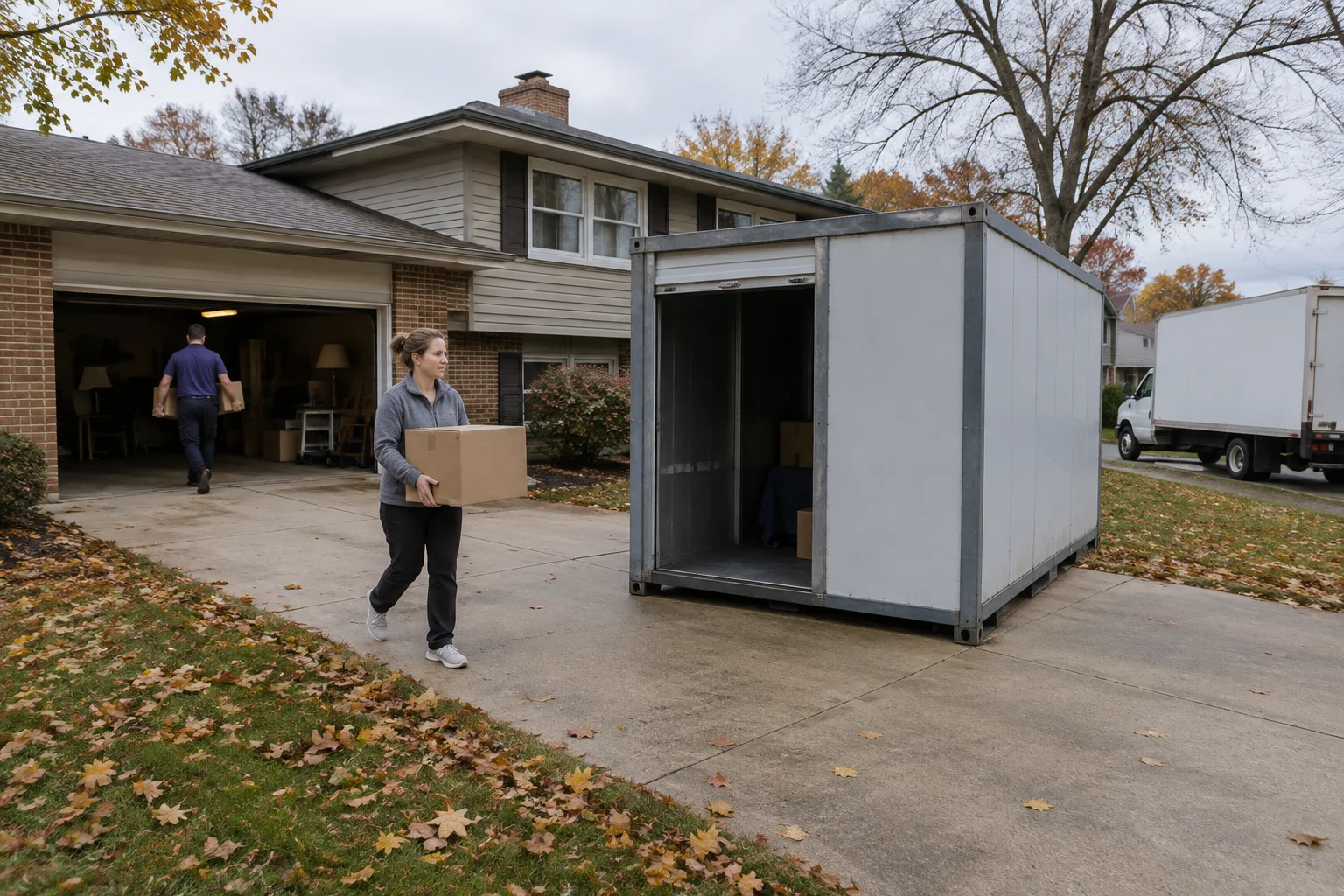
The rules that most often affect moving day come from city and village codes, and in DuPage they change sharply a few miles apart. Storage containers are the clearest example: one town lets a container sit for two weeks without a permit, while another caps it at a week.
| Town | Portable storage container rule | Overnight street parking |
|---|---|---|
| Naperville | Up to 15 consecutive days without a permit; a permit beyond that; no more than two 15-day periods a year | Banned 2 to 5 a.m.; temporary permission up to three requests per vehicle per month |
| Glen Ellyn | No more than 15 consecutive days and 30 days per calendar year, on a hard surface | Banned 2 to 6 a.m.; call police by 1 a.m. for an exception |
| Elmhurst | Two PODS at most, for no more than 7 days within a 30-day period | Banned 3 to 6 a.m.; overnight form online |
| Oak Brook | Two units at most, 15 consecutive days, one more 15-day period with village approval | Banned 2 to 6 a.m. without an overnight permit |
| Woodridge | 14 consecutive days once a year, up to three more 14-day periods with written permission; never in the right-of-way | Banned 2 to 6 a.m.; approval one night at a time, three nights within 30 days |
| Warrenville | Cargo container permit; no more than four times and 30 days total a year | Banned for 24 hours after 2 inches of snow or until cleared |
| Villa Park | Temporary moving and storage container permit application | Banned 2 to 6 a.m.; up to six overnight requests a month |
Closings carry their own paperwork. Elmhurst requires a sump pump inspection before it issues transfer stamps and asks owners to schedule it at least two weeks before closing, and West Chicago requires a point-of-sale inspection that should be booked at least two months ahead. In Wheaton the buyer purchases the city transfer stamp, and the final utility bill must be paid before it is issued; Lombard has no village transfer stamps at all. A missed inspection can push a closing, and the moving date moves with it, which is when short-term moving and storage earns its place.
The truck plan is the other variable. On local moves Amenity runs several truck sizes and keeps one household’s belongings per truck, so a narrow street, a cul-de-sac or a tight condo lot can be matched with a smaller truck instead of a longer carry. Tell the estimator about parking bans, loading docks and association rules so the truck and crew fit what the town allows.
County and state roadwork through 2027
DuPage County’s Division of Transportation lists several 2026 and 2027 projects on roads that moving crews use every week. Lane closures don’t cancel a move, but they change start times and routes.
- Warrenville Road bridge, Lisle. Reconstruction over the East Branch DuPage River with long-term lane closures, scheduled from April 2024 to December 2026.
- Naperville Road, I-88 to Ridgeland Road. Intersection and corridor work with the City of Naperville, summer 2026 to November 2027, with intermittent lane closures.
- Lemont Road, 83rd to 87th Street, Woodridge. Turn lanes and resurfacing listed for May 2026 to November 2027; the county notes the start was delayed by utility relocations.
- 2026 resurfacing. 75th Street from IL 53 to I-355, plus segments of County Farm Road, Geneva Road, Lemont Road and St. Charles Road, April to October 2026, with daily lane closures.
- Tollway bridges over I-88. Deck and wall repairs at Raymond Drive, Meyers Road and Midwest Road, June to November 2026.
State and Tollway projects add to the list. IDOT’s traffic signal modernization on Butterfield Road (IL 56) between IL 59 and York Road was expected to wrap up in fall 2026, and IDOT plans deck and joint work on the Roosevelt Road (IL 38) bridge over the East Branch DuPage River starting in spring 2027 with one lane open. On the county’s east edge, the Illinois Tollway’s rebuild of the I-290/I-88 interchange at I-294 is scheduled to be finished by the end of 2027, with long-term ramp closures and posted detours that touch moves to and from Elmhurst, Oak Brook and Villa Park.
DuPage towns at a glance
Each DuPage town page goes deeper on parking, refuse, schools and housing. This table pulls one verified detail per town that tends to shape the move, along with the services that town’s page leads with.
| Town | Miles | One detail that shapes the move | Services featured |
|---|---|---|---|
| Naperville | 5.3 | Split between DuPage (65.6%) and Will (34.4%) in the 2020 Census | Storage, long-distance, packing |
| Warrenville | 8.8 | 26.8% of homes are townhomes; Cantera employs 5,000-plus at I-88 | Storage, office, long-distance |
| Lisle | 10.2 | Warrenville Road bridge rebuild through December 2026 | Apartments and condos, long-distance, storage |
| Woodridge | 10.5 | Village spans DuPage, Will and Cook counties | Apartments and condos, storage, piano |
| Wheaton | 12.9 | County seat with two UP-W stations | Piano, apartments and condos, packing |
| Downers Grove | 13.1 | Three BNSF stations: Fairview Avenue, Main Street, Belmont | Long-distance, senior, piano |
| Winfield | 13.2 | Only 1.7% of homes in buildings of 10+ units | Senior, packing, storage |
| West Chicago | 13.5 | Point-of-sale inspection; book two months before closing | Apartments and condos, gun safe, piano |
| Darien | 13.7 | 46.9% of homes built 1960-1979, the highest share here | Senior, packing, piano |
| Glen Ellyn | 14.8 | Containers capped at 15 consecutive days, 30 a year | Packing, piano, long-distance |
| Westmont | 15.3 | 44.9% of homes rented, the highest share here | Apartments and condos, senior, long-distance |
| Willowbrook | 16.1 | Only 34.1% of homes are detached houses | Senior, apartments and condos, long-distance |
| Carol Stream | 16.2 | 52.3% of homes built 1980-1999 | Apartments and condos, senior, packing |
| Lombard | 16.7 | No village transfer stamps; 2.75 miles of the Illinois Prairie Path | Apartments and condos, long-distance, office |
| Burr Ridge | 16.9 | 39% of residents in its Cook County part; 36.1% are 65+ | Senior, long-distance, packing |
| Oak Brook | 17.6 | Incorporated 1958; 34.1% of residents are 65+ | Long-distance, senior, piano |
| Hinsdale | 17.6 | 81.9% detached; 13.6% of residents in the Cook County part | Piano, packing, long-distance |
| Villa Park | 18.7 | 57.3% of homes built before 1960; about 80 possible Sears houses | Piano, apartments and condos, packing |
| Elmhurst | 20.5 | Sump pump inspection before transfer stamps | Long-distance, piano, packing |
County services before and after a DuPage move
A handful of things a moving crew can’t load are handled through county programs or the regional facility DuPage residents share. Household hazardous waste goes to the Regional Household Hazardous Waste Facility in Naperville, which DuPage County describes as a free, drive-through drop-off open every Saturday and Sunday from 9 a.m. to 2 p.m. The City of Naperville lists it at 156 Fort Hill Drive; it takes propane tanks up to 20 pounds and oil-based paint, while dried latex paint can go out with the trash. That covers much of the list of items movers will not move.
Electronics are banned from Illinois landfills, and DuPage County lists drop-off sites open to every county resident, including locations in Burr Ridge, Elmhurst, Lisle, Naperville, Westmont and Wheaton. The county charges a fee for TVs and monitors and says appliances with refrigerants can’t be accepted, so plan a separate route for an old freezer or dehumidifier you aren’t taking.
After the move, property tax paperwork is lighter here than in some counties. The DuPage Supervisor of Assessments says that in most cases the township assessor grants the general homestead exemption automatically, without a formal application. That applies to DuPage parcels only. If you buy south of 87th Street in Naperville or in the Cook County parts of Hinsdale or Burr Ridge, another county assesses the property. Aurora works the other way: the 2020 Census counted 51,587 Aurora residents in DuPage, so an east-side Aurora address may fall under DuPage’s offices.
If you are leaving Illinois rather than moving across the county, Amenity handles long-distance moves as an authorized agent of Wheaton World Wide Moving, and the shipment travels under Wheaton Van Lines’ federal authority (USDOT 70719). Amenity’s crew inventories each item and its condition on moving day, and you review and approve the list before the truck is loaded.
Towns we serve in DuPage County
- Burr Ridge
- Carol Stream
- Darien
- Downers Grove
- Elmhurst
- Glen Ellyn
- Hinsdale
- Lisle
- Lombard
- Naperville
- Oak Brook
- Villa Park
- Warrenville
- West Chicago
- Westmont
- Wheaton
- Willowbrook
- Winfield
- Woodridge
See every town on the service area directory.
Frequently asked questions
How much do movers cost in DuPage County?
There is no single DuPage rate. The Illinois Commerce Commission allows moves within DuPage and the other collar counties to be billed by the number of workers and hours, so crew size, time on the job and how travel time is counted set the total. Amenity gives a free, no-obligation in-home estimate; our guide to how moving costs are calculated in Illinois explains each line you will see.
Do I need a permit for a moving container in DuPage County?
It depends on the town, not the county. Naperville allows a container for 15 consecutive days before a permit is needed, Elmhurst caps containers at 7 days within any 30, and Villa Park and Warrenville require a permit application. Check your village code before ordering one, or skip the driveway container and keep belongings in Amenity’s Plainfield warehouse instead.
Can a moving truck park on my DuPage street overnight?
Usually not without permission. Naperville bans street parking from 2 to 5 a.m., and Glen Ellyn, Oak Brook, Villa Park and Woodridge ban it from 2 to 6 a.m., each with its own request process. Amenity’s trucks arrive on moving morning, so the bans matter most if you rented a truck and planned to load the night before.
Which DuPage towns are closest to your warehouse?
Measured in a straight line to each town’s Census center point, Naperville is about 5.3 miles from Amenity’s Plainfield warehouse and Warrenville about 8.8. Lisle (10.2) and Woodridge (10.5) are next. Elmhurst, at about 20.5 miles, is the farthest DuPage town on this site. Road miles run longer than these figures.
Do you move people between DuPage County and Chicago?
Yes. A move from a Chicago apartment to a DuPage house is still a local move, but the city end usually involves a street-parking permit and building rules. The Chicago movers page covers that side, and the guide to moving from Chicago to the western suburbs walks through the whole switch.
Where do I take paint, propane and old electronics before moving out of DuPage?
Household hazardous waste, including oil-based paint and propane tanks up to 20 pounds, goes to the regional facility at 156 Fort Hill Drive in Naperville, open weekends from 9 a.m. to 2 p.m. DuPage County also lists electronics drop-off sites open to all county residents, with a fee for TVs and monitors. Movers can’t carry hazardous materials, so clear them out before moving day.
Is my Naperville home in DuPage County or Will County?
The City of Naperville uses 87th Street as the line: north of it is DuPage, south of it is Will. The 2020 Census counted 98,102 Naperville residents in DuPage and 51,438 in Will. The county decides who assesses your property and which county programs you use, but the move itself is planned the same way on either side.
How do I check that a DuPage mover is licensed?
Anyone moving household goods for hire within Illinois needs an ICC household goods license and a tariff on file, and you can look up a license with the Commission’s online entity search. Amenity’s Illinois license is ILCC 73744 MC-C. Our guide to checking a moving company’s license in Illinois shows each step.
Sources
- DuPage County, Illinois profile (ACS 2020-2024 5-year estimates) — U.S. Census Bureau
- Highway Construction Projects — DuPage County Division of Transportation
- Recycling FAQ — DuPage County Environment and Sustainability
- General Homestead Exemptions – Residential — DuPage County Supervisor of Assessments
- Not Your Father's Corridor: The Re-Reinvention of the I-88 Region — Choose DuPage
- Household Goods Movers — Illinois Commerce Commission
Who handles your move
Local Moving Specialists is operated by Amenity Moving & Storage Inc., 10028 Mandel St, Plainfield, IL 60585 — a family-run Illinois mover since 1986. Illinois household goods license ILCC 73744 MC-C. Interstate moves are transported under the authority of Wheaton Van Lines, Inc. (USDOT 70719, MC-87113), for which Amenity is an authorized agent. See licenses & disclosures.
Last reviewed November 11, 2026 against Amenity Moving & Storage’s published service details and the public sources listed above.
Ready for a straight answer on your move?
Book a free, no-obligation in-home estimate with Amenity’s Plainfield team.