Chicago Movers for Moves To and From the Western Suburbs
Amenity Moving & Storage works from Plainfield, about 30 miles southwest of the city. This page covers what a Chicago pickup or delivery involves when the other end is a suburb.
- Plainfield warehouse ~30 mi away
- Illinois license ILCC 73744 MC-C
- Wheaton World Wide agent
- Free in-home estimates

Can a suburban mover handle a Chicago move, and how is it priced?
Yes. Amenity Moving & Storage, a licensed Illinois mover (ILCC 73744 MC-C) about 30 miles away in Plainfield, plans the city end of moves to and from the western and southwest suburbs with its own crews. Illinois lets moves within Cook, DuPage, Will and four other counties be billed by workers and hours, so stairs, elevators and curb access drive the cost. Each job starts with a free in-home estimate.
Get your free moving quote
Tell us where and when. Amenity’s Plainfield office replies directly.
On this page
Source: U.S. Census Bureau, American Community Survey 2020–2024 5-year estimates (data.census.gov profile for Chicago). About 30 miles straight-line from Amenity’s Plainfield warehouse.
Two-flats, walk-ups and towers: the housing a city move starts in
A Chicago move almost always starts or ends in a multi-unit building. Census Bureau estimates for 2020 to 2024 put 39.0% of the city’s housing units in buildings with 2 to 9 units and another 31.6% in buildings with 10 or more, while single-family detached houses make up 25.6% and townhomes and other attached homes 3.5%. Renters head 54.0% of the city’s 1,160,205 households.
The buildings are old and the rooms are compact. Of the city’s housing units, 58.0% were built before 1960 and only 6.3% in 2010 or later, and the median home has 4.7 rooms. In practice that means interior stairways with tight landings, shared hallways, back porches and, in the larger buildings, an elevator someone else also needs. Access, more than furniture count, is what decides how long the city end takes.
What homes look like in Chicago
Share of housing units by building type
When Chicago homes were built
Share of housing units by decade built
Source: U.S. Census Bureau, ACS 2020–2024 5-year estimates, table DP04.
People move often here. Three in ten households, 30.0%, moved into their current home in 2020 or later, and only 16.9% have stayed since before 2000. The suburbs those households move to tend to have more room to fill: the median home has 6.9 rooms in La Grange and 8.2 in Western Springs, both on the BNSF Line west of the city.
Amenity is a suburban company: its trucks leave from 10028 Mandel St in Plainfield, about 30 miles in a straight line from Chicago. This page is written for moves where one address is in the city and the other is in a suburb on Amenity’s map, which reaches into Cook County as well as DuPage, Will, Kane, Kendall and Grundy counties. If both addresses are inside city limits, ask at the estimate how the drive from Plainfield figures into the plan.
Condo and apartment buildings set the moving schedule
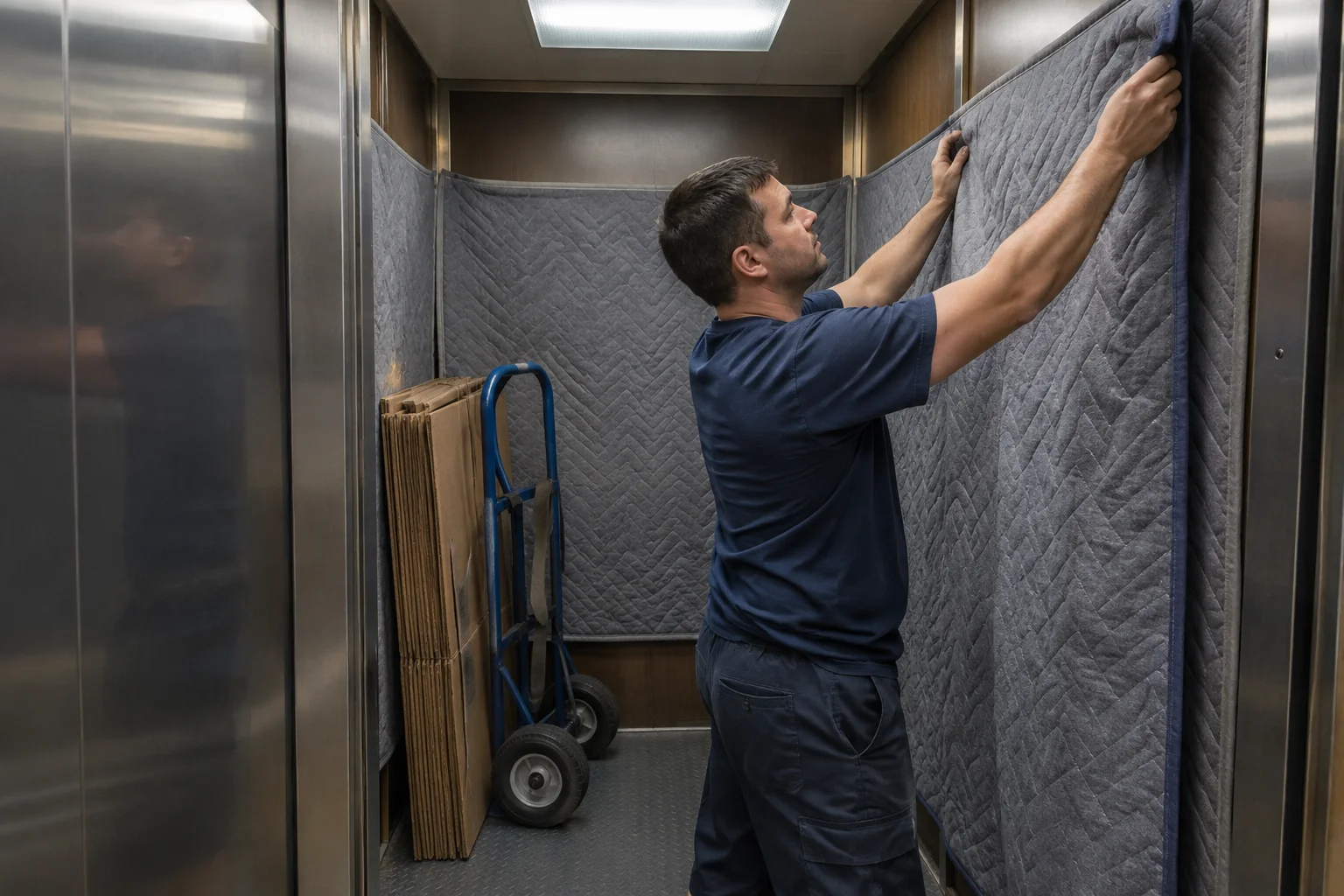
In a managed building, management usually decides the day and the hours before your mover has any say. Elevator time, the loading area and the paperwork a building requires all have to line up with the truck, so get the building’s move policy in writing as soon as you have a target date and bring it to the estimate.
| Ask management | Why it changes the plan |
|---|---|
| Which elevator, which hours, and how far ahead it must be booked | The crew’s start time and the length of the job are built around that window; a reservation that ends mid-afternoon can mean a larger crew rather than a longer day. |
| Whether a certificate of insurance is required, and the exact names it must list | A building that requires one can turn a crew away without it, so the wording has to be settled days ahead, not on the morning of the move. |
| Where the truck may load: dock, alley, side street or front entrance | It decides the carry distance from the unit to the truck and whether a city street permit is needed at all. |
| Permitted move days, including weekend limits, and any move-out deposit | A Saturday-only lease turnover is no help if the building allows moves only Monday through Friday. |
| Whether hallways and elevator cabs must be padded or protected | Protection goes up before the first piece moves, and the crew needs to bring enough of it. |
Two-flats and three-flats bring a different problem: no elevator, a front stair that may turn at a landing, and a rear porch stair that is sometimes the better way out. The estimator should walk both routes and measure the tightest turn before anyone promises that a sectional or a king box spring will make it. Our apartment and condo moving page explains how crews plan building moves.
If you rent, the city’s Residential Landlord and Tenant Ordinance sets the deposit clock. Before deducting for damage, a landlord must give you an itemized statement within 30 days of the date you vacate, and the deposit, minus unpaid rent and damage, is due back within 45 days. Photograph each room once it is empty, after the crew is gone, so you have a dated record of the condition you left it in.
Curb space: CDOT permits, ward signs and seasonal parking bans
Enforceable no-parking signs for a moving van come from the Chicago Department of Transportation’s permit system; signs from a ward office are a courtesy that no one can ticket or tow on. Several citywide parking rules also apply on moving day, depending on the season and the street.
| Rule or tool | What it means for your move | Source |
|---|---|---|
| CDOT “Occupy the Public Right of Way” permit, Moving Van Parking activity | Filed online at ipi.cityofchicago.org. The application asks for start and end dates, the number of vehicles parked at one time and the mover’s ICC vehicle number, and a permit on an arterial street needs a work zone sketch or traffic plan. | CDOT Permits |
| Ward courtesy signs | Some aldermanic offices hand out free signs that are not enforceable. The 44th Ward’s cover an eight-hour window, must be posted at least 48 hours ahead and give way to street-cleaning signs. | 44th Ward |
| Winter Overnight Parking Ban | No parking from 3 to 7 a.m. on 107 miles of arterial streets from December 1 to April 1, whether or not it snows. Cars left there are towed to Pound 2 or Pound 6. | Streets and Sanitation |
| Two-inch snow ban | A separate ban covers another 500 miles of main streets once at least two inches of snow is on the street, at any hour and on any date. | Streets and Sanitation |
| Street sweeping | The 2026 season began April 1 and runs through the end of November or later. Bright orange temporary signs go up two days before a sweep, and some streets carry permanent weekly or twice-monthly signs. | Streets and Sanitation |
| Residential permit parking zones | Some neighborhoods limit parking to residents and their guests during posted hours. A helper’s car may need a temporary guest permit from the resident. | Department of Finance |
Because the CDOT application asks for an Illinois Commerce Commission vehicle number, the enforceable permit is set up for licensed moving companies, not for residents. Ask any mover you are considering who files it, how many days ahead they apply and which block faces it will cover. CDOT also warns that its permit fees can change from year to year, so the current fee schedule is the one that applies.
Truck size is the other half of the curb plan. Amenity runs several truck sizes, up to full semi trailers, so that a load can be finished in as few trips as possible; which size fits a particular block, alley or loading dock is decided at the estimate, once someone has seen the street. On local moves each truck carries one household, so your things are never mixed with another customer’s.
Moving in or out of Chicago?
Book a free, no-obligation in-home estimate with Amenity’s Plainfield team.
Picking a date around leases, CPS and the winter ban
Your moving date is usually set by three outside calendars: your lease or closing, the school year at both ends and, from December through March, the winter parking ban. Settle those first, then book the crew.
Chicago Public Schools classes for 2026-27 started Monday, August 24, 2026 and end Friday, June 11, 2027. Several suburban districts started the same school year earlier. Oak Lawn-Hometown School District 123 and Western Springs School District 101 both began August 19, 2026, and Lyons Township High School began August 17, while La Grange School District 102 did not start until September 2. A family leaving a CPS school for a suburban one should pull up the new district’s 2027-28 calendar before agreeing to a summer closing date.
Summer is when most families with school-age children want to move, and the Illinois Commerce Commission’s tips for hiring a mover recommend starting your search at least six weeks before the move. For a summer move out of the city, the guide on moving from Chicago to the western suburbs walks through the full timeline.
Winter moves in the city
The winter ban changes how a December-to-March move is staged. If the building sits on one of the 107 miles of signed arterial streets, nothing can be left parked at the curb between 3 and 7 a.m., including a helper’s car or a rental truck loaded the night before. Amenity lays floor runners in winter and can change dates when the weather turns, subject to availability; the guide to moving in winter around Chicago covers the rest.
Before you leave the city: trash, chemicals, water and stickers
Leaving Chicago involves a few city steps that have nothing to do with the truck: getting rid of what you won’t move, settling the water account if you sell, and, for people moving in, registering a car with the city.
- Garbage service depends on building size. Streets and Sanitation collects from about 600,000 households in single-family homes and buildings of four units or fewer; larger buildings arrange private collection. In a big building, ask management where move-out debris and broken furniture may go before you start clearing closets.
- Household chemicals go to the city’s drop-off site. The Household Chemicals and Computer Recycling Facility at 1150 N. North Branch St. takes household cleaners, oil-based paint, solvents, compact fluorescent bulbs and computers on Tuesdays from 7 a.m. to noon, Thursdays from 2 to 7 p.m. and the first Saturday of each month from 8 a.m. to 3 p.m. It does not take latex paint.
- Sellers need a Full Payment Certificate. The Department of Finance requires one in every transfer of real property, and without it the parties can’t get the city transfer tax stamps needed to record the deed. In-person applications go to City Hall, 121 N. LaSalle St., Room 107; the city asks applicants to allow at least 10 business days for processing before following up.
- New residents need a city sticker. If your move runs the other way, into the city, you must buy and display a city vehicle sticker within 30 days of becoming a Chicago resident.
Anything flammable or corrosive should be gone before moving day, because movers generally won’t load it. Use the drop-off site for the chemicals, give away the rest, and pack only what you’ll use in the new place.
Pianos and other pieces that need their own plan
A piano in a walk-up is the single item most likely to change a Chicago estimate, because the stairway, not the piano, sets the method. Amenity moves pianos, including Steinway, Baldwin, Kawai, Young Chang and Yamaha instruments, and treats each one as a separate part of the plan.
Show the estimator the whole route: the width of every doorway, the turn at each landing, the condition of the front steps and whether a rear porch stair is wider or straighter. An upright that came in through a back porch decades ago may need the same route out. Grands are a separate case and are usually taken off their legs and moved on their side on a padded board, which needs room to set down and turn. Once the piano is placed in the suburban house, let it settle into the new room before booking a tuning. The piano moving page covers what to tell the estimator.
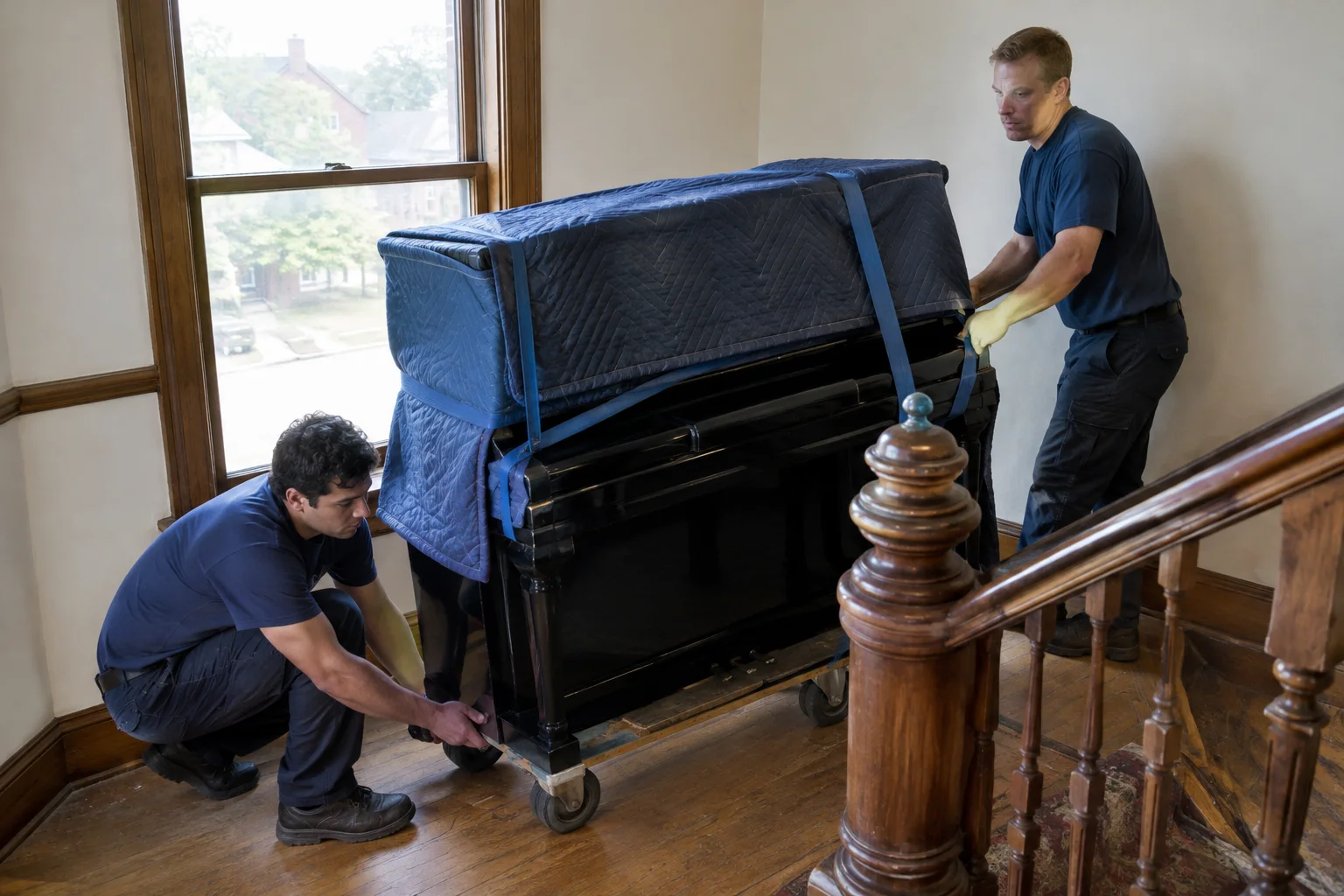
The same thinking applies to anything heavy and awkward in a city apartment: a marble-top dresser, a full-size safe in a closet, an antique armoire that was assembled in the room. Point each one out at the estimate so the crew and equipment are sized for it, rather than finding out on the stairs.
Which suburb? Metra lines from the downtown stations
For most people leaving the city with a downtown job, the train line narrows the search before anything else. Five Metra lines run from the three downtown terminals into the suburbs on Amenity’s service map.
| Metra line | Downtown terminal | Suburbs on our map it serves |
|---|---|---|
| BNSF | Union Station, 210 S. Canal St. | La Grange (La Grange Road and Stone Avenue stations), Western Springs, Hinsdale, Westmont, Downers Grove, Lisle, Naperville and Aurora |
| SouthWest Service | Union Station | Oak Lawn (Patriot Station, 9525 S. Tulley Ave.), Orland Park (three stations) and New Lenox |
| Union Pacific West | Ogilvie Transportation Center, 500 W. Madison St. | Elmhurst, Villa Park, Lombard, Glen Ellyn, Wheaton, Winfield, West Chicago, Geneva and Elburn |
| Heritage Corridor | Union Station | Lemont, Romeoville, Lockport and Joliet |
| Rock Island | LaSalle Street Station, 414 S. LaSalle St. | Tinley Park (two stations), Mokena, New Lenox and Joliet |
Commute times vary more than the map suggests. Chicago residents average 33.1 minutes to work, according to the Census Bureau. Out on the BNSF, the Village of Western Springs says express trains reach the Loop in about 25 minutes and locals in about 36. Ride the train you’d actually take, at rush hour, before you sign for a house near a station.
Station-area housing can bring back the city’s access problems on a smaller scale. A condo building near a downtown platform may still have an elevator reservation, a narrow loading area and its own paperwork, while a detached house a few blocks away usually needs none of that.
How Amenity plans a move between the city and a suburb
Amenity plans these moves from the harder end first, which is almost always the Chicago address. Here is the order the planning usually follows.
- Free in-home estimate at the city addressAn estimator walks the unit and everything that goes with it: basement storage cages, a garage space, the back porch, anything on a balcony. The visual estimate is free and carries no obligation.
- Building paperworkYou forward the move policy, elevator window and any certificate-of-insurance wording so the crew start time can be set around them.
- Curb planDecide who files the CDOT moving van permit and check the date against street sweeping, the winter ban or a snow ban.
- Truck and crewTruck size and crew size are matched to the access at both ends; local moves carry one household per truck.
- Written estimateMoves inside Cook, DuPage, Kane, Kendall, Lake, McHenry and Will counties may be charged by workers and hours. Under Illinois Commerce Commission rules you can be asked to pay up to 110% of the written estimate at delivery, with any balance due within 30 days.
- Moving dayThe crew protects floors (with runners in winter), loads to the building’s window and keeps any inventory you asked for.
- Delivery in the suburbFurniture and boxes go to the rooms on your labels. Note any damage on the inventory or bill of lading before signing; written claims are due within 90 days of delivery.
If a lease ends before a closing, Amenity can hold the household in its 12,000-square-foot Plainfield warehouse, where furniture is padded, wrapped and sealed into 8′ x 7.5′ x 5′ wooden crates and every item is logged in an inventory database. Terms run from one day to several years.
Out-of-state moves that start in the city
For a move out of Illinois, Amenity acts as an authorized agent of Wheaton World Wide Moving, and the shipment travels under the authority of Wheaton Van Lines, Inc. (USDOT 70719, MC-87113). Those federal numbers belong to Wheaton, not Amenity; Amenity’s own Illinois license is ILCC 73744 MC-C. Amenity notes the affiliation connects customers to more than 300 Wheaton agents across the country.
On loading day the crew records each item and its condition, you review and approve that list, and the truck is loaded piece by piece, with furniture wrapped in blankets and held with restraints. The Amenity driver and Wheaton dispatch stay in contact while the load is on the road, and scheduling and tracking are computerized. The long-distance moving page explains estimates and delivery windows.
Federal rules for interstate moves protect you in a few specific ways. The mover must base its estimate on a physical survey of your goods, on site or by video, unless you waive it in writing. On a non-binding estimate, it can’t require more than 110% of that estimate at delivery. And basic released value, which costs nothing extra, limits the mover’s liability to 60 cents per pound per article; full value protection, the higher level, costs more. Before you sign with anyone, look up an in-state mover in the Illinois Commerce Commission’s license search and an interstate carrier in the FMCSA’s SAFER system.
Services we lead with in Chicago
Nearby towns we move every week
- Movers in Oak Lawn
- Movers in La Grange
- Movers in Western Springs
- Movers in Hinsdale
- Movers in Burr Ridge
- Movers in Oak Brook
More towns in Cook County · every service area
Frequently asked questions
Can I reserve street parking for a moving truck in Chicago?
Only a CDOT “Occupy the Public Right of Way” permit for moving van parking produces signs that can be enforced, and the online application asks for the mover’s ICC vehicle number, so your mover normally files it. Some ward offices give residents free courtesy signs, but they can’t be enforced and street-cleaning signs take precedence. Ask your mover how far ahead they apply.
How far in advance should you hire movers for a Chicago-to-suburbs move?
Start at least six weeks out, which is the Illinois Commerce Commission’s own recommendation, and earlier for June through August. Summer is when CPS families move: classes end June 11, 2027, and several suburban districts started the 2026-27 year in mid-August. Building elevator bookings and a CDOT permit both need lead time too, so lock the date before you lock the crew.
How much do movers cost from Chicago to the western suburbs?
There’s no flat rate, because the job depends on what you’re moving and how hard the city end is to reach. Moves within Cook, DuPage, Will and four other nearby counties may be charged by workers and hours, so stairs, elevator waits and carry distance all add time. A free in-home estimate turns those specifics into a written number.
Does everything need to be in boxes for movers?
Loose belongings do: dishes, books, closet shelves, bathroom cabinets and anything in a storage cage. Furniture doesn’t, since the crew pads and wraps it on site. In a building with a timed elevator, unboxed odds and ends slow every trip, so finish packing the day before. Amenity offers full or partial packing if you run short of time.
What will movers not take from a city apartment?
Expect a crew to refuse flammable, corrosive or pressurized items such as paint thinner, cleaning chemicals, propane cylinders and aerosol cans. In Chicago, take household chemicals and oil-based paint to the city’s drop-off facility at 1150 N. North Branch St. on one of its posted days; it does not accept latex paint. Keep medications, documents and valuables with you.
Is it rude to not tip movers?
No. Tipping is optional and depends on the job and your budget. Many people tip when a crew handles hard access well, such as a fourth-floor walk-up or a long elevator wait, and cold drinks are always welcome. The guide to tipping movers explains how people usually decide on an amount.
I'm moving from a suburb into Chicago. What do I need to do with my car?
Buy and display a city vehicle sticker within 30 days of becoming a Chicago resident; cars without a current sticker can be ticketed. If your new street is in a residential permit parking zone, you’ll also need a zone permit for each car parked on the street, plus temporary permits for guests and anyone helping on moving day.
Sources
- CDOT Permits — City of Chicago Department of Transportation
- Winter Snow Parking Restrictions — City of Chicago Department of Streets and Sanitation
- Full Payment Certificates — City of Chicago Department of Finance
- BNSF (BNSF) — Metra
- Household Goods Movers — Illinois Commerce Commission
- Appendix A to Part 375: Your Rights and Responsibilities When You Move — Legal Information Institute, Cornell Law School
Who handles your move
Local Moving Specialists is operated by Amenity Moving & Storage Inc., 10028 Mandel St, Plainfield, IL 60585 — a family-run Illinois mover since 1986. Illinois household goods license ILCC 73744 MC-C. Interstate moves are transported under the authority of Wheaton Van Lines, Inc. (USDOT 70719, MC-87113), for which Amenity is an authorized agent. See licenses & disclosures.
Last reviewed November 11, 2026 against Amenity Moving & Storage’s published service details and the public sources listed above.
Moving in or out of Chicago?
Book a free, no-obligation in-home estimate with Amenity’s Plainfield team.