How much to tip movers, and when it is optional
Illinois regulators say a tip is never required. Here is what the published guides suggest, how to do the math for your crew, and how to hand it over.
- Licensed: ILCC 73744 MC-C
- Family-run since 1986
- Wheaton World Wide agent
- Free in-home estimates

How much should you tip movers?
Tipping movers is optional; the Illinois Commerce Commission says a tip is not required. If you do tip, NerdWallet’s guide puts common amounts at 10% to 20% of the moving bill, $4 to $15 per mover per hour, or $20 to $50 per mover per working day. Pay each mover in cash at the end, and tip more for stairs, heavy items or bad weather.
Get your free moving quote
Tell us where and when. Amenity’s Plainfield office replies directly.
On this page
Do you have to tip movers?
No. A tip is a thank-you, not part of the price. The Illinois Commerce Commission’s Smart Tips for Hiring a Household Goods Mover states plainly that tipping is not required, and that if a moving crew demands a tip you should call the company immediately.
Most people still tip. NerdWallet’s guide to tipping movers cites a 2025 Consumer Affairs survey in which only 3% of people who had moved in the previous three years said they never tip their movers. So a tip is customary, the way it is for restaurant servers, but it stays your decision.
The tip also sits outside the paperwork. Illinois rules list what a mover’s written estimate must show for a move inside the state: crew size, equipment, estimated hours including travel time, accessorial charges such as packing and valuation, and a total (92 Ill. Adm. Code 1457.610). A gratuity is not on that list. If you see a tip added to an estimate or bill as a required charge, ask the office to explain it before you sign.
A tip is never a condition of delivery
The ICC’s tips say a mover cannot hold your goods if you pay the written estimate plus an additional 10 percent. Your belongings are released on payment of the charges, not on a gratuity. Pressure for cash at the truck door is one of the warning signs covered in our guide to moving scam red flags.
What published tipping guides suggest
There is no official tipping rate for movers, so the numbers you see online are editors’ guidance, and they differ. Two widely read guides use three different methods. The table puts them side by side with their dates so you can see how much the advice varies.
| Guide (date) | Method | What the guide says |
|---|---|---|
| NerdWallet (updated June 9, 2025) | Percentage of the bill | 10% to 20% of the total moving cost is common |
| NerdWallet (updated June 9, 2025) | Hourly | Typically $4 to $15 per mover per hour |
| NerdWallet (updated June 9, 2025) | Per working day | Typically $20 to $50 per mover; long-distance moves typically $50 to $100 per mover per day |
| Bob Vila (updated Feb. 10, 2022) | Half day or full day | $10 minimum per mover for a half day (four hours), $20 for a full day (eight hours) |
| Bob Vila (updated Feb. 10, 2022) | Hard jobs | $20 to $50 per mover per four-hour stretch when the work is extremely labor-intensive, such as pianos or many flights of stairs |
Read the ranges as a starting point. The older guide’s half-day and full-day amounts sit at the low end of the newer one’s per-day range, which is a reminder that these figures drift over time and that no single number is correct.
Which method should you use?
- Per hour scales with how long the crew actually worked, which suits local moves billed by the hour.
- Per day is simple when the job fills most of a day, or spans several days with packing, loading and unloading.
- Percentage ties the tip to the size of the bill, but it can overshoot on a long-distance move where much of the charge is transportation rather than labor at your door.
Working out a tip for 3, 4, 7 or 8 hours
The quickest way to size a tip is to multiply an hourly range by the hours on your bill of lading and the number of movers. Using NerdWallet’s range of $4 to $15 per mover per hour, the math looks like this for each mover:
| Hours on the job | Per mover at NerdWallet's hourly range | Per mover at NerdWallet's per-day range |
|---|---|---|
| 3 hours | $12 to $45 | $20 to $50 (one working day) |
| 4 hours | $16 to $60 | $20 to $50 (one working day) |
| 7 hours | $28 to $105 | $20 to $50 (one working day) |
| 8 hours | $32 to $120 | $20 to $50 (one working day) |
Notice that the two methods agree for short jobs and split apart on long ones. A seven-hour day at the hourly range can run past the per-day range, which is why some people use the hourly figure for long, hard days and the per-day figure for an easy one.
- Count the crewNote how many movers show up, including anyone who joins partway through. Illinois estimates for hourly moves must state the number of personnel, so your estimate is a good preview.
- Check the hoursFor an hourly move inside Illinois, the bill of lading records loading and unloading start and end times, so you have an exact figure rather than a guess.
- Pick a point in the rangeStart in the middle and move up for stairs, long carries, heavy items or bad weather, or down if the job was handled carelessly.
- Round to bills you can hand overRound each mover’s amount to whole bills before moving day so you are not making change at the curb.

Ready for a straight answer on your move?
Book a free, no-obligation in-home estimate with Amenity’s Plainfield team.
What pushes a tip up or down
The work, not the distance alone, is what most guides tell you to reward. NerdWallet lists service quality, distance, difficulty, home size, extra stops, weather, fragile or valuable items and extra services such as furniture assembly as the main factors.
Reasons people tip more
- Heavy or awkward items such as an upright piano or a large safe. Both take extra people and equipment, which is why we treat piano moving and gun safe moving as specialty services.
- Walk-up apartments, narrow basement stairs, long carries from the curb or a slow freight elevator.
- Weather. Loading through sleet or a hot July afternoon is harder work; our guide to moving in winter around Chicago covers what changes on a cold day.
- Crews who take apart and reassemble beds, desks or tables, or who pad and protect fragile pieces with extra care.
- A job finished faster than estimated with nothing scratched.
Reasons people tip less, or not at all
- Late arrival without a call, or long unexplained breaks.
- Rough handling of boxes marked fragile.
- Damage to your home or belongings. Bob Vila’s guide notes that a tip is unnecessary when belongings were damaged or service was poor.
Keep one thing separate: a smaller tip is not how you get compensated for damage. Note any damage on the inventory at delivery and file a written claim with the mover. Our explainer on Full Value Protection and Released Value covers how claims are settled.
Cash, cards and apps: how to hand it over
Cash, handed to each mover individually, is the simplest way to tip. NerdWallet reports that cash is preferred by most movers, according to Consumer Affairs, because each person gets the amount you intended and can use it right away.
- Cash in envelopes. Bob Vila’s guide recommends a separate envelope for each mover rather than one lump sum to the crew leader.
- Crew leader. NerdWallet calls handing the total to the crew leader to divide perfectly fine when individual envelopes are not practical.
- Card at checkout. Some companies let you add a tip when paying by card. It leaves a record, but it may not reach the crew that day.
- Check or payment app. These work, but ask the moving company first whether it allows them; NerdWallet advises confirming any non-cash method before moving day.
- The day beforeWithdraw the cash, in small bills, for the high end of your planned range so you can adjust either way.
- At arrivalCount the crew and learn names. It makes the thank-you personal and helps if you need to call the office later.
- At the endWalk the rooms, check the inventory and sign the paperwork first, then hand out the envelopes.
- On a multi-day jobTip at the end of each working day so a packing crew that never returns is not left out.
Water, snacks and lunch for the crew
Food and drinks are a kind gesture, but they are not part of the tip. NerdWallet says providing nonalcoholic drinks, snacks or lunch is not required or expected, and that feeding your movers should not reduce the dollar amount you give them.
- A cooler of bottled water by the door, so nobody walks through your kitchen in boots.
- Hot coffee on a winter morning, sports drinks on a humid summer afternoon.
- If you order lunch for a long day, ask about allergies and food preferences first.
- Point out the bathroom the crew may use, and keep a roll of paper towels nearby.
- Nothing alcoholic. The crew is driving a truck and lifting your furniture.
Simple courtesy goes a long way on an apartment move. If you are moving out of a third-floor walk-up in Aurora or into a condo with a booked elevator, have the building’s rules, keys and elevator time sorted before the truck arrives. Our apartment and condo moving page lists what to arrange with your building.
Long-distance moves: two ends, possibly two crews
On a long-distance move you may tip twice, because the crew that loads at your old home is not always the crew that unloads at the new one. NerdWallet notes that the people who pack and load may not be the ones who unload and unpack, and Bob Vila’s guide suggests tipping the loading and unloading crews separately.
NerdWallet also says it is customary to tip more on long-distance moves than local ones, typically $50 to $100 per mover per day. Bob Vila adds that some companies build a gratuity into long-distance pricing, so read your paperwork before you add another.
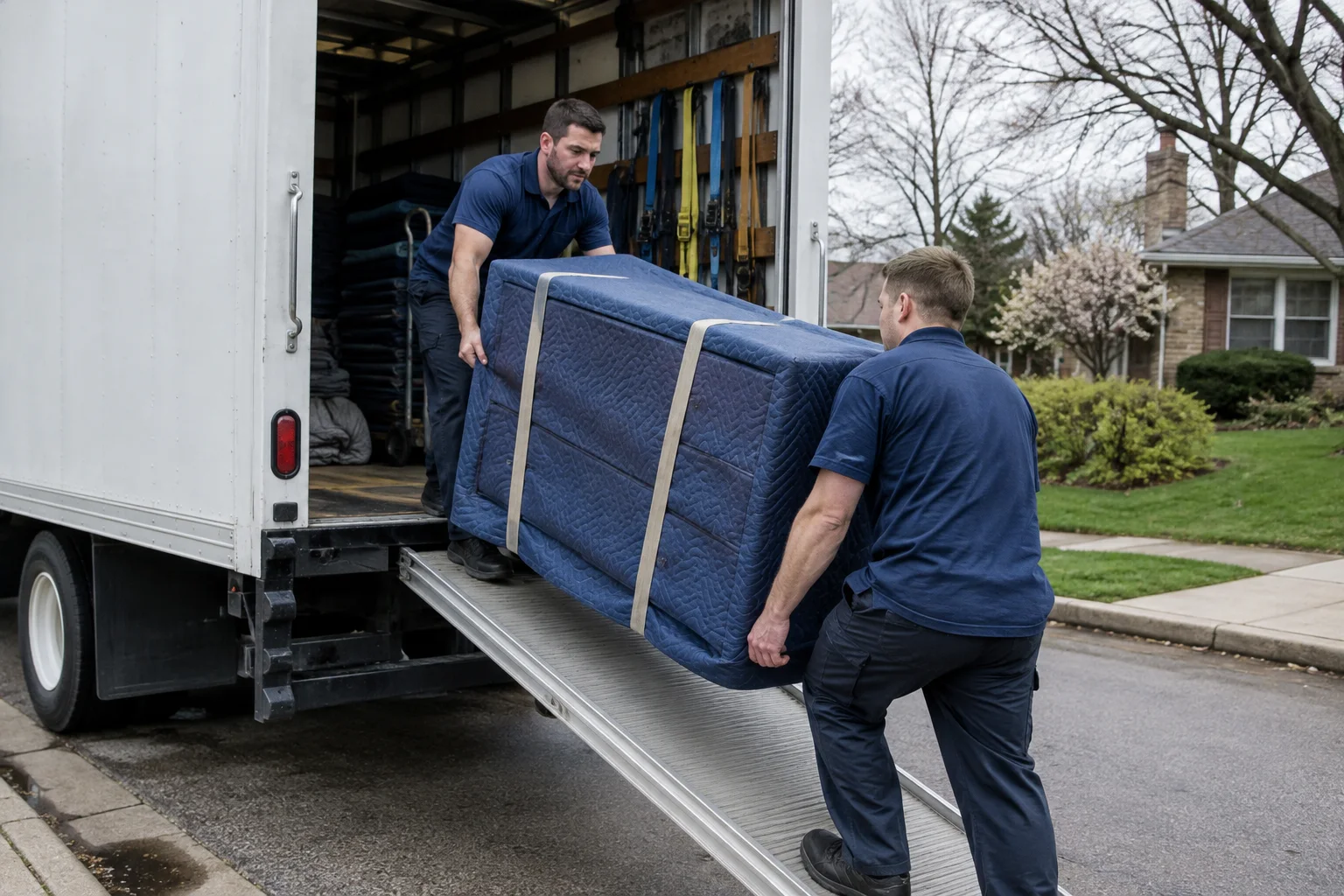
For interstate moves booked through us, Amenity Moving & Storage handles the origin work as an agent of Wheaton World Wide Moving: an Amenity crew inventories your items and their condition on moving day, you review and approve that list, and the truck is loaded item by item with furniture wrapped in blankets and secured with restraints. Ask during your estimate who will be at the destination end so you can plan envelopes for both crews. Our long-distance moving page explains how those moves are scheduled and tracked.
Putting the tip into your moving budget
Budget the tip as its own line, next to the moving charges, boxes and any storage. A mover’s estimate covers transportation and services; the tip is extra money you set aside. Our guide to how moving costs are calculated in Illinois walks through what goes into the main bill.
Also plan for the payment rule. The ICC tells consumers to be prepared to pay 110 percent of the written estimate on moving day, with any balance above that due later. If you are working from a tight number, read our comparison of binding and non-binding moving estimates so the tip and the final charges both fit.
The easiest time to size a tip is right after your estimate, when you know the likely crew size and hours. Amenity offers free, no-obligation in-home visual estimates for local moves in the suburbs it serves, from Naperville to Joliet, and the estimator can tell you how many movers to expect. If you add packing services, plan for that crew as well.
- Decide your method: per hour, per day or a percentage.
- Write down the expected crew size and hours from your estimate.
- Set a low, middle and high amount per mover.
- Withdraw cash the day before, in small bills, with envelopes.
- Stock water and plan lunch if the job runs past midday.
- Hand out tips only after the inventory check and paperwork are done.
Keep reading
- How Moving Costs Are Calculated in Illinois
- Binding vs. Non-Binding Moving Estimates
- Full Value Protection vs. Released Value
- How to Check a Moving Company's License in Illinois
Browse the full moving guide library or see every moving service.
Frequently asked questions
Is it rude not to tip movers?
It is not a breach of any rule. The Illinois Commerce Commission’s consumer tips say tipping is not required, and if a crew demands a tip you should call the company. Most people do tip when the work is good, so if you skip it, a sincere thank-you, water and a clear path through the house still matter. Poor service or damage is a fair reason to tip less.
Should I tip movers in cash?
Cash is the simplest choice. NerdWallet reports that most movers prefer it, since each person receives the amount you intended right away. Use a separate envelope per mover if you can. Cards, checks and payment apps can work too, but confirm with the moving company before moving day that it accepts that method.
How much do I tip movers for 4 hours?
Using NerdWallet’s guidance of $4 to $15 per mover per hour, a four-hour job works out to about $16 to $60 per mover. Bob Vila’s older guide suggests at least $10 per mover for a half day of about four hours. Start in the middle and adjust for stairs, heavy items, weather and how carefully your things were handled.
Is $20 per mover a good tip?
For a short, easy local job, it fits the published guidance. NerdWallet gives $20 to $50 per mover for a working day as a common range, and Bob Vila’s guide suggests $20 for a full eight-hour day. On a long, hard day with stairs or a piano, the hourly method points higher, so many people give more.
Is 10% a good tip for movers?
Ten percent of the moving bill sits at the low end of the 10% to 20% range NerdWallet calls common. On a $500 local bill, that method suggests $50 to $100 for the whole crew to share. On a long-distance move, where much of the bill is transportation, many people use a per-day amount instead because a percentage can overshoot.
How much should I tip movers on a long-distance move?
NerdWallet says long-distance crews are typically tipped more, about $50 to $100 per mover per day. The movers who load at your old home may not be the ones who unload at the new one, so budget for both crews and tip each at the end of their working day. Check your paperwork first in case a gratuity is already included.
Is $100 per mover a good tip?
For a typical local day it is generous: it is above NerdWallet’s $20 to $50 per-day range, though within the hourly range for a seven- or eight-hour job. On a long-distance move, $100 per mover per day is the top of NerdWallet’s range. It makes sense for a long, hard day or exceptional care with valuable items.
How much to tip movers in 2026?
No regulation sets a tip, and the guidance has not changed by rule. The most recent guide we cite, NerdWallet’s, updated June 9, 2025, puts common amounts at 10% to 20% of the bill, $4 to $15 per mover per hour, or $20 to $50 per mover per day. In Illinois, a tip remains optional.
Sources
- ICC Smart Tips for Hiring a Household Goods Mover — Illinois Commerce Commission
- ICC recommends tips for hiring intrastate household goods movers (May 4, 2026) — Illinois Commerce Commission
- How Much to Tip Movers — NerdWallet
- How Much Do You Tip Movers? — Bob Vila
- Section 1457.610 Estimate of Charges (92 Ill. Adm. Code 1457.610) — Illinois General Assembly, Joint Committee on Administrative Rules
Who handles your move
Local Moving Specialists is operated by Amenity Moving & Storage Inc., 10028 Mandel St, Plainfield, IL 60585 — a family-run Illinois mover since 1986. Illinois household goods license ILCC 73744 MC-C. Interstate moves are transported under the authority of Wheaton Van Lines, Inc. (USDOT 70719, MC-87113), for which Amenity is an authorized agent. See licenses & disclosures.
Last reviewed November 11, 2026 against Amenity Moving & Storage’s published service details and the public sources listed above.
Ready for a straight answer on your move?
Book a free, no-obligation in-home estimate with Amenity’s Plainfield team.