How to verify a moving company's license in Illinois
Two free lookups tell you whether a mover is legal: the ICC for moves inside Illinois and FMCSA for moves across state lines. Here is how to run both.
- Licensed: ILCC 73744 MC-C
- Family-run since 1986
- Wheaton World Wide agent
- Free in-home estimates

How do I verify a moving company's license in Illinois?
For a move that starts and ends in Illinois, search the company’s name or ILCC number in the Illinois Commerce Commission’s Motor Carrier Information System, or call the ICC at 217-782-6448. For a move to another state, look up its USDOT or MC number in FMCSA’s mover search and SAFER snapshot, and confirm it is an active carrier authorized for household goods.
Get your free moving quote
Tell us where and when. Amenity’s Plainfield office replies directly.
On this page
Which license a mover needs depends on where your move ends
The destination decides the regulator. A household move that begins and ends inside Illinois is an intrastate move, and the company doing it must hold a household goods license from the Illinois Commerce Commission (ICC). A move that crosses a state line is interstate, and the carrier must be registered with the Federal Motor Carrier Safety Administration (FMCSA) and authorized to haul household goods.
The ICC is direct about why this matters. Its consumer guide, Household Moves in Illinois, says unlicensed movers operate outside the law, may give you little or no protection for loss or damage, and that hiring one is itself against the law. The same guide counts more than 300 movers licensed by the Commission, so there is no shortage of legal options anywhere in the state.
| Your move | Who regulates it | What to look up | Where to check |
|---|---|---|---|
| Any Illinois-to-Illinois move, such as Naperville to Plainfield or Joliet to Wheaton | Illinois Commerce Commission | Household goods license (ILCC number) | ICC MCIS Entity Search |
| Any move across a state line, such as Aurora to Indianapolis | FMCSA, U.S. Department of Transportation | USDOT number, MC number and household goods authority | FMCSA Search by Company |
| Storage between homes | Illinois Commerce Commission | A separate warehouse license, per the ICC’s Smart Tips | ICC Smart Tips |
Short local moves are not exempt. The ICC guide explains that for moves outside Cook County that stay within one incorporated community plus the area ten miles beyond its limits, the Commission doesn’t regulate what the mover charges. Even in that rate-exempt zone, the mover must still be licensed.

How to look up an Illinois mover with the ICC
Use the ICC’s Motor Carrier Information System (MCIS) Entity Search, which the Commission links from its Household Goods Movers page as the place to find a licensed household goods mover. It is free and takes a couple of minutes.
- Open the searchGo to the MCIS Entity Search on icc.illinois.gov. The page asks you to tick an “I’m not a robot” box before it returns results.
- Filter to moversSet Authority Type to Household Goods Movers. The same tool also lists brokers, warehouses, bus companies and towing companies, so the filter keeps you from mistaking one type of license for another.
- Search by number if you have itThe form accepts Entity Name, ZIP Code, City, ILCC Number and USDOT Number. A license number gives the cleanest result, because brand names often differ from the legal name on the license.
- Read the recordConfirm the legal name matches the company on your estimate and that its household goods authority is active. The ICC says its website also shows the number of complaints filed against each company.
- Call if anything is unclearThe ICC’s moving line is 217-782-6448, and its email is ICC.Moving@illinois.gov. The Commission says you can call that number to check a license, ask about complaints, or verify the rates a mover has on file.
Rates are part of the license. Every licensed Illinois mover files a tariff with the ICC, and the consumer guide suggests asking the mover for the tariff page that applies to you, then calling the Commission to confirm that page is on file and in effect. For moves under 50 miles, or entirely within Cook, DuPage, Kane, Kendall, Lake, McHenry and Will counties, the guide says charges may be based on the number of workers and hours; longer moves outside those counties are priced by weight and distance. Our guide to how moving costs are calculated in Illinois explains both methods.
No search result? Ask the ICC directly
If the company doesn’t appear, call 217-782-6448 before you sign or pay anything. Ask three questions: Is this company licensed as a household goods carrier? Is its tariff on file and in effect? Are complaints on record? The ICC adds that a licensed mover’s license number should appear on all of its advertising and paperwork.
How to check an interstate mover on FMCSA
For a move out of Illinois, find the company in FMCSA’s household goods search, then read its SAFER Company Snapshot. Both are free, public and need no account.
- Search the mover databaseOn FMCSA’s Search by Company tool, enter the company name (starts with, contains or ends with), the U.S. DOT number or the MC number. The tool covers interstate movers only. Select a company in the results to see complaints, safety information and contact details.
- Open the SAFER snapshotSearch the same USDOT number on safer.fmcsa.dot.gov. The snapshot lists Entity Type, USDOT Status, Operating Authority Status, MC number, legal and DBA names, address, power units, drivers and the cargo the company is set up to carry.
- Check four linesEntity Type should read CARRIER, not BROKER, if the company says it will move you itself. USDOT Status should be ACTIVE. Operating Authority Status should include Motor Carrier of Household Goods. Cargo Carried should have Household Goods marked.
- Match the paperworkThe legal name, USDOT number and MC number on your estimate and bill of lading should match the snapshot. If they don’t, get an explanation in writing before you pay a deposit.
A USDOT number on its own proves less than people assume. FMCSA points out that a company can be registered with the agency but not authorized to move household goods, which is why the Operating Authority line matters more than the number itself. FMCSA also cautions that a missing safety rating shouldn’t be read as unsafe on its own, and that it doesn’t endorse any mover based on what the search shows.
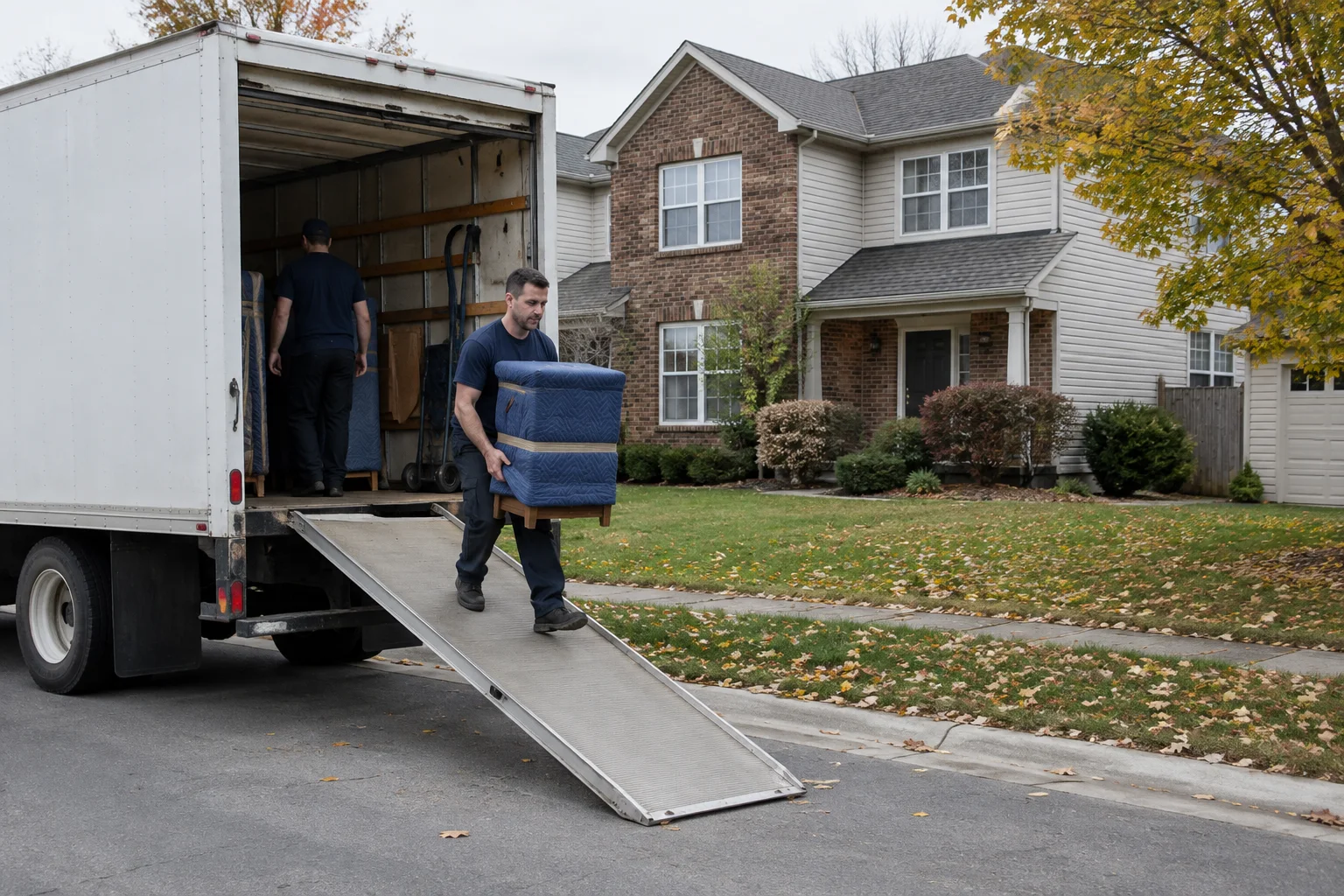
Ready for a straight answer on your move?
Book a free, no-obligation in-home estimate with Amenity’s Plainfield team.
Worked example: checking the numbers behind this site
Here is the same process run on Amenity Moving & Storage Inc., the Plainfield company that operates Local Moving Specialists and performs every move booked here. Amenity’s Illinois household goods license is ILCC 73744 MC-C. That is the number to search in the ICC’s MCIS tool for any move between two Illinois addresses, such as Naperville to Plainfield.
Interstate moves work differently. Amenity is an authorized agent of Wheaton World Wide Moving, and moves that cross a state line are transported under the federal authority of Wheaton Van Lines, Inc. The USDOT number on an interstate move is therefore Wheaton’s, not Amenity’s, and it is the one to look up. This is what the SAFER snapshot showed when we checked it:
| SAFER field | What it showed for USDOT 70719 | What it tells you |
|---|---|---|
| Entity Type | CARRIER | The company operates trucks and transports goods; it is not a broker |
| USDOT Status | ACTIVE | Federal registration is current |
| Operating Authority Status | Authorized for Motor Carrier of Household Goods (and of property other than household goods) | It holds federal authority to carry household goods across state lines |
| MC number | MC-87113 | The authority number to match on your paperwork |
| Legal and DBA name | WHEATON VAN LINES INC, doing business as WHEATON WORLD WIDE MOVING | The carrier name your interstate bill of lading should show |
| Physical address | Indianapolis, Indiana | The van line’s headquarters, not the local agent’s office |
Agent arrangements like this are common in long-distance moving. A local company handles the estimate, packing and loading, and a van line holds the interstate authority. Amenity notes that its Wheaton affiliation connects customers to more than 300 Wheaton agents across the U.S. Our long-distance moving page explains how a Wheaton move runs, and every number above is listed on our licenses and disclosures page so you can check it yourself.
Mover or broker: how to tell the difference
A mover operates the trucks and crews; a broker sells the job and hands it to a mover. FMCSA’s Movers vs. Brokers guidance says household goods brokers generally don’t have moving trucks or professional movers, don’t take responsibility for transporting your belongings, and must use FMCSA-registered movers for interstate jobs.
Brokers aren’t illegal, but you should know when you’re talking to one. Federal rules require a household goods broker’s ads and website home page to show its physical location, its MC and USDOT numbers, and the fact that it arranges moves through an authorized mover. FMCSA also says a broker may give a written estimate only for a mover it has a written agreement with, and it warns that when a broker can’t place a job, the customer can be left without a mover on moving day.
- The FMCSA search or SAFER snapshot lists the company as a BROKER rather than a CARRIER.
- The salesperson can’t say which company’s trucks and crew will arrive.
- A firm price arrives over the phone or online with no walk-through of your home.
- The name on the deposit receipt differs from the name on the estimate.
Local Moving Specialists is not a broker and does not list or refer other moving companies. Every quote request goes to Amenity’s own office, and Amenity’s crews do the work. To see what a real walk-through covers, read what happens during an in-home moving estimate.
Red flags that should stop you from booking
The fastest red flag is a mover who won’t give you a license number, or whose number doesn’t check out. Beyond that, FMCSA’s Spot the Red Flags list and the ICC’s Smart Tips overlap closely:
- Cash or a large deposit up front. FMCSA lists a demand for cash or a big deposit before the move as a warning sign.
- No look at your belongings. FMCSA flags movers who skip an onsite inspection and quote by phone or online, sight unseen.
- A price set after loading. No written estimate, or a promise to figure out the cost once your things are on the truck.
- Blank paperwork. Any request to sign documents that have blanks in them.
- A website with no address. FMCSA notes that rogue movers’ sites often list no local address and no registration or insurance information.
- A rental truck on moving day instead of a company-owned or company-marked truck.
- Only a phone number. The ICC’s Smart Tips say not to trust a company that advertises nothing but a phone number.
- App-only booking. The ICC advises against relying on mobile apps alone to choose and schedule a mover.
- A crew that demands a tip. The ICC says tipping isn’t required, and if a crew demands one, you should call the company immediately.
Our guide to moving scam red flags explains how hostage-load schemes work and what to do if one happens. Complaints about an Illinois mover go to the ICC online or at 217-782-6448; interstate complaints go to FMCSA’s National Consumer Complaint Database. In its 2025 spring release, the ICC said its police officers patrol year-round and cite companies operating without a household goods license.
What a license protects, and what it doesn't
A license means the mover answers to a regulator, charges from filed rates and must follow consumer rules on estimates, payment and claims. It doesn’t make every licensed mover a good fit, and it doesn’t decide how much your belongings are protected; that comes from the valuation option you choose.
Moves within Illinois (ICC rules)
- Licensed movers must give you a free, written estimate. The ICC stresses that the estimate isn’t binding: you are billed from the mover’s tariff for the service actually performed.
- Unless other terms were confirmed in writing, you can be asked to pay up to 110 percent of the written estimate at delivery. Once you do, the mover must unload and release your goods and give you 30 days to pay any balance.
- Movers must issue a bill of lading, your contract. Don’t sign it until you understand it, especially the liability section.
- Rates are based on liability of 60 cents per pound per article unless you pay for a higher declared value.
- Claims go to the mover in writing within 90 days of delivery. The mover must acknowledge a claim within 30 days and pay, settle or deny it within 120 days.
Moves across state lines (FMCSA rules)
- Your mover must give you FMCSA’s booklet Your Rights and Responsibilities When You Move.
- Released Value, the no-extra-charge option, limits the mover’s liability to 60 cents per pound per article, and you must agree to it in writing; otherwise Full Value Protection applies, according to FMCSA’s liability and protection guidance.
- You have nine months from delivery to file a written claim, and the mover has 30 days to acknowledge it and 120 days to respond, according to FMCSA’s loss and damage guidance.
Valuation is where the license and your own choices meet. Read full value protection vs. released value before moving day, and if the estimate type is unclear, binding vs. non-binding estimates lays out the difference.
Questions to ask any mover before you sign
A licensed, established mover can answer all of these on the first call. Write the answers down and compare them with what the lookups show.
- What is your ICC household goods license number, and what legal name is it issued to?
- For an interstate move, whose USDOT and MC numbers will appear on the bill of lading?
- Will your own employees and trucks do the job, or will another company?
- Will someone walk through my home, including the basement, attic and garage, before writing the estimate?
- Which tariff page applies to my move, and can I see it?
- What valuation options do you offer, and what does each one pay on a claim?
- If my belongings go into storage, where will they be kept and under which license?
- How and where do I file a claim if something is damaged?
For reference, Amenity offers free, no-obligation in-home visual estimates, puts one household per truck on local moves, describes itself as fully bonded, licensed and insured, and has been accredited by the Better Business Bureau since August 25, 2017. If you’re weighing timing as well as credentials, how far in advance to book movers covers lead times by season.
Keep reading
- The 8-Week Moving Checklist
- Best Time of Year to Move in the Chicago Suburbs
- Moving in Winter Around Chicago
- How to Move a Gun Safe
Browse the full moving guide library or see every moving service.
Frequently asked questions
Is it illegal to hire an unlicensed mover in Illinois?
Yes. The ICC’s consumer guide says it is against the law to hire an unlicensed mover for a move within Illinois, and ICC police cite companies operating without a household goods license. Unlicensed movers may also offer little or no protection if something is lost or damaged. Check any company in the ICC MCIS Entity Search or call 217-782-6448 before you book.
Does a local mover need a USDOT number?
For a move that stays in Illinois, the credential that matters is the ICC household goods license. A USDOT number with household goods authority is what matters for a move across state lines. Some Illinois movers carry both, and the ICC’s search accepts either an ILCC number or a USDOT number, so you can look a company up with whichever number it gives you.
How far in advance should you hire movers?
The ICC recommends starting your search at least six weeks before moving day. That leaves time to check licenses, schedule in-home estimates and compare written estimates. FMCSA’s consumer booklet places the busy moving season between May and September, so summer dates call for more lead time. Our guide on how far in advance to book movers covers each season.
Can I see complaints against a moving company?
Yes. For Illinois movers, the ICC says its website shows the number of complaints filed against each licensed company, and you can also call 217-782-6448. For interstate movers, select the company in FMCSA’s Search by Company results to see its complaint history. The ICC’s consumer guide also suggests checking with the Better Business Bureau.
Why does a mover's paperwork show another company's USDOT number?
Usually because the local company is an agent of a van line. On an interstate move, the van line is the carrier and its USDOT number goes on the bill of lading. Amenity, for example, handles interstate moves as an agent of Wheaton World Wide Moving, so those moves run under Wheaton Van Lines’ USDOT 70719 and MC-87113. Confirm the carrier named is authorized for household goods.
Is tipping movers required in Illinois?
No. The ICC’s Smart Tips state that tipping isn’t required, and if a moving crew demands a tip, you should call the company immediately. Tipping is a personal choice for good work. If you want a sense of what people typically do, see our guide on how much to tip movers.
Does a mover need a separate license to store my things?
According to the ICC’s Smart Tips, if your belongings go into storage, the company must have a separate warehouse license, and the ICC regulates warehouses as well as movers. Ask where your goods will be kept and under which license. Amenity stores goods in its own 12,000-square-foot Plainfield warehouse; see moving and storage for how it works.
What are red flags when hiring movers?
The biggest ones: no license number, a demand for cash or a large deposit, an estimate given without seeing your home, a price set after loading, blank documents to sign, a website with no address, a rental truck on moving day, and a crew that demands a tip. FMCSA and the ICC both publish these warning signs.
Sources
- Household Goods Movers — Illinois Commerce Commission
- Household Moves in Illinois: A Consumer's Guide (revised 3/2026) — Illinois Commerce Commission
- ICC Smart Tips for Hiring a Household Goods Mover — Illinois Commerce Commission
- Protect Your Move: Search by Company — FMCSA
- SAFER Company Snapshot, USDOT 70719 — FMCSA
- Spot the Red Flags — FMCSA
Who handles your move
Local Moving Specialists is operated by Amenity Moving & Storage Inc., 10028 Mandel St, Plainfield, IL 60585 — a family-run Illinois mover since 1986. Illinois household goods license ILCC 73744 MC-C. Interstate moves are transported under the authority of Wheaton Van Lines, Inc. (USDOT 70719, MC-87113), for which Amenity is an authorized agent. See licenses & disclosures.
Last reviewed November 11, 2026 against Amenity Moving & Storage’s published service details and the public sources listed above.
Ready for a straight answer on your move?
Book a free, no-obligation in-home estimate with Amenity’s Plainfield team.