Moving services, from full packing to crated storage
Every service Amenity Moving & Storage offers, what each one includes, and how to decide how much help your move actually needs.
- Full or partial packing
- Crated warehouse storage
- Wheaton World Wide agent
- Free in-home estimates

What do full-service movers do?
Full-service movers pack your belongings, protect the furniture, load, drive, unload and set everything in place at the new home. Amenity Moving & Storage, the licensed Plainfield mover behind this site, offers that whole package or any piece of it: local and long-distance moves, office moves, full or partial packing, crated storage, and pianos, gun safes, hot tubs and senior moves.
Get your free moving quote
Tell us where and when. Amenity’s Plainfield office replies directly.
On this page
The services, one by one
Amenity’s services fall into three groups: the move itself, the work around it (packing and storage), and items or situations that need special handling. Each paragraph below gives the essentials and links to the page with the full detail.
Local moving
Home moves between suburbs, and between Chicago and the suburbs. Amenity runs multiple truck sizes so a house moves in the fewest trips, keeps full semi trailers for very large loads, and assigns one customer per truck on local moves, so your goods never share space with another household’s. Read more about local moving.
Long-distance moving
Moves out of Illinois run through Amenity’s agency with Wheaton World Wide Moving, under Wheaton Van Lines’ federal authority. An Amenity crew records each item and its condition, you approve that list, and the load is tracked through Wheaton’s dispatch and computerized scheduling. See long-distance moving.
Office and commercial moving
Office and corporate moves for businesses. Planning an office move starts from downtime: what has to work on the first morning, which furniture comes apart, who labels what, and what the building asks of a mover. Details are on the office moving page.
Apartment and condo moving
Smaller homes, bigger logistics. Elevator reservations, loading zones, long hallways and stairs can affect the day more than the amount of furniture, so they belong on the estimate. See apartment and condo moving.
Packing
Full or partial packing. Crews arrive with the right materials in the right quantities, can step in with last-minute packing when your timeline slips (subject to availability), and can collect emptied containers after the move, with some limitations. Optional liability valuation coverage is available on items Amenity packs. More on packing services.
Storage
Storage for one day to several years in Amenity’s 12,000 sq ft Plainfield warehouse. Furniture is padded, wrapped in cardboard and sealed in wooden crates, sofas go on racks, and each item is logged in an inventory database. It is not drive-up self-storage, and customers don’t get a key. Read about moving and storage.
Piano moving
Uprights, spinets and grands, including Steinway, Baldwin, Kawai, Young Chang and Yamaha instruments. The route matters as much as the piano: every step, landing and doorway between the room and the truck should be on the estimate. See piano moving.
Gun safe moving
Amenity says the safes it moves weigh roughly 300 to 2,000 lb. Crews use power dollies and have moved Stack-On, Browning and Liberty ProVault models, and safes can be stored if the new floor isn’t ready. See gun safe moving.
Hot tub and spa moving
Hot tubs and spas are planned as their own job; measure the path from the patio to the street before the estimate so the crew knows what it is working with. Amenity can also store them between homes. See hot tub moving.
Senior moving
Moves for older adults leaving a long-time home, usually tied to decisions about what fits in a smaller place. Amenity offers senior moving as its own service; see senior moving and downsizing.
Full-service, partial packing or pack-it-yourself
Most households end up at one of three levels of help. The crew loads, moves and unloads the furniture in all three; what changes is who fills the boxes, how long the run-up takes, and how liability works for what’s inside them.
| Full-service | Partial packing | You pack, movers load | |
|---|---|---|---|
| Who packs | Amenity’s crew packs the whole home | The crew packs the rooms you pick, often the kitchen, china and framed art | You pack every box before moving day |
| Materials | Crew brings materials sized to the job | Crew brings materials for the rooms it packs | You buy or collect boxes, paper and tape |
| Liability for box contents | Covered at the valuation level you choose; optional valuation coverage on items Amenity packs | Same terms for crew-packed boxes; your own boxes fall under the next column | The ICC warns a mover may not be liable for the contents of cartons you packed unless the carton itself shows visible damage |
| Your time before the move | Least | Moderate | Most; a full house takes weeks of evenings |
| What the estimate needs | Room-by-room contents and fragile items | Which rooms the crew will pack | A realistic box count and furniture list |
| Fits | Tight timelines, long-distance moves, busy households | People who want control of everyday items but help with fragile ones | Smaller homes, flexible schedules, careful packers |
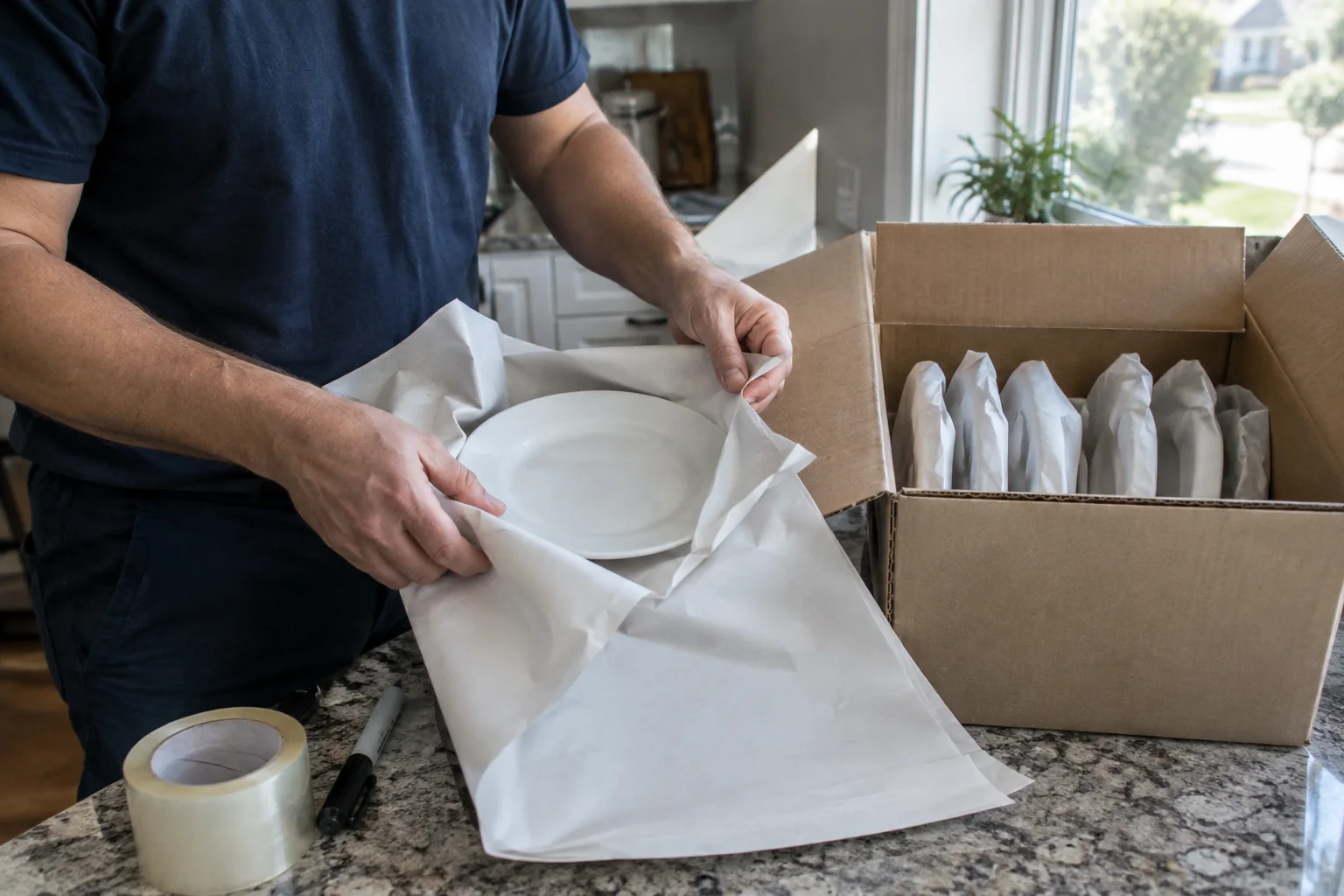
If you decide to pack yourself, our guide on how to pack for a move covers box sizes, labeling and which rooms to start with. Packing a few rooms yourself and leaving the kitchen and breakables to the crew is a common middle path, and it is easy to describe on the estimate.
How to choose the right level of help
Start with time, then with what is fragile, then with distance. Those three questions settle most of the decision, and the checklist below covers the rest.
- Calendar. If moving day is close and the house is full, crew packing takes the biggest single task off your list.
- Fragile and valuable pieces. China, glass, framed art and electronics are where professional packing earns its cost, and crew-packed boxes keep the liability question simple.
- Distance. A long-distance shipment travels farther and for longer, so packing quality matters more than on a cross-town move.
- Storage in the middle. Goods headed for crated storage are handled into and out of the warehouse, so boxes need to be sturdy and stack well.
- Physical limits. If lifting or stairs are hard for you, packing help and a senior move plan reduce the risk of injury before moving day.
- Budget. Packing yourself moves labor from the crew to you. It lowers the packing part of the bill, not the moving part.
Some things should never go on the truck no matter which level you choose. The Illinois Commerce Commission’s consumer guide says not to pack jewelry, money, important papers, medicines or other valuables for shipment; carry them with you, because the mover is not responsible for them. Our guide to what movers will not move lists the rest.
Ready for a straight answer on your move?
Book a free, no-obligation in-home estimate with Amenity’s Plainfield team.
How moving prices are built
Amenity doesn’t publish prices, because the price depends on what the estimator sees in your home. What is fixed is the method. In Illinois, the ICC’s consumer guide says moves under 50 miles, or entirely within Cook, DuPage, Kane, Kendall, Lake, McHenry and Will counties, may be charged by the number of workers and the hours they work; longer moves outside those counties are charged by total shipment weight and distance.
Movers file their rates with the ICC in documents called tariffs. The Commission’s guide says you can ask to see the tariff page that applies to your move and then call the ICC to confirm the page is on file and in effect. A low hourly rate on its own tells you little; the guide points out that the bill follows actual time and the number of workers.
On a local move, these are the things that change the total:
- Crew size and hours, including how long loading and unloading take at each address.
- Truck size and the number of trips.
- Packing labor and materials, if you add packing.
- Access: stairs, elevators, long carries and how far the truck can park from the door.
- Specialty items such as pianos, safes and hot tubs.
- Storage, which the ICC notes adds charges for unloading into the warehouse and reloading out of it, on top of the storage charge.
- Valuation above the basic level, if you choose it.
Interstate moves follow federal estimate rules. A binding estimate under 49 CFR 375.403 fixes the charges for the goods and services it lists and must be in writing. A non-binding estimate is the mover’s reasonable projection, and under 49 CFR 375.405 you can’t be required to pay more than 110 percent of it at delivery. Our guide to binding vs. non-binding estimates explains when each makes sense, and how moving costs are calculated in Illinois works through hourly and weight-based pricing in more depth.
In-state estimates carry a different protection. The ICC’s guide is blunt that an estimate is not binding and the bill follows the tariff for the work actually performed. The safeguard comes at delivery: unless you agreed to other terms in writing, paying 110 percent of the written estimate obliges the mover to unload and release your goods, and you then have 30 days to settle whatever remains.
Protecting what you own: valuation is not insurance
A mover’s liability for your goods is called valuation, and it is not the same thing as insurance. Both the ICC and the FMCSA describe the basic level as 60 cents per pound per article. It costs nothing extra, but it pays by weight: a 10-pound lamp that breaks is worth six dollars under it, whatever the lamp cost.
You can choose a higher valuation for an added charge. The ICC recommends asking your insurance agent whether your homeowner’s or renter’s policy covers goods in transit, and notes that if you buy insurance through the mover, the policy must be issued before the move. Amenity offers optional liability valuation coverage on items it packs.
For interstate moves, the FMCSA’s liability and protection page explains Full Value Protection and released value, and our valuation guide compares the two with worked examples.
If something is damaged on an in-state move, write it on the inventory or the bill of lading at delivery, keep the damaged item so the mover can inspect it, and file a written claim within 90 days. The ICC’s guide says movers must acknowledge a claim within 30 days and pay, settle or deny it within 120 days, and the Commission offers mediation and then arbitration if you can’t reach agreement.
What the in-home estimate covers
Every Amenity service starts with the same free, no-obligation in-home visual estimate. A visual estimate means someone looks at the actual furniture, boxes and access rather than pricing from a phone description, which makes the written number far more dependable. For interstate moves it is also a legal step: 49 CFR 375.401 requires the mover to physically survey your goods before giving a written estimate, unless you waive the survey in writing.
Get the most out of the visit by preparing a little beforehand:
- Decide what is staying, being sold or being donated, so it isn’t counted.
- Open the basement, attic, garage and any storage rooms; the ICC tells consumers to make sure the estimator sees all of them.
- Point out specialty items: pianos, safes, hot tubs, heavy exercise equipment and large artwork.
- Describe access at the new address: stairs, elevator, loading dock, driveway length and parking.
- Ask for an inventory form if you want one. Amenity provides them on request and keeps a formal inventory for anything it stores.
- Ask how valuation options work and how storage would be billed if your dates shift.
What Amenity does not offer
Being clear about scope saves you a phone call. Amenity does not offer junk removal, labor-only help loading a rental truck or container, car shipping, house cleaning or international moves, and Local Moving Specialists does not hand those jobs to other companies. Plan them separately and mention them at the estimate so the timing works.
If you are weighing a rental truck against a full crew, compare total time, the strain on your own back, and liability. When you load and drive your own truck, no mover’s valuation applies at all, so anything damaged on the way is yours to replace or claim through your own insurance.
Putting several services together on one move
Most moves use more than one service, and booking them together keeps one crew plan, one estimate and one point of contact. Four combinations come up often:
- Sale closes first. Pack and load from the old house, crate the goods in the Plainfield warehouse, then deliver when the new keys arrive. Storage can run as short as a single day.
- City condo to suburban house. Partial packing for the kitchen and breakables, an elevator reservation on the city end, and delivery to a house with a driveway and a basement.
- Downsizing. A senior move where the furniture that fits goes to the new apartment and the rest goes into storage while the family decides what to keep.
- Heavy items with the household. A piano or gun safe listed on the same estimate as the rest of the house, so the crew size and equipment are planned once.
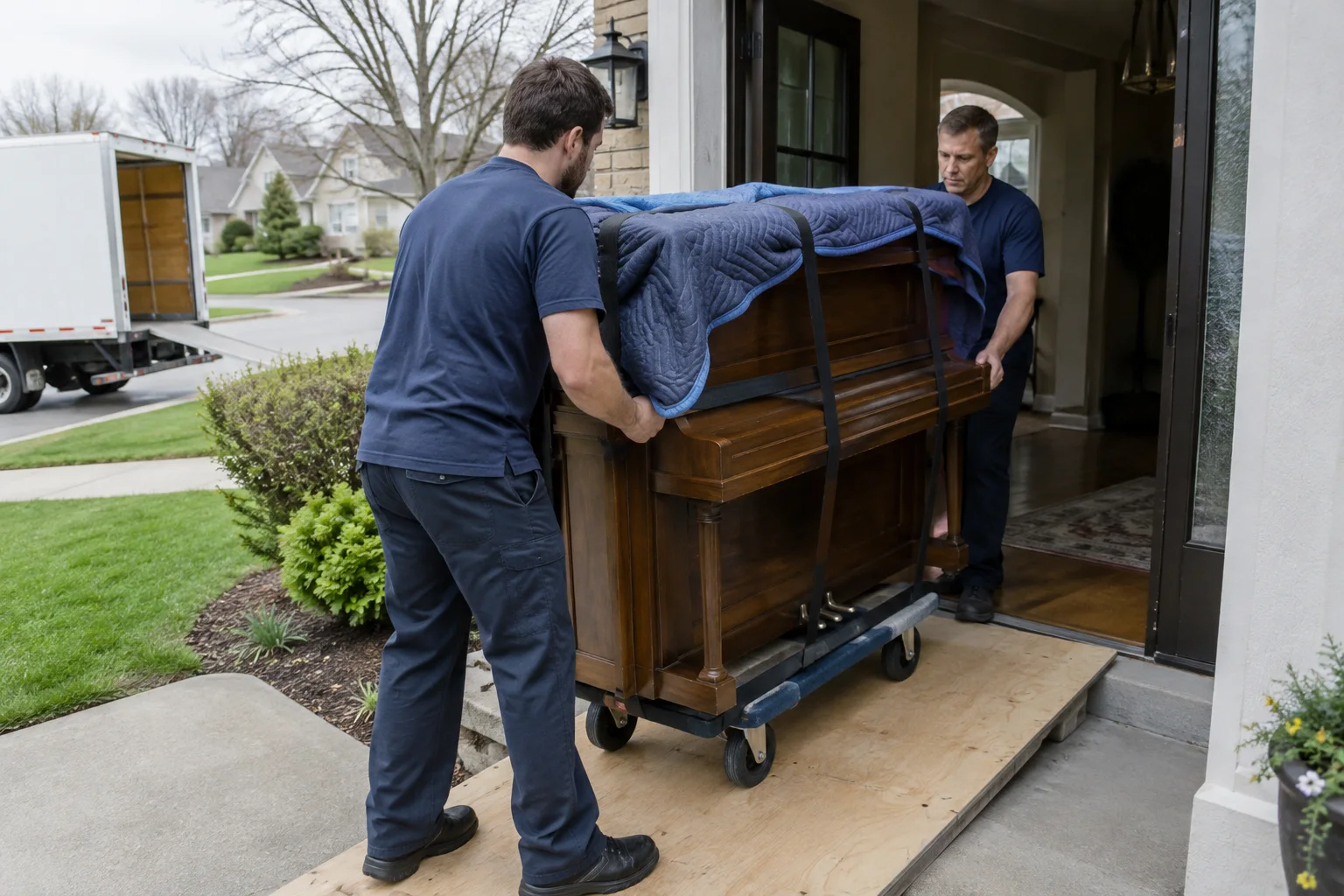
Tell the estimator about every piece up front, because each service changes the crew plan, the truck and the schedule. Amenity’s crews work across the western and southwest suburbs; the service area directory lists every town by county.
Every moving service we offer
Frequently asked questions
What is the difference between full-service movers and regular movers?
A full-service move includes packing, furniture protection, loading, transport, unloading and placement, so you mostly supervise. A basic move covers the loading, driving and unloading while you handle the boxes. Amenity offers both, plus partial packing in between, and the written estimate spells out exactly which services you booked.
When you hire movers, do they pack your stuff?
Only if packing is part of what you book. With Amenity you can choose full packing, partial packing for selected rooms, or no packing at all. Crews bring the materials for whatever they pack. If you pack your own cartons, the ICC notes the mover may not be liable for their contents unless the box shows visible damage.
Is a moving estimate the final price?
For moves within Illinois, the ICC’s guide says an estimate is not binding; the bill follows the mover’s tariff for the work performed. You get protection at delivery, though: paying 110 percent of the written estimate obliges the mover to unload, and you have 30 days for the rest. Interstate moves can use binding or non-binding estimates under federal rules.
Can I pack some boxes myself and have the crew pack the rest?
Yes, that is partial packing, and it is a common choice. Many people pack books, clothes and closets themselves and leave the kitchen, glassware and art to the crew. Tell the estimator which rooms you will handle so the materials and crew time are planned correctly, and use sturdy, well-taped boxes for anything you pack.
What should I not pack on the moving truck?
The Illinois Commerce Commission’s guide says to keep jewelry, money, important papers, medicines and other valuables with you rather than shipping them, because the mover is not responsible for them. Add anything you’ll need in the first day or two, such as chargers, a change of clothes and keys, to a bag that rides in your car.
Do you offer labor-only help or truck loading?
No. Amenity does not offer labor-only loading or unloading for rental trucks or portable storage containers. Its crews handle complete moves with Amenity’s own trucks, one customer per truck on local moves. If a rental truck suits your budget better, our guide comparing renting a truck with hiring movers lays out the trade-offs.
How is moving-company storage billed?
Amenity doesn’t publish storage prices; you get them on your written estimate. The ICC’s guide explains that storage involves three parts: unloading into the warehouse, the storage charge itself, and reloading when the goods come out. Ask for all three in writing, and ask how a change in your delivery date would affect them.
Can a piano, gun safe or hot tub be part of a house move?
Yes. List it on the same estimate as the rest of the household so crew size, equipment and timing are planned together. Amenity moves pianos, gun safes from roughly 300 to 2,000 lb, and hot tubs and spas, and it can store safes and hot tubs if the new home isn’t ready for them.
Sources
- Household Moves in Illinois: A Consumer's Guide (revised 3/2026) — Illinois Commerce Commission
- Liability & Protection — Federal Motor Carrier Safety Administration
- Your Rights and Responsibilities When You Move — Federal Motor Carrier Safety Administration
- 49 CFR 375.403 – How must I provide a binding estimate? — Legal Information Institute, Cornell Law School
- 49 CFR 375.405 – How must I provide a non-binding estimate? — Legal Information Institute, Cornell Law School
- 49 CFR 375.401 – Must I estimate charges? — Legal Information Institute, Cornell Law School
Who handles your move
Local Moving Specialists is operated by Amenity Moving & Storage Inc., 10028 Mandel St, Plainfield, IL 60585 — a family-run Illinois mover since 1986. Illinois household goods license ILCC 73744 MC-C. Interstate moves are transported under the authority of Wheaton Van Lines, Inc. (USDOT 70719, MC-87113), for which Amenity is an authorized agent. See licenses & disclosures.
Last reviewed November 11, 2026 against Amenity Moving & Storage’s published service details and the public sources listed above.
Ready for a straight answer on your move?
Book a free, no-obligation in-home estimate with Amenity’s Plainfield team.