Movers for the Chicago suburbs, county by county
One warehouse in north Plainfield, six counties, 50 suburbs and the city. Here is how the service area works and how to read each town's page.
- 50 suburbs plus Chicago
- Six counties
- Dispatched from Plainfield
- Free in-home estimates
Which Chicago suburbs do these movers serve?
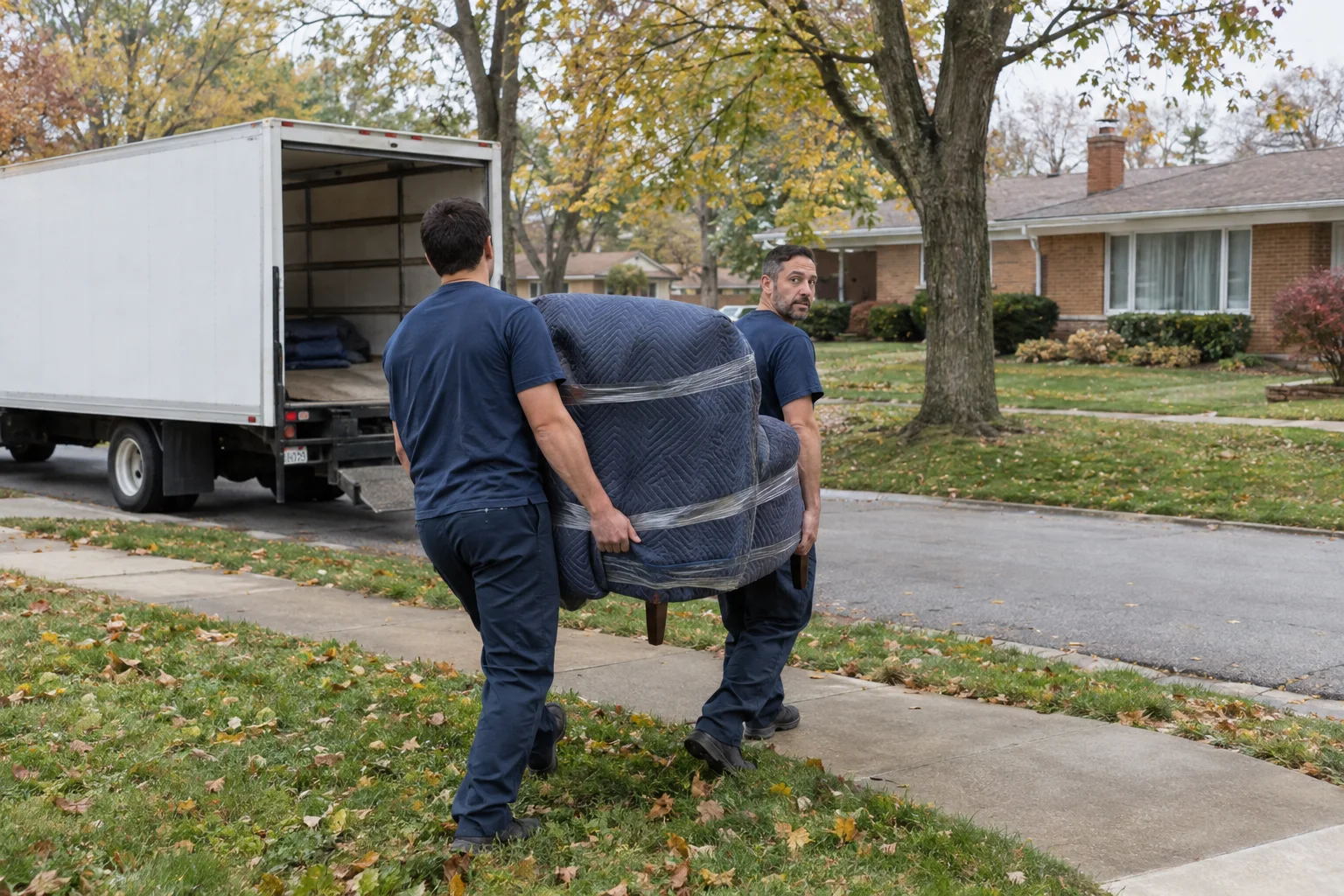
Amenity Moving & Storage, the licensed mover behind Local Moving Specialists, serves 50 suburbs in DuPage, Will, Kane, Kendall, Grundy and southwest Cook counties, plus moves to and from Chicago. Every crew leaves the same Plainfield warehouse. Ten of those suburbs lie within 10 miles of it in a straight line, and the farthest, Oak Lawn, is about 25 miles away.
Get your free moving quote
Tell us where and when. Amenity’s Plainfield office replies directly.
On this page
How the service area is drawn
The service area is drawn around one building: Amenity’s warehouse at 10028 Mandel St, on Plainfield’s north side near the Naperville line. Crews, trucks and stored household goods all start from that address, so distance from the warehouse is the first thing that shapes a suburban move.
Each town page gives a straight-line distance from the warehouse to the town’s Census center point. Measured that way, 10 of the 50 suburbs are within 10 miles, 26 are within 15 miles and 42 are within 20 miles. Even Plainfield’s own center point sits almost five miles south of the warehouse, because the building is at the village’s northern edge. Road miles always run longer than these figures, so treat them as a way to compare towns, not as drive times.
Roadwork is the other variable. In August 2026 the Illinois Tollway board approved its Driving Connections capital program for 2027 through 2042, which includes widening the Veterans Memorial Tollway (I-355) between I-55 and Army Trail Road, improving the I-355/I-88 interchange, and widening parts of the Reagan Memorial Tollway (I-88) between the Aurora toll plaza and the Eisenhower Expressway. Those are the corridors that tie the Will County side of the map to DuPage and the city, so a move scheduled during a construction season may need an earlier start.
Distance also decides how a move can be priced in Illinois. The Illinois Commerce Commission’s consumer guide says moves of less than 50 miles, or moves entirely within Cook, DuPage, Kane, Kendall, Lake, McHenry and Will counties, may be charged by the number of workers and hours. Longer moves outside those counties are charged by weight and distance. Every suburb on this site sits well inside 50 miles of the warehouse; our explainer on how moving costs are calculated in Illinois covers both methods.
| County | Towns on this site | County seat | 2020 Census population | Homes renter-occupied | Single-family detached |
|---|---|---|---|---|---|
| DuPage | 19 | Wheaton | 932,877 | 26.9% | 58.4% |
| Will | 11 | Joliet | 696,355 | 17.2% | 74.4% |
| Kane | 7 | Geneva | 516,522 | 24.0% | 69.1% |
| Kendall | 4 | Yorkville | 131,869 | 16.0% | 73.9% |
| Grundy | 3 | Morris | 52,533 | 25.6% | 71.8% |
| Cook | 6 suburbs plus Chicago | Chicago | 5,275,541 | 42.3% | 39.6% |
DuPage County: the most towns, the widest range
DuPage holds more of the service area than any other county: 19 of the 50 suburbs. The 2020 Census counted 932,877 residents, and the county government is based on County Farm Road in Wheaton. The housing mix is wider than in the counties to the south and west. The ACS puts single-family detached homes at 58.4 percent of DuPage’s housing, lower than Will, Kane, Kendall or Grundy, and DuPage has the highest median home value of the six counties in that data.
The towns show that range clearly. Naperville, with 150,692 residents in the ACS estimate, is the largest DuPage town on the list, and its center point is about five miles from the warehouse. A few miles east, Lisle looks very different: 44.1 percent of its homes are renter-occupied and only 43.2 percent are detached houses, so elevator bookings, shared hallways and parking-lot loading come up far more often in planning there.

Will County: the warehouse's home county
Will County is where the warehouse sits, and its housing is the most suburban of the six counties: the ACS shows 74.4 percent of homes are single-family detached and 17.2 percent are renter-occupied. The 2020 Census counted 696,355 residents, up from 677,560 in 2010, and the county courthouse stands in downtown Joliet. In Plainfield itself, 51.4 percent of homes were built between 2000 and 2009, and about two-thirds date from 2000 or later.
Joliet, about 13.5 miles from the warehouse, has 150,445 residents in the ACS estimate, almost exactly Naperville’s size, and its page leads with gun safe, office and long-distance moves. At the far southeast corner of the area, Frankfort is about 23 miles out. Only 5.2 percent of its homes are rented and 80.8 percent are detached houses, which usually means full house loads with basements and garages to clear.
Ready for a straight answer on your move?
Book a free, no-obligation in-home estimate with Amenity’s Plainfield team.
Kane County: Fox River towns and the largest suburb
Kane County counted 516,522 residents in 2020, and its government center is on South Batavia Avenue in Geneva. Several of its towns line the Fox River: a regional housing study prepared for Batavia, Geneva, North Aurora and St. Charles notes that all four sit on the river’s banks and share commercial corridors along Illinois Route 31, Randall Road and Kirk Road. County-wide, 69.1 percent of homes are detached houses and 24.0 percent are rented.
Aurora is the largest suburb on this site, with 179,898 residents in the ACS estimate, and its center point is about five miles from the warehouse. A third of its homes (33.6 percent) are renter-occupied, and its page pairs storage and office moves with gun safe work. Upriver, St. Charles sits about 15.6 miles away; 17.4 percent of its residents are 65 or older, and its page leads with apartment, piano and senior moves.
Kendall County: fast growth close to the warehouse
Kendall County grew from 114,736 residents in the 2010 Census to 131,869 in 2020, an increase of 14.9 percent, and the City of Yorkville, the county seat, describes Kendall as the fastest growing county in Illinois. It also has the youngest profile of the six counties: residents 65 and older make up 11.2 percent in the ACS, and only 16.0 percent of homes are rented, the lowest renter share in the service area.
Oswego is one of the closest towns to the warehouse at about 5.2 miles, and 71.6 percent of its homes are detached houses. Yorkville, about 10 miles out, has 23,617 residents. Both pages feature the same three services, hot tubs, gun safes and storage, and so do the pages for Montgomery and Plano. No other county on the map is that uniform.
Grundy County: the southwest edge
Grundy is the smallest county in the service area, with 52,533 residents in the 2020 Census, and its courthouse is on East Washington Street in Morris. The Illinois & Michigan Canal runs through this corner of the map. The National Park Service describes the hand-dug canal as 96 miles long, opened in 1848, and the core of America’s first National Heritage Area, designated in 1984; its heritage area page features Morris among the places to visit.
Morris is about 24 miles from the warehouse, one of the three farthest towns on the list, and 42.8 percent of its homes are renter-occupied, well above the county’s 25.6 percent. Minooka, about 17.5 miles out, is the opposite: 8.4 percent renters and 81.4 percent detached houses. Grundy is not on the ICC’s list of counties where in-county moves may be billed by the hour, but a move from Minooka or Channahon to Plainfield is far shorter than the 50-mile line, so hourly billing can still apply.
Southwest Cook County suburbs
Six southwest Cook County suburbs are on the list, from Lemont and Western Springs to Orland Park, Tinley Park and Oak Lawn. Cook is a different housing market from the collar counties: the ACS shows 42.3 percent of the county’s homes are renter-occupied and only 39.6 percent are detached houses. The ICC treats Cook differently too. Its rate exemption for moves that stay within one community and the ten miles beyond its limits applies only outside Cook County.
Orland Park, about 21 miles from the warehouse, has an older population than most of the area, with 24.8 percent of residents 65 or older, so its page leads with senior moves. Lemont is closer, about 13.4 miles away, and sits on the same canal corridor as Morris; the National Park Service’s heritage area page highlights historic downtown Lemont. Oak Lawn, at about 25 miles, is the farthest suburb on the map.
What changes when a move starts or ends in Chicago
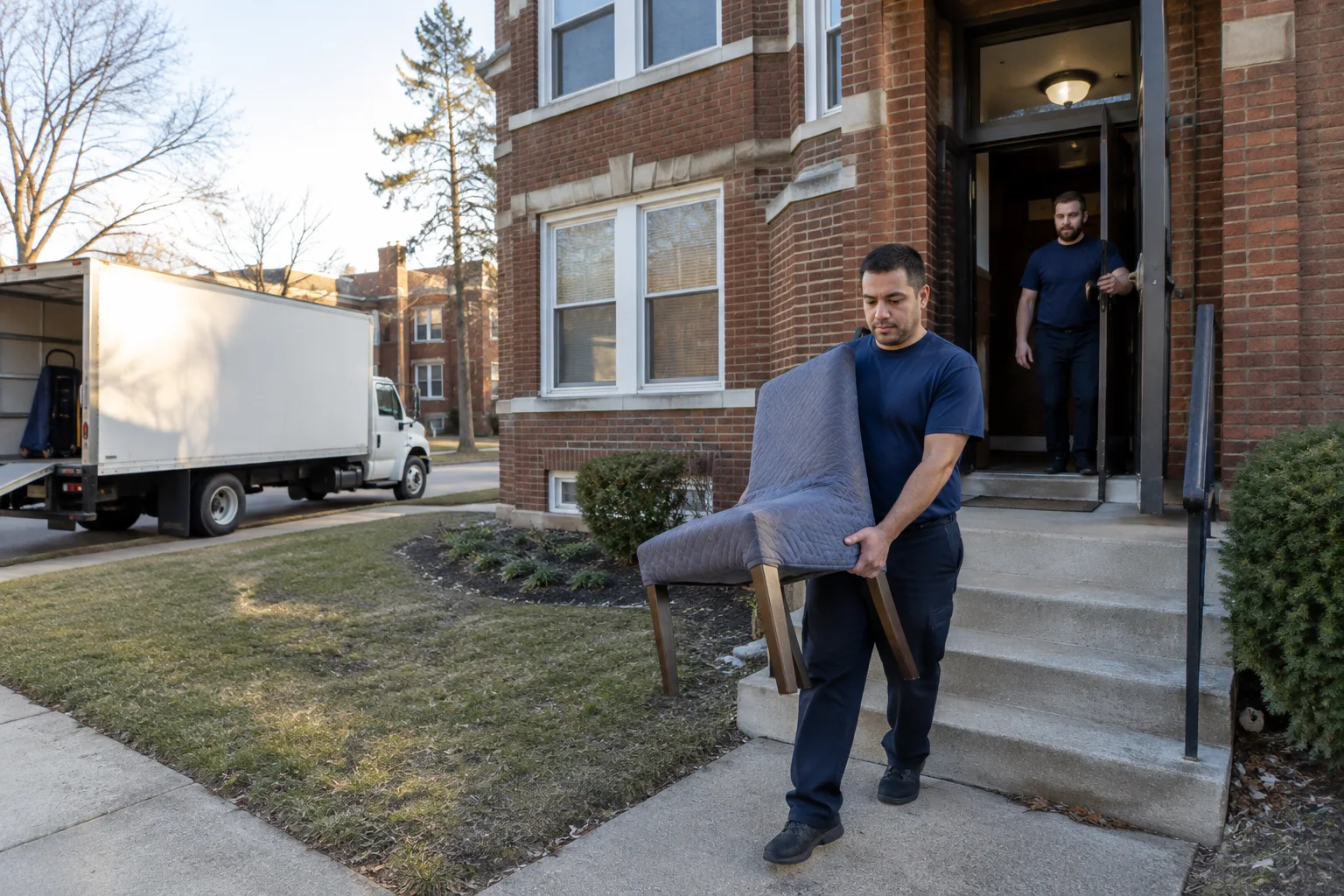
A move between Chicago and the suburbs is still a local move, but the city end of the day runs differently. Chicago’s center point is about 30 miles from the warehouse in a straight line, and the housing is mostly multi-unit: the ACS puts single-family detached homes at 25.6 percent of the city’s housing and renter-occupied homes at 54.0 percent.
- Street parking for the truck. The Chicago Department of Transportation handles moving-van parking on public streets through its permit application to occupy the public right of way, which has a moving-van option. Settle who requests it, and how far ahead, when you book.
- Building rules. Ask your building manager about elevator reservations, loading dock hours and any paperwork the building wants from the mover before the date is fixed.
- Walk-ups. Describe the stairs, landings and tight turns in a two-flat or three-flat at the estimate. The ICC specifically tells consumers to make sure the estimator understands elevators and stairs at the destination.
- The suburban end. Moving into a house usually trades elevator time for driveway access, garage space and basement stairs, so describe both addresses in equal detail.
The Chicago movers page covers city-side planning in more depth, and the guide to moving from Chicago to the western suburbs walks through the full switch, from lease timing to the first week in a house.
How to read a town page
Each town page opens with four Census figures: residents, households, the share of homes that are single-family detached, and the share of households that moved in since 2020. They come from the U.S. Census Bureau’s American Community Survey 2020-2024 5-year estimates, and every page links to that town’s profile on data.census.gov so you can check the numbers yourself. The move-in figure is the one movers watch: a high share of households that arrived since 2020 points to a town with steady turnover, newer subdivisions or a large rental stock, while a low share usually means long-settled homes with decades of belongings in the basement.
Two charts follow. One breaks the town’s housing down by building type: detached houses, townhomes, small buildings of two to nine units, and buildings of ten or more. The other shows when the homes were built, by decade. Together they tell you whether a typical move there involves a garage and a driveway or an elevator and a loading zone, and whether you are more likely to meet the narrow stairways of older housing.
Every town page also features three services, chosen from that town’s housing profile. The measures include the renter share, buildings with ten or more units, residents 65 and older, home values and pre-1960 housing, lot size, nearby office corridors and distance from the warehouse. That is why the Kendall County pages lead with hot tub and gun safe moves while Westmont’s leads with apartment, senior and long-distance moves. Fourteen towns, Joliet, Aurora, Bolingbrook and Frankfort among them, also have a separate moving-and-storage page for households whose closing dates don’t line up.
If you are leaving Illinois rather than moving across the suburbs, the same warehouse handles long-distance moves through Amenity’s agency with Wheaton World Wide Moving. The full county-by-county directory of town pages and the service map follow below.
DuPage County
- Movers in Burr Ridge
- Movers in Carol Stream
- Movers in Darien
- Movers in Downers Grove
- Movers in Elmhurst
- Movers in Glen Ellyn
- Movers in Hinsdale
- Movers in Lisle
- Movers in Lombard
- Movers in Naperville
- Movers in Oak Brook
- Movers in Villa Park
- Movers in Warrenville
- Movers in West Chicago
- Movers in Westmont
- Movers in Wheaton
- Movers in Willowbrook
- Movers in Winfield
- Movers in Woodridge
Will County
- Movers in Bolingbrook
- Movers in Crest Hill
- Movers in Frankfort
- Movers in Homer Glen
- Movers in Joliet
- Movers in Lockport
- Movers in Mokena
- Movers in New Lenox
- Movers in Plainfield
- Movers in Romeoville
- Movers in Shorewood
Kane County
- Movers in Aurora
- Movers in Batavia
- Movers in Elburn
- Movers in Geneva
- Movers in North Aurora
- Movers in St. Charles
- Movers in Sugar Grove
Kendall County
Grundy County
Cook County
- Movers in Chicago
- Movers in La Grange
- Movers in Lemont
- Movers in Oak Lawn
- Movers in Orland Park
- Movers in Tinley Park
- Movers in Western Springs
Frequently asked questions
Which towns are closest to the Plainfield warehouse?
Measured in a straight line to each town’s Census center point, Plainfield, Aurora, Oswego and Naperville are all about five miles from the warehouse, followed by Montgomery at about 6.3 miles and Bolingbrook at about 7 miles. Ten of the 50 suburbs sit within 10 miles. The warehouse is on Mandel Street at Plainfield’s north edge, near the Naperville line.
Do you serve towns that aren't on this list?
The 50 suburbs and Chicago on this site are where Amenity’s crews work regularly. If your town isn’t listed, put it on the quote form anyway, and the Plainfield office can tell you whether the move fits its schedule. For moves out of Illinois the starting town matters more than the destination, because the shipment travels through Amenity’s Wheaton World Wide Moving agency.
How far from Plainfield do these movers go for a local move?
The farthest suburbs on the list are about 24 to 25 miles from the warehouse in a straight line: Morris, Tinley Park and Oak Lawn. Chicago’s center point is about 30 miles away. Under the Illinois Commerce Commission’s rules, moves under 50 miles may be charged by workers and hours, which covers every suburb on this site.
Does a town farther from the warehouse cost more to move?
On an hourly move, the crew size and the hours worked drive the bill, so time on the road can matter. How travel time is handled varies by mover and tariff, so ask the estimator to show it on your written estimate. The ICC says you can also ask to see the tariff page that applies and confirm with the Commission that it is on file.
Can you move me between two suburbs that are both far from Plainfield?
Yes. A move from Elmhurst to Orland Park or from St. Charles to Frankfort runs the same way as any local move: estimate, written terms, then moving day with a truck that carries only your household. The crew starts from the Plainfield warehouse either way, which is worth factoring into your start time.
Do I need a permit to park a moving truck?
It depends on where you live. In Chicago, moving-van parking on public streets falls under the Department of Transportation’s public right-of-way permit. Suburban rules vary by village and by homeowners or condo association, so check your village website and your association’s rules before moving day. Town pages on this site note verified local rules where we found them.
Where do the numbers on the town pages come from?
Population, households, housing type, year built and move-in figures come from the U.S. Census Bureau’s American Community Survey 2020-2024 5-year estimates, linked to each town’s data.census.gov profile. Distances are straight-line miles from Amenity’s Plainfield warehouse to each town’s Census center point, so road miles will be longer.
Is this a directory of moving companies?
No. Every town page on Local Moving Specialists describes the same mover, Amenity Moving & Storage Inc. of Plainfield, licensed in Illinois as ILCC 73744 MC-C. The site doesn’t list or refer other movers. If you want to compare companies, check each one’s ICC license and complaint record with the Illinois Commerce Commission before you sign anything.
Sources
- 2020 Census Redistricting Data, Table P1 (Illinois counties) — U.S. Census Bureau
- Kendall County, Illinois profile (ACS 2020-2024 5-year) — U.S. Census Bureau
- Household Moves in Illinois: A Consumer's Guide (revised 3/2026) — Illinois Commerce Commission
- Illinois & Michigan Canal National Heritage Area — National Park Service
- Homes for a Changing Region, Phase 3: Central Fox Valley housing study — City of St. Charles / Chicago Metropolitan Agency for Planning
- City Information — United City of Yorkville
Who handles your move
Local Moving Specialists is operated by Amenity Moving & Storage Inc., 10028 Mandel St, Plainfield, IL 60585 — a family-run Illinois mover since 1986. Illinois household goods license ILCC 73744 MC-C. Interstate moves are transported under the authority of Wheaton Van Lines, Inc. (USDOT 70719, MC-87113), for which Amenity is an authorized agent. See licenses & disclosures.
Last reviewed November 11, 2026 against Amenity Moving & Storage’s published service details and the public sources listed above.
Ready for a straight answer on your move?
Book a free, no-obligation in-home estimate with Amenity’s Plainfield team.