Local movers for homes across the western and southwest suburbs
Amenity Moving & Storage has moved households from its Plainfield warehouse since 1992. One customer per truck, trucks sized to your home, and a free in-home estimate first.
- One customer per truck
- Free in-home estimates
- ILCC 73744 MC-C
- Est. 1986
What do local movers do, and how is a local move priced in Illinois?
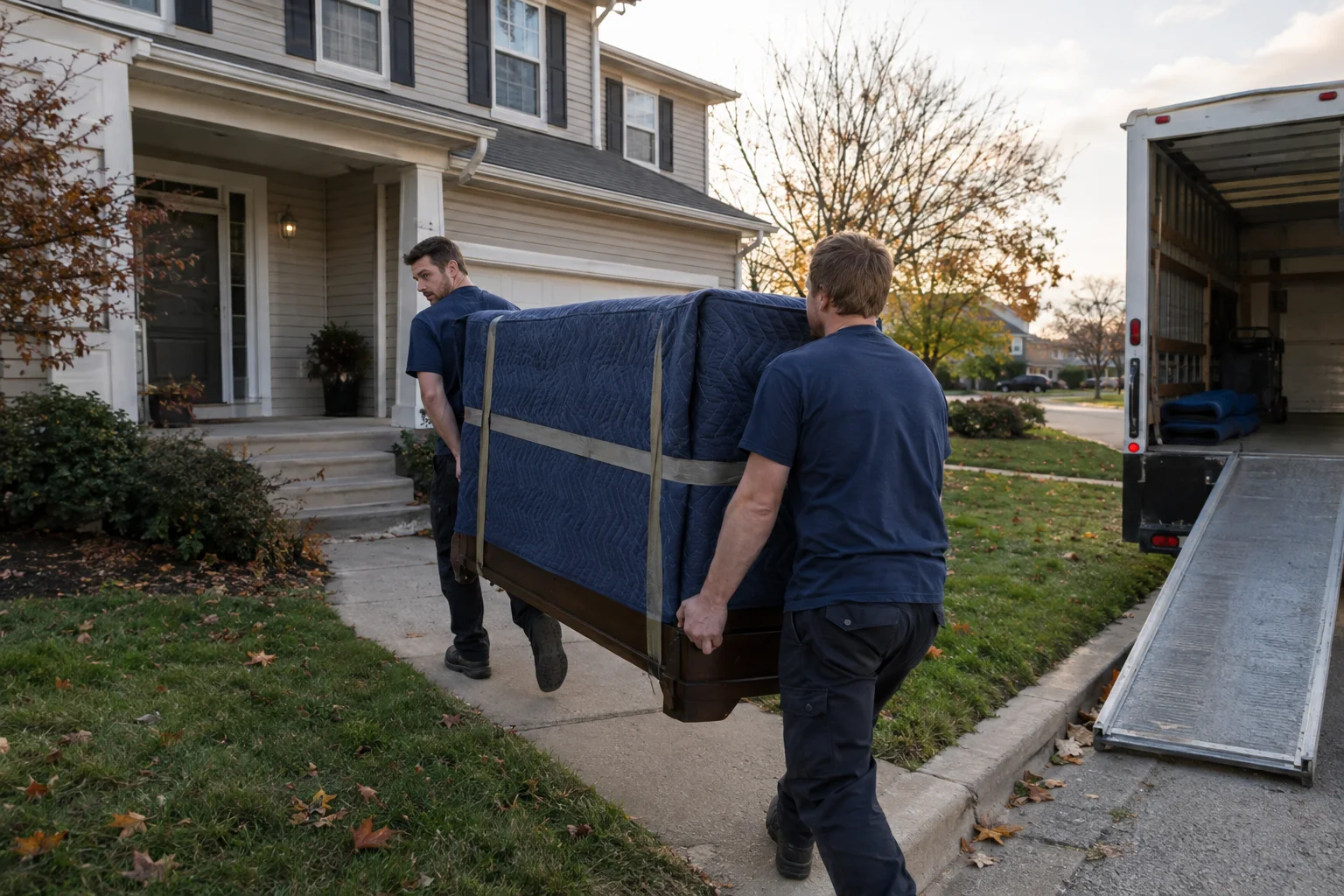
Local movers pack, load, drive and unload a household within the region, usually in a single day. In Illinois, moves under 50 miles, or entirely inside Cook, DuPage, Kane, Kendall, Lake, McHenry and Will counties, may be billed by crew size and hours, according to the Illinois Commerce Commission. Amenity Moving & Storage starts with a free in-home visual estimate and puts only your household on the truck.
Get your free moving quote
Tell us where and when. Amenity’s Plainfield office replies directly.
On this page
What a local move with Amenity includes
Every local move booked here is performed by Amenity Moving & Storage Inc., a household goods mover licensed by the Illinois Commerce Commission as ILCC 73744 MC-C. Three brothers founded the company in 1986, ran it from a small Naperville warehouse starting in 1987, and moved it to 10028 Mandel St in Plainfield in 1992. Local Moving Specialists is Amenity’s own brand, not a broker, so the people who estimate your move are the people who carry it out.
Here is what that means for a household move:
- A free, no-obligation in-home estimate. An estimator walks the house with you and sizes the job by sight instead of from a phone inventory.
- A truck sized to your home. Amenity runs multiple truck sizes and can bring a full semi trailer when a large house would otherwise take several trips.
- One customer per truck. On local moves your belongings ride alone. They are never mixed with another household’s load.
- Packing at the level you choose. Full or partial packing, crews who bring the right materials in the right quantities, help with last-minute packing when time runs short (subject to availability), and pickup of emptied containers after the move (some limitations apply). The packing and unpacking page has the detail.
- An inventory if you want one. Ask for Amenity’s inventory forms when you’d like an item-by-item record of a local move.
- Winter protection. Floor runners go down in cold-weather months, and when the forecast turns, Amenity can change your date if its calendar allows.
- Storage when dates don’t line up. A 12,000 sq ft Plainfield warehouse holds goods from one day to several years; see moving and storage.
- Heavy and specialty pieces. Pianos, gun safes, hot tubs and spas are handled by the same company, as are senior moves and downsizing.
One customer per truck matters more than it sounds. When a truck carries a single household, nothing has to be dropped at another address first, your cartons never sit beside a stranger’s, and the crew’s whole day belongs to your move. Paired with a truck sized to the house, it also keeps round trips down, which counts when a local move is billed by time.
Amenity lists memberships in the American Moving & Storage Association (ProMover), the Illinois Movers and Warehousemen’s Association and the Plainfield Chamber of Commerce, and it has been BBB accredited since August 25, 2017. Amenity describes itself as fully bonded, licensed and insured; if your HOA or building needs paperwork, raise it at the estimate.

How local moves are priced in Illinois
Most local moves in this area are priced by the size of the crew and the hours the job takes, not by weight. The Illinois Commerce Commission’s consumer guide, Household Moves in Illinois, says moves under 50 miles, or moves entirely within Cook, DuPage, Kane, Kendall, Lake, McHenry and Will counties, may be charged by the number of workers and the hours spent loading, driving and unloading. Longer moves outside those counties are charged by shipment weight and distance.
| Your move | How charges are calculated | What to watch |
|---|---|---|
| Under 50 miles, or entirely inside Cook, DuPage, Kane, Kendall, Lake, McHenry or Will counties | Number of workers and hours for loading, transit and unloading | The lowest hourly rate isn’t always the lowest bill; crew size and pace decide the total |
| Over 50 miles and outside those seven counties | Total shipment weight and the distance moved | You may witness the official weighing and can ask for a re-weigh |
| Begins and ends in the same town plus 10 miles beyond its limits, outside Cook County | The ICC does not regulate the rate charged | The mover must still hold an ICC household goods license |
Every licensed mover files its rates with the ICC in a document called a tariff, and the Commission says a licensed mover must give you a free written estimate. That estimate is not a bid. Your final bill follows the tariff and the work actually performed, which is why the guide tells you to show the estimator everything, basement, attic and garage included, and to mention stairs or elevators at the new place.
The hours on a local job depend on details you can see in advance: how much is packed before the crew arrives, how far the truck can park from the door, stairs and elevators at both ends, furniture that has to come apart, and the drive between addresses. An in-home estimate turns those details into a crew size, a truck size and a time range. For a fuller breakdown, read how moving costs are calculated in Illinois. This site doesn’t publish prices, because two houses on the same street can take very different days.
Delivery-day payment has a built-in cushion. The ICC guide says that unless other arrangements were confirmed in writing, you can be asked to pay up to 110 percent of the written estimate. If the charges run higher, the mover must unload and release your goods once you pay that amount and give you 30 days to pay the balance. Keep your copy of the estimate.
How a local move works, step by step
A local move with Amenity runs through seven steps, from the first call to the last carton.
- Request a quoteUse the quote form or call (630) 904-2300 with both addresses, the size of your home and the dates you’re considering. The ICC suggests starting your search for a mover at least six weeks before moving day.
- In-home visual estimateAn estimator walks every room, closet, basement and garage with you, notes stairs, tight turns and heavy pieces, and asks about access at the new home. The visit is free and carries no obligation.
- Written estimate and choicesYou receive a written estimate of what will be moved and the services you picked. Decide on full, partial or no packing, whether anything goes to storage, and whether you want an inventory form.
- Booking and building logisticsLock the date, then take care of the items only you can arrange: overnight or street parking permission where your village requires it, elevator reservations for a condo, and closing or lease times at both ends.
- PackingIf Amenity is packing, crews arrive with the cartons and materials the estimate called for. If you’re packing, finish everything except a last-night box and the kitchen basics.
- Moving dayThe crew protects the floors (runners go down in winter), prepares and loads the furniture, and drives your household in its own truck. Walk the empty house with the crew lead before the truck leaves so nothing stays behind in closets or the garage.
- Unloading and wrap-upYou direct each piece and carton to its room. Check items before you sign, write any damage on the paperwork, and schedule pickup of emptied containers if Amenity packed for you.
Ready for a straight answer on your move?
Book a free, no-obligation in-home estimate with Amenity’s Plainfield team.
Preparation checklist for a local move
Work through this list in the two weeks before your date. It also answers the questions people ask most about dressers, boxes and what stays off the truck.
- Book early. The ICC recommends starting your mover search at least six weeks ahead, and earlier if your date is fixed by a closing or lease.
- Show the estimator every space, including the basement, attic, garage, sheds and crawl spaces.
- Measure your largest pieces against doorways, stair turns and any elevator at the new home.
- Sell, donate or recycle what you won’t use. Anything left behind is time you don’t pay to move.
- Take fragile, heavy, valuable and liquid items out of dresser drawers, and ask at the estimate whether folded clothes can stay in.
- Box everything small and loose. Furniture, mattresses and large appliances are prepared for the truck by the crew.
- Keep jewelry, cash, important papers and medications with you; the ICC guide says never to pack them on the truck.
- Set aside flammables and chemicals such as gasoline, propane, paint and aerosols, and read what movers will not move for the full list.
- Drain fuel from lawn mowers and power tools a few days before the move.
- Request street or overnight parking permission if the truck or your cars need the curb; several villages require it (see the table below).
- Reserve the freight elevator and loading area if either home is a condo or apartment; apartment and condo moving covers building rules.
- Clear snow and ice from walks and the driveway the day before a winter move.
- Label each carton on its side with the room name, and pack one essentials box that rides with you.
- Photograph electronics connections and high-value items before they’re packed.
- Be home for the walk-through at both ends, and keep your estimate and bill of lading together.
Do dressers have to be emptied, and does everything need a box?
There isn’t one rule for dressers. Folded clothes in a solid dresser add little risk; glass, liquids, documents and heavy items in drawers add a lot, and an antique chest or a dresser with worn drawer runners is safer carried empty. Mention your heavier pieces during the estimate so the crew can plan each carry.
Anything small enough to fit in a carton should be in one. Open bins, bags and loose décor slow the loading and are the first things to go missing or break. Lamps, shades, framed pictures and electronics without their original boxes are worth handing to a packing crew even if you pack everything else yourself.
Full-service, partial packing or DIY: which fits your move
The right level of service depends on how much time you have, how much of what you own is fragile, and how much risk you’re willing to carry yourself. This table compares the four realistic choices for a household move in the suburbs.
| Full-service move | Partial packing | You pack, Amenity moves | Rental truck (DIY) | |
|---|---|---|---|---|
| Who packs | Amenity crews pack the house | Amenity packs the rooms or items you pick; you pack the rest | You pack everything | You pack everything |
| Who loads, drives and unloads | Amenity crew and truck | Amenity crew and truck | Amenity crew and truck | You, family and friends |
| Packing materials | Crews bring the right cartons and quantities | Crews bring materials for what they pack | You supply cartons and tape | You buy or rent everything |
| Damage claims on cartons | Strongest position; optional valuation coverage is available on items Amenity packs | Strong for cartons Amenity packed | Harder: the ICC says a mover may not be liable for owner-packed cartons without visible damage | No mover is liable; check your own insurance |
| Consumer protections | ICC-licensed mover, written estimate, bill of lading | Same as full-service | Same as full-service | None; you are the mover |
| Your time before the move | Least | Moderate | Most of the packing workload | All of it, plus truck pickup and return |
| Fits when | Your schedule is tight or the house is large | You’ll pack most rooms but want help with the fragile ones | You have weeks to pack and a mostly sturdy household | A small load, a short drive and able helpers |
One DIY cost people miss is on the tollways. The Illinois Tollway classifies any vehicle with two axles and six tires as a small commercial vehicle, not a passenger car, so a dual-rear-wheel rental box truck pays truck tolls, with separate daytime (6 a.m. to 10 p.m.) and overnight periods. Before deciding, our guide to rental trucks vs. hiring movers compares the full cost and the risk.
Partial packing is the option most worth a second look. Kitchens, framed art, lamps and anything without its original box take the longest to pack well and are the hardest to protect, so handing only those to a crew can take the most fragile work off your list without paying for a whole-house pack.
Local realities in the western and southwest suburbs
Village parking rules, snow, tollway truck rules and highway construction shape a local moving day more than distance does. These are the ones that come up most around Amenity’s Plainfield base, each checked with the municipality or agency that sets it.
| Where | Rule | What it means on moving day | Source |
|---|---|---|---|
| Naperville | City code 11-2A-8 bans parking on city streets from 2 to 5 a.m.; temporary permission is limited to three requests per vehicle per month | If cars must sit on the street overnight before the move, ask Naperville police for permission in advance | City of Naperville |
| Downers Grove | Overnight parking on village streets is prohibited from 2 to 6 a.m.; residents can request temporary permission online | Plan where helpers’ cars or a loaded vehicle will sit the night before | Village of Downers Grove |
| Aurora | Parking is prohibited on any city street after 2 inches of snowfall until plows clear to the curb; violators may be ticketed or towed | On a snowy moving day, the truck and cars need driveway or off-street space | City of Aurora |
| Plainfield | Residents who want to park on village streets overnight must submit a request form (1 to 3 nights, or 4 or more) | File the request early if driveways will be full during closing week | Village of Plainfield |
| Chicago | Curb space for a moving van is reserved through CDOT’s Occupy Right-of-Way permit for moving van parking | Moving from a city apartment to the suburbs? Arrange the permit for the pickup block | Chicago Department of Transportation |
Highways set the drive between addresses. According to the Illinois Tollway’s 2026 budget, the Reagan Memorial Tollway (I-88) runs 96.5 miles west from near the junction of I-294 and the Eisenhower Expressway, and the Veterans Memorial Tollway (I-355) runs 30 miles alongside Illinois Route 53 through DuPage and Will counties, from I-290 in Addison to I-80 near Joliet. A moving truck with six or more tires is tolled in a commercial tier on either road, not at the passenger-car rate.
On the south side of the area, IDOT is rebuilding about 16 miles of I-80 from Ridge Road in Minooka to U.S. 30 in New Lenox, including some 30 bridges, and its I-80 project site expects substantial completion in 2028. Lane patterns through Joliet shift as stages finish, so check current conditions in the days before a move on that corridor.
Winter is the other local variable. An ice storm can make a moving day unsafe, so watch the forecast with your mover; Amenity can change dates when the weather turns, subject to its calendar. On the day itself, runners keep slush off your floors, and a shoveled, salted path from the door to the truck saves time on every trip.

Where Amenity's local crews work
Amenity’s crews move households across DuPage, Will, Kane, Kendall and Grundy counties and into Cook County, and the communities it names most often are Aurora, Plainfield, Naperville and Joliet.
The Mandel Street warehouse sits on Plainfield’s north side, near the Naperville line. Plainfield residents asking to park on village streets overnight file a request with the police department first. Naperville households plan around the city’s 2-to-5 a.m. street parking ban, and Aurora moves in winter have to work around the 2-inch snow parking rule.
To the south, Joliet moves cross or run near the I-80 rebuild. Oswego sits in Kendall County, which is still on the ICC’s list of counties where local moves may be billed by the hour. To the northeast, Downers Grove bans overnight street parking from 2 to 6 a.m., one hour later than Naperville’s cutoff. Each town page covers that community’s own parking, permit and housing details.
Questions to ask before you hire any local mover
The quickest way to tell a professional mover from a risky one is to ask a handful of direct questions and listen for specific answers. These draw on the ICC’s smart tips for hiring a mover and the FMCSA’s red-flag list.
- What is your ICC license number? Any in-state household mover needs one. Check it on the ICC’s licensed mover search; Amenity’s is ILCC 73744 MC-C.
- Will you see the house before quoting? The ICC advises asking the mover to visit and see every room, and the FMCSA lists estimates given sight unseen by phone or online as a red flag.
- Is the estimate in writing, and what happens if the bill runs over? Listen for the 110 percent protection described above.
- Will my things share the truck? Ask whether your goods travel alone or alongside another household’s load.
- What liability applies, and what are my options? The ICC guide says movers’ rates are based on 60 cents per pound per article unless you pay for higher valuation. Get your choice in writing.
- How will you handle stairs, elevators and parking at both addresses? A specific answer shows the estimator actually looked.
- What deposit do you require, and how do you take payment? The FMCSA flags movers who demand cash or a large deposit before the move.
Red flags are the mirror image of those answers. The FMCSA warns about a company that answers the phone “movers” instead of its name, won’t put the estimate in writing, asks you to sign blank documents or arrives in a rental truck, and the ICC adds a company that advertises only a phone number. Our guide to moving scam red flags walks through each warning sign with its official source.
Tipping is a separate matter, and the ICC is clear that it is not required. If a crew demands a tip, the Commission says to call the company right away. If you do want to thank a crew, our guide on how much to tip movers covers how people usually decide.
Where we provide local moving
Related moving services
Frequently asked questions
How far in advance should I book local movers?
The Illinois Commerce Commission recommends starting your search at least six weeks before the move. That leaves time for an in-home estimate, a written quote and any parking or elevator reservations. If your date is fixed by a closing or lease end, or you need packing and storage scheduled as well, call earlier so the estimate and the booking aren’t squeezed into the final week.
Do I need to empty my dressers before the movers come?
Not always. Folded clothes in a sturdy dresser are often fine to leave, but take out anything breakable, liquid, valuable or heavy, and empty antiques or pieces with loose drawers completely. Ask during the in-home estimate how your specific furniture should be prepared, so nothing has to be unloaded on the driveway on moving day.
Does everything need to be in boxes for movers?
Everything small and loose should be boxed and taped shut; open bins, bags and loose décor slow the crew and break easily. Furniture, mattresses and appliances don’t go in your boxes; the crew prepares them for the truck. If you’re short on time, partial packing lets Amenity take just the kitchen or the fragile rooms.
What will movers not take?
Expect a mover to refuse flammables and hazardous materials such as gasoline, propane, paint and household chemicals. The ICC also tells you never to pack jewelry, cash, important papers or medicines on the truck; keep them with you. Perishable food and houseplants are usually better moved in your own car. Ask about anything you’re unsure of at the estimate.
Is it rude not to tip movers?
No. The Illinois Commerce Commission states that tipping is not required, and a tip should never be a condition of unloading. Some people offer drinks or a tip as thanks for careful work, but it’s your choice. If a crew demands a tip, the ICC says to call the moving company immediately.
Is it less expensive to move on certain days?
On an hourly local move, cost follows the crew size and the hours worked, so preparation and access matter more than the day of the week. A packed, labeled house with clear parking moves faster on any day. Flexible dates do make it easier to fit into the calendar, and the estimator can tell you which dates are open.
How long does a local move take?
It depends on the size of the home, how much is packed beforehand, stairs and elevators at both ends, and the drive between addresses. The in-home estimate turns those details into a time range for your move. Some households have packing done the day before so loading day runs faster.
What if something is damaged during a local move?
Note the damage on the inventory or bill of lading before you sign, on both copies. The ICC guide says claims on Illinois moves must be filed in writing within 90 days of delivery, and movers must acknowledge them within 30 days and act within 120. Liability defaults to 60 cents per pound per article unless you paid for more; Amenity offers optional valuation coverage on items it packs.
Sources
- Household Moves in Illinois: A Consumer's Guide — Illinois Commerce Commission
- ICC Smart Tips for Hiring a Household Goods Mover — Illinois Commerce Commission
- Spot the Red Flags — Federal Motor Carrier Safety Administration
- Traffic Concerns & Parking Enforcement — City of Naperville
- Tolling Information Overview — Illinois Tollway
- I-80 Will County Project — Illinois Department of Transportation
Who handles your move
Local Moving Specialists is operated by Amenity Moving & Storage Inc., 10028 Mandel St, Plainfield, IL 60585 — a family-run Illinois mover since 1986. Illinois household goods license ILCC 73744 MC-C. Interstate moves are transported under the authority of Wheaton Van Lines, Inc. (USDOT 70719, MC-87113), for which Amenity is an authorized agent. See licenses & disclosures.
Last reviewed November 11, 2026 against Amenity Moving & Storage’s published service details and the public sources listed above.
Ready for a straight answer on your move?
Book a free, no-obligation in-home estimate with Amenity’s Plainfield team.