Senior Moving Services for Downsizing and Senior Living Moves
Packing, careful moving and climate-controlled storage for older adults and their families, from a licensed Plainfield mover serving the suburbs since 1986.
- ILCC 73744 MC-C
- Free in-home estimates
- Climate-controlled storage
- One customer per truck
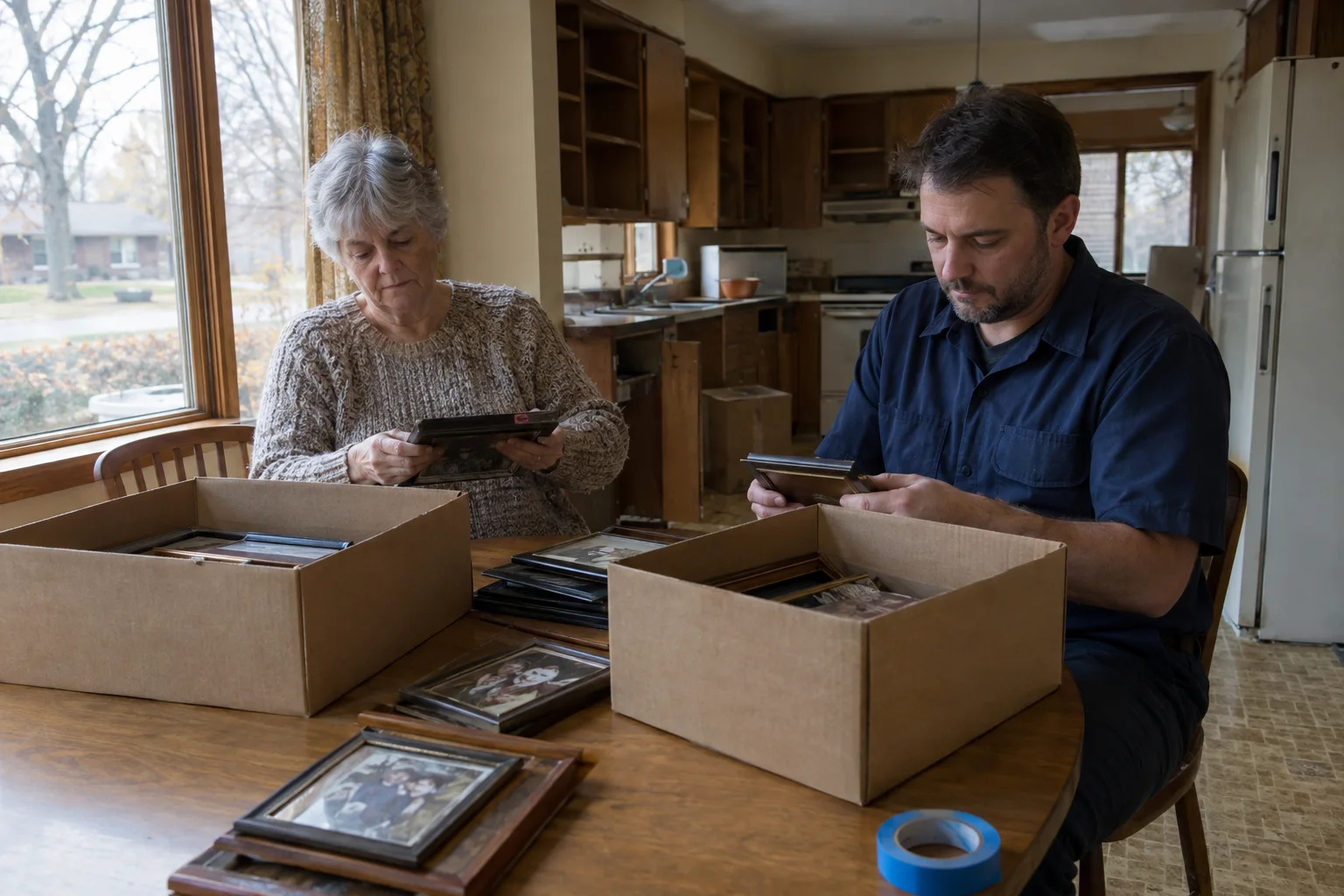
What do senior moving services include, and who handles what?
Senior moving services cover the physical move of an older adult’s household: packing, protecting and transporting furniture, setting it up in a smaller house, condo or senior living apartment, and storing what doesn’t fit yet. Amenity Moving & Storage handles the moving, packing and warehouse storage. Sorting decisions, estate sales and overall move coordination belong to the family or to a senior move manager.
Get your free moving quote
Tell us where and when. Amenity’s Plainfield office replies directly.
On this page
What senior moving services cover, and where a move manager fits
Senior moving services are the packing, loading, transport, unloading and storage that get an older adult from one home to the next. What sets these moves apart is the context: fewer square feet at the destination, an owner who may have lived in the same house for decades, and a family that is often coordinating from several towns or states at once.
Amenity Moving & Storage, the licensed Plainfield mover that operates this site, handles the physical side of the move. Its crews can pack the whole house or only the slow rooms through full or partial packing, move everything on a truck that carries only your household’s goods on local moves, and hold what isn’t needed yet in Amenity’s own warehouse.
Other tasks often get bundled under the same label. The National Association of Senior & Specialty Move Managers lists what its members typically help with: an overall move or age-in-place plan, organizing and sorting, customized floor plans, disposing of unwanted items through auction, estate sale, consignment or donation, and scheduling and overseeing movers (NASMM FAQs). Amenity works as the mover, not as a senior move manager. Many families handle the planning themselves; others hire a move manager who then works alongside the moving crew.
| Task | Usually handled by | What to know |
|---|---|---|
| Deciding what to keep, give to family, donate or sell | The older adult and family, or a senior move manager | Decisions take longer than packing; start them first |
| Estate sale, consignment or donation pickup | Family or a senior move manager | Schedule these so leftover items are gone before the house closes |
| Floor plan for the new home | Family or a senior move manager | Measure rooms and doorways so furniture can be placed to the plan on arrival |
| Packing, wrapping and labeling | Amenity (full or partial packing) or the family | Professional packing can be limited to the kitchen, china or fragile pieces |
| Loading, transport and placing furniture | Amenity | One customer per truck on local moves |
| Holding items until the next home is ready | Amenity’s warehouse storage | From one day to several years, with an itemized inventory list |
| Move-in time slot, keys and community paperwork | Family, working with the community’s staff | Ask for the community’s move-in rules in writing |
Start with the new floor plan, then sort
The quickest way to downsize is to decide what fits before deciding what goes. Get the dimensions of the new rooms, or a floor plan from the community or the seller, and measure the furniture your parent uses every day: the bed, the favorite chair, a dresser, a small dining table. Once those pieces are drawn in, the question for everything else gets simpler. Is there a place for it?
- Each room in the new home, wall to wall, with window, radiator and closet positions marked
- Doorways, hallways and elevator doors at the new building
- The bed, nightstands, dresser, recliner and dining table that are definitely coming
- Wall space for artwork and family photographs
- Closet rod length in feet, to judge how much hanging clothing will fit
Sort by category rather than by room when energy is limited. One afternoon for photographs and papers, another for clothing, another for the kitchen. Five piles cover almost everything: moving with your parent, going to a family member, being sold, being donated and being thrown out. Colored tape or stickers keep the piles straight once boxes start filling. Our downsizing checklist for seniors spreads this work across a week-by-week schedule.
Keep the older adult in charge of the decisions that matter to them. Choosing which dishes, which books and which paintings come along gives back some control over a change that may not have been entirely their idea. Items promised to relatives should be claimed and picked up early, so nobody’s keepsake ends up in a donation box by accident.
How families coordinate a parent's move
Senior moves go more smoothly when one family member is the single point of contact for the mover, the community and any other vendors. Siblings can split the work, but the estimator, the crew lead and the building manager should each hear one name and one phone number.
- Pick the coordinatorChoose the person who can be present for the estimate and on moving day, usually whoever lives closest. Give that person’s contact information to the community and to Amenity’s office.
- Hold the estimate with the decision-maker in the roomAmenity’s estimates are free, no-obligation and done in the home. Walk every room, the basement and the garage with the estimator, and point out what stays, what goes to family and what goes to storage. Our guide to the in-home moving estimate explains what gets measured and why.
- Write down the destination planGive the crew a labeled floor plan showing which room each piece goes in and where the bed should sit. Tape a copy inside the front door of the new home.
- Divide the paperworkDecide who signs the estimate and the bill of lading, who pays, who handles the community’s forms and who keeps the inventory. Write it down so nothing gets signed twice or not at all.
- Plan the day around your parentMany families arrange for the older adult to spend loading day with a relative or friend, then arrive once the bed is made and familiar things are in place.
For families spread across the country, the move is sometimes toward the children rather than within the suburbs. Amenity is an authorized agent of Wheaton World Wide Moving and notes that the affiliation connects customers to more than 300 Wheaton agents across the U.S.; long-distance moving explains how an interstate move is inventoried and tracked.
Ready for a straight answer on your move?
Book a free, no-obligation in-home estimate with Amenity’s Plainfield team.
Moving into senior living: questions to ask the community
Independent living, assisted living and memory care communities usually have written move-in procedures, and the details differ from one building to the next. The requirements below are common ones, not universal ones. Ask the community’s move-in coordinator or executive director for their rules in writing before you settle on a date.
| Common requirement | What to ask the community |
|---|---|
| Move-in days and hours | Which days and times are moves allowed, and is there an afternoon cutoff? |
| Elevator reservation | Does the elevator need to be reserved and padded? Who provides the pads or the key? |
| Certificate of insurance | Do movers need to provide a certificate of insurance? Exactly whose name and address go on it, and how far ahead is it due? |
| Loading area | Where can a moving truck park, and how far is it from that spot to the apartment door? |
| Furniture and appliance limits | Are there limits on furniture, rugs, small appliances or electrical items in residents’ apartments? |
| Apartment readiness | When will painting, flooring and repairs be finished, and when are keys released? |
| Help after move-in | Will maintenance hang pictures, mount a TV or install grab bars, or should the family arrange it? |
Pass the answers to Amenity’s office when you request an estimate, along with the community’s address and the apartment’s floor. Elevator time, long interior hallways and a short move-in window all change how the day is staffed and scheduled. If the community has a move-in packet, forward the whole thing.
Expect the apartment to be smaller than the floor plan suggests once a bed, a chair and a dresser are in place. A labeled sketch that shows exactly where each piece goes lets the crew set the room up in one pass instead of moving furniture twice.
What Amenity handles on a senior move
Amenity’s part is the moving, packing and storage, done by its own crews out of the Plainfield warehouse it has operated since 1992. The company was established in 1986 by three brothers, holds Illinois household goods license ILCC 73744 MC-C, and describes itself as fully bonded, licensed and insured.
- Free in-home visual estimate. An estimator walks the home with you, sees what is moving and what is staying, and prices the move from what is actually there.
- One household per truck. On local moves Amenity puts one customer’s belongings on a truck, so a parent’s furniture is never mixed with another family’s load. Multiple truck sizes keep trips to a minimum.
- Full or partial packing. Crews can pack the entire house or just the kitchen, china cabinet and fragile pieces, and they bring the right materials in the right quantities. Last-minute packing help is available when time runs short, subject to availability.
- Empty boxes collected. Amenity collects emptied containers after the move, with some limitations, which helps in a small apartment with no room for flattened cartons.
- Inventory on request. Inventory forms are available on request, and anything stored with Amenity gets a formal inventory.
- Winter precautions. Floor runners go down in winter, and Amenity can change dates when weather turns, subject to availability.
- References. References for storage, packing and specialty work are available on request.
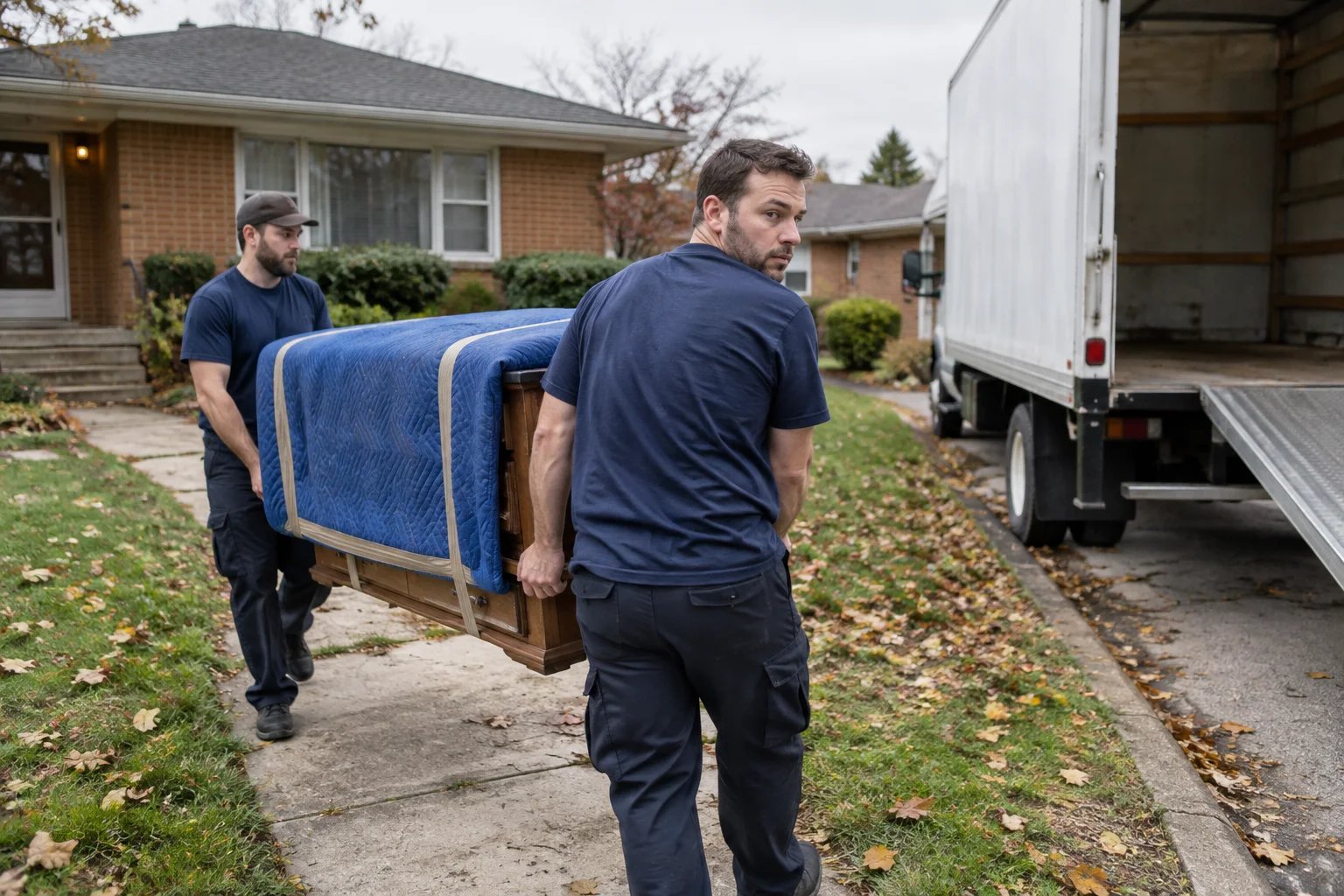
Heavy heirlooms come up often in senior moves, either because they are going to a grandchild or because they no longer fit. Amenity also moves pianos and gun safes, and a safe can go into storage if the family hasn’t decided where it belongs.
Storage as a bridge between two homes
Storage solves the timing problems that come up constantly in senior moves: the house sells before the apartment is ready, the community has a waiting list, or a relative will take the dining set but not until spring. Amenity stores household goods in a 12,000-square-foot warehouse in Plainfield for anywhere from one day to several years, and it can pick up from the house or accept a drop-off.
It is not drive-up self-storage. Furniture is wrapped in pads and cardboard, then packed and sealed in large wooden crates measuring 8′ x 7.5′ x 5′, and sofas go on sofa racks. Every item is entered in an inventory database, and the customer receives a detailed list. Only Amenity personnel access the warehouse, which has a well-lit yard, an alarm system and an outdoor security camera, and the storage space is climate-controlled.
That arrangement suits families who can’t visit a storage unit every weekend, and it keeps an out-of-state sibling from having to carry a key. The trade-off is access: there is no unit to walk into, so items come back on a scheduled delivery. Moving and storage covers how pickup, crating and redelivery work.
Some families also use storage before the house is listed, moving extra furniture out while the owner still lives there. The stored pieces can then go to the new home, to relatives or to an estate sale company later, without a second scramble at closing.
Suburbs where senior moves are common
Several suburbs in Amenity’s service area have a much older population than the region’s newer subdivisions. U.S. Census Bureau estimates for 2020 to 2024 show that more than a third of residents are 65 or older in Burr Ridge (36.1%) and Oak Brook (34.1%), compared with 9.9% in Plainfield, where Amenity’s warehouse sits.
| Town | Residents 65 and older | Median age |
|---|---|---|
| Burr Ridge | 36.1% | 56.9 |
| Oak Brook | 34.1% | 55.2 |
| Willowbrook | 26.6% | 45.0 |
| Orland Park | 24.8% | 46.3 |
| Sugar Grove | 24.7% | 45.4 |
| Darien | 24.3% | 44.4 |
| Shorewood | 22.4% | 44.2 |
| Westmont | 22.3% | 43.2 |
| Winfield | 21.9% | 44.0 |
| Tinley Park | 21.5% | 43.2 |
| Downers Grove | 21.0% | 43.6 |
Those numbers show up as specific kinds of moves. In Oak Brook, 20.8% of householders moved into their current home in 1989 or earlier, which usually means basements, garages and closets that have been filling for more than 35 years. In Darien the figure is 17.2%, and in Downers Grove it is 14.3%, so many moves there involve a parent leaving the house the children grew up in.
Other towns point toward condo and townhome moves. In Willowbrook, 21.4% of housing units are in buildings with 20 or more units, so many senior moves there are condo to condo or condo to community, with elevators and building rules to plan around. In Orland Park and Tinley Park, attached single-family homes make up 21.1% and 22.2% of housing units, a common step down from a larger detached house. Each situation is priced differently, which is why the estimate happens in the home.
Moving day for an older adult
A well-run senior moving day protects the person’s routine as carefully as the furniture. Plan it so medications, meals and rest happen on schedule, and so the first night in the new home already looks familiar.
Pack a day bag the movers never touch
- Medications for at least a week, with the pharmacy’s phone number and a current medication list
- Glasses, hearing aids, dentures, chargers and spare batteries
- Phone, address book and the names and numbers of doctors
- Identification, insurance cards, checkbook and closing or lease papers
- Jewelry and other small valuables
- A change of clothes, toiletries and a favorite pillow or blanket
Set up the bedroom first at the destination: bed assembled and made, lamps plugged in, a clear path to the bathroom. Then the bathroom, then the chair your parent sits in every evening, with the TV or radio in reach. Family photos on the wall before the first night matter more than a perfectly organized kitchen.
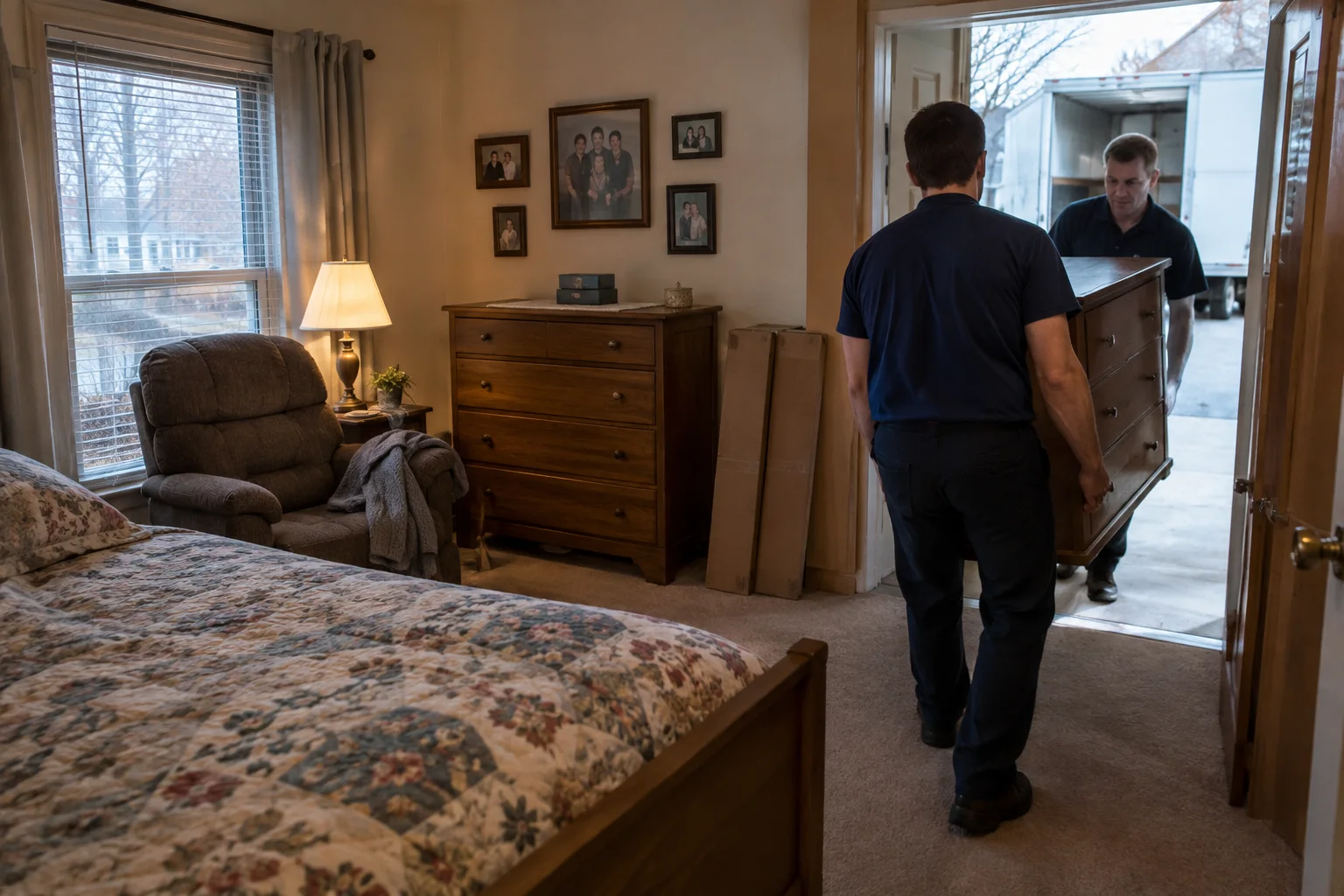
Winter adds risk on both ends, from an icy driveway in Lemont or Geneva to a long walk from a community’s loading area. Amenity lays floor runners in winter and can move the date if weather turns, subject to availability. If the community allows it, schedule the older adult’s arrival for late in the day, after the crew has finished and the paths are clear.
Free help for older adults and caregivers in Illinois
Public agencies can help with the parts of a senior move that have nothing to do with furniture, such as in-home services, benefits, housing questions and caregiver support. These are free places to start.
- Illinois Department on Aging Senior HelpLine: 1-800-252-8966 (711 for TRS), Monday to Friday, 8:30 a.m. to 5:00 p.m. It connects people 60 and older and their caregivers with community services and local care coordination (Senior HelpLine).
- AgeGuide: the Area Agency on Aging for Northeastern Illinois, based in Lombard, serving DuPage, Grundy, Kane, Kendall and Will counties among others; 1-800-528-2000.
- AgeOptions: the Area Agency on Aging for suburban Cook County, based in Oak Park; 1-800-699-9043 (suburban Cook only).
- City of Chicago: the Department of Family and Support Services runs the Area Agency on Aging for Chicago residents; 312-746-5682.
- Eldercare Locator: 1-800-677-1116, a public service of the federal Administration for Community Living that connects callers with local services anywhere in the country, which helps when a parent is moving out of state (eldercare.acl.gov).
- NASMM directory: searchable by ZIP code at nasmm.org. Only NASMM members may use the Senior Move Manager title; NASMM says its members complete required safety and ethics courses and are screened for insurance, and it advises confirming coverage before hiring.
Whoever you hire, check the license. Moves that start and end in Illinois are regulated by the Illinois Commerce Commission, and our guide on how to check a moving company’s license shows where to look up an ILCC number before anyone signs.
Where we provide senior moving & downsizing
- Orland Park
- Downers Grove
- Tinley Park
- Oak Brook
- Oak Lawn
- St. Charles
- Geneva
- Lemont
- Shorewood
- Sugar Grove
- Darien
- Westmont
- Burr Ridge
- Carol Stream
- Willowbrook
- Winfield
- Crest Hill
Related moving services
Frequently asked questions
What is the difference between a senior move manager and a mover?
A senior move manager plans and organizes: sorting, floor plans, estate sales or donations, and scheduling vendors. A mover packs, loads, transports and places furniture. NASMM notes that some move managers are also movers, while others work closely with a local moving company. Amenity is a licensed mover that offers packing and storage, not a senior move manager, and it can work alongside one your family hires.
How far ahead should we book a move into assisted living?
Call as soon as the community gives you a move-in date or window. Senior living moves often have a fixed time slot and an elevator reservation, so the date matters more than on a typical house move. Booking early also leaves time for the in-home estimate, for sorting, and for any storage pickup before the house closes or the lease ends.
Can you store my parent's furniture while the house is on the market?
Yes. Amenity stores household goods in its 12,000-square-foot Plainfield warehouse for anywhere from one day to several years. Furniture is padded, sealed in wooden crates, logged in an inventory database and kept in climate-controlled space that only Amenity staff can enter. It is not self-storage, so you won’t have a key; items are delivered when the new home is ready.
Do I need to be there if I live out of state?
Someone who knows the plan should walk through the home with the estimator and be reachable on moving day. That can be a sibling, a friend or a move manager you’ve hired. Send the floor plan, the list of items going to relatives and the community’s move-in rules ahead of time, and ask the crew lead to call when loading starts and when the last piece is placed.
What should my parent keep out of the moving boxes?
Medications, glasses, hearing aids, identification, checkbooks, closing or lease documents, jewelry and other small valuables should travel with the family, not the truck. Hazardous items such as old paint, gasoline and propane can’t be packed at all. On an interstate move, federal rules let a mover limit liability for articles worth more than 100 dollars per pound unless you list them in writing.
What does a senior living community usually require from movers?
Common requirements include a reserved move-in day and time window, an elevator reservation with pads, a certificate of insurance naming the community, and a designated loading area. Some communities also limit furniture, rugs or appliances in apartments. Requirements vary, so ask the community for its written move-in rules and share them with the mover when you book.
How much do senior moving services cost?
The price depends on how much is moving, how far, how much packing you want, stairs and elevator access at both ends, and whether anything goes into storage. Amenity doesn’t quote from a room count; an estimator visits the home for a free, no-obligation estimate. Our guide to how moving costs are calculated in Illinois explains each factor.
Are there free resources to help plan an older adult's move?
Yes. The Illinois Department on Aging Senior HelpLine (1-800-252-8966) connects older adults and caregivers with local services. AgeGuide serves DuPage, Kane, Kendall, Will and Grundy counties, and AgeOptions serves suburban Cook County. The federal Eldercare Locator (1-800-677-1116) finds help in any state, and NASMM’s online directory lists senior move managers by ZIP code.
Sources
- FAQs – NASMM — National Association of Senior & Specialty Move Managers
- Find a Move Manager – NASMM — National Association of Senior & Specialty Move Managers
- Senior HelpLine — Illinois Department on Aging
- Illinois Area Agencies on Aging — Illinois Department on Aging
- Eldercare Locator — Administration for Community Living, U.S. Department of Health and Human Services
- DP05 ACS Demographic and Housing Estimates, 2020–2024 5-Year — U.S. Census Bureau
Who handles your move
Local Moving Specialists is operated by Amenity Moving & Storage Inc., 10028 Mandel St, Plainfield, IL 60585 — a family-run Illinois mover since 1986. Illinois household goods license ILCC 73744 MC-C. Interstate moves are transported under the authority of Wheaton Van Lines, Inc. (USDOT 70719, MC-87113), for which Amenity is an authorized agent. See licenses & disclosures.
Last reviewed November 11, 2026 against Amenity Moving & Storage’s published service details and the public sources listed above.
Ready for a straight answer on your move?
Book a free, no-obligation in-home estimate with Amenity’s Plainfield team.