What Happens During an In-Home Moving Estimate
An estimator walks every room, closet and outbuilding, then turns what they see into a crew, a truck and a written estimate. Here is how to make that visit count.
- ILCC 73744 MC-C
- Free, no-obligation estimates
- Written Illinois estimate form
- Wheaton World Wide agent

What happens during an in-home moving estimate?
An estimator walks every room, closet, attic, basement, garage and shed, notes furniture, box count, specialty items and access at both homes, then writes up the crew, truck and estimated hours or weight. In Illinois the estimate must be on an Estimate of Charges form and may rest on an in-person or virtual inspection. Amenity’s in-home visual estimates are free and carry no obligation.
Get your free moving quote
Tell us where and when. Amenity’s Plainfield office replies directly.
On this page
What the estimator is actually measuring
An in-home estimate measures three things: how much is moving, how hard it is to get out of one home and into the other, and what services you want on top of transport. Everything on the written estimate, from crew size to the number of hours, comes from those three answers.
- Volume and weight. The estimator counts furniture room by room, estimates how many boxes your belongings will fill and flags items that are unusually heavy or bulky.
- Access. Stairs, elevators, long carries, narrow doorways, where the truck can park and how far it is from the door. They will ask the same questions about the new home.
- Services. Whether you want full or partial packing, storage, help with specialty pieces or extra stops.
- Timing. Your dates, any building move windows and whether closings line up or a storage bridge is needed.
Regulators push movers to see the goods for a reason. The Illinois Commerce Commission’s consumer guide tells you to make sure the estimator sees everything you want moved, including the basement, attic and garage, and understands special problems at the destination such as elevators and stairs. Anything they do not see cannot be in the estimate.
What the estimator writes down also depends on how the move will be priced. The ICC’s guide explains that moves under 50 miles, or entirely within Cook, DuPage, Kane, Kendall, Lake, McHenry and Will counties, may be charged by workers and hours, while longer moves outside those counties are charged by shipment weight and distance. For an hourly move, the estimator is really estimating time; for a weight-based move, they are estimating pounds.
Room by room: what to show the estimator
Show the estimator every space that holds something you plan to move, especially the ones you rarely open. The ICC’s Smart Tips for hiring a mover put it simply: show the contents of every room, closet and garage, and talk about what the crew can expect at the new home.
- Every bedroom closet, linen closet and the space under beds
- The attic, including anything stored over the garage
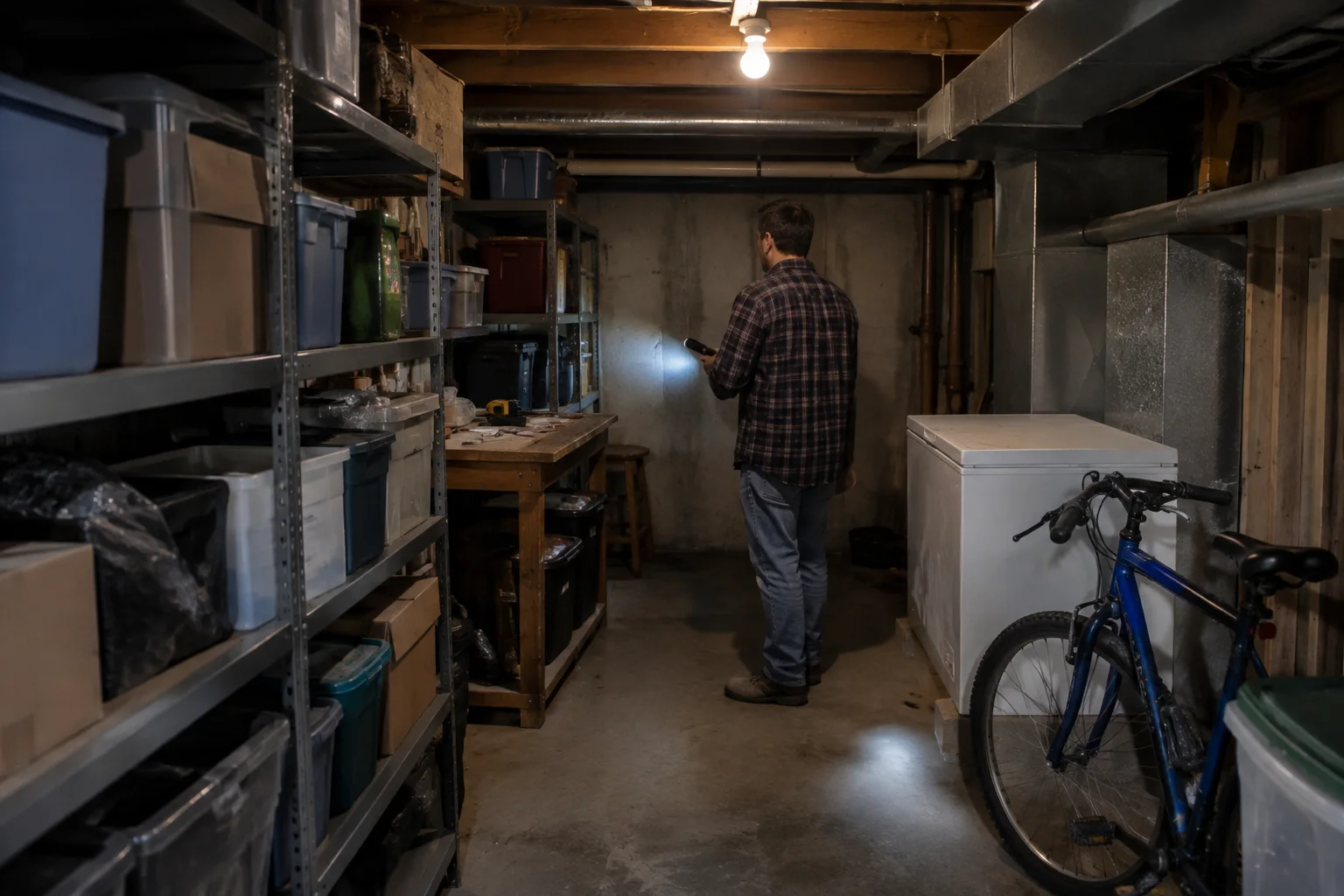
- The basement, including storage shelving and a workshop
- The garage: tools, bikes, shelving, a second refrigerator or freezer
- Sheds and outbuildings: mowers, snow blowers, ladders, yard tools
- Outdoor items: patio sets, grills, planters, play equipment, a hot tub
- Anything stored off-site, such as a self-storage unit or items at a relative’s house
- Heavy or valuable pieces: a piano, a gun safe, artwork, antiques
Be clear about what is not going. Point out furniture you are selling, donating or leaving for the buyer, and mark it if you can. An estimate built around your real list is far more accurate than one that assumes everything goes and then gets adjusted on moving day.
Describe the new home too
The estimator cannot walk a home you have not moved into yet, so bring the details to them. Tell them which floor the unit is on, whether there is an elevator and whether it must be reserved, how close the truck can park, and whether a homeowners association or building sets move hours. Measure tight doorways and stairways if you are worried about a sofa or a bed frame, and mention any spot where a piece must go up or down a turned staircase.
Questions to ask before the estimator leaves
The visit is the easiest time to pin down how you will be charged. These questions cover what most often causes surprises later.
- What is your Illinois Commerce Commission license number, and for a move out of state, which carrier’s federal authority will haul my goods? (Our guide to checking a mover’s license shows where to look these up.)
- Will this move be charged by the hour or by weight and distance?
- How many movers and what size truck are you planning, and how many hours including travel time?
- What packing materials and packing labor are included, and which are extra?
- What valuation options do I have for loss or damage, and what does each cost?
- What payment forms do you accept at delivery?
- What happens if I add items after today, or if moving day takes longer than estimated?
- How are specialty items such as a piano, safe or hot tub handled and priced?
- If I need storage, where is it, who has access and how is it inventoried?
- When will I get the written estimate, and will it come with the ICC consumer guide?
Write down the answers or ask for them in the written estimate. If an answer about valuation is unclear, our guide comparing full value protection and released value explains the trade-off; Illinois and federal guidance both describe the released-value level as 60 cents per pound per article.
Ready for a straight answer on your move?
Book a free, no-obligation in-home estimate with Amenity’s Plainfield team.
Binding and non-binding estimates: what the rules say
Whether an estimate is binding depends on whether the move crosses state lines. Interstate moves follow federal rules that recognize both binding and non-binding estimates; moves within Illinois follow state rules under which a written estimate is an estimate, not a fixed price.
| Question | Interstate move (FMCSA) | Move within Illinois (ICC) |
|---|---|---|
| Is a written estimate required? | Yes, signed and dated by you and the mover (49 CFR 375.401) | Yes, on a Commission-approved Estimate of Charges form, with a signed copy before service (92 Ill. Adm. Code 1457.610) |
| Binding option | Binding estimate: you cannot be required to pay more than the estimate at delivery for the listed goods and services; the mover may charge to prepare it | The ICC says a written estimate is not binding |
| Non-binding limit at delivery | Mover cannot require more than 110% of a non-binding estimate at delivery; the rest is billed after 30 days | If you pay 110% of the written estimate, the mover must release your goods and give you 30 days to pay the balance |
| Survey basis | Physical survey, on-site or virtual, unless you waive it in writing | In-person or virtual inspection, or your description of the goods confirmed in writing |
| Changes | Estimates can be amended by agreement only before loading | Ask for a revised written estimate before moving day |
For a move within Illinois, the practical takeaway is to get the estimate in writing and make sure it describes your move accurately. The Illinois rule lists what the form must show: the carrier’s name as licensed, its address and phone number, the pickup and delivery addresses, the number of vehicles and workers, the estimated hours for an hourly move or weight and distance for a weight-based move, any packing, materials, valuation or storage charges, the total, and a place to confirm you received the ICC’s consumer guide. Our guide to binding vs. non-binding moving estimates goes deeper on both systems.
Virtual surveys and when they make sense
Both federal and Illinois rules allow an estimate based on a virtual look at your home. Under the FMCSA’s definitions in 49 CFR 375.103, a physical survey can be done on-site or virtually, as long as the mover can see the household goods through live or pre-recorded video that lets it clearly identify what is being moved. Illinois allows an estimate based on an in-person or virtual inspection.
A video walkthrough can work well for a small apartment or when you are out of town. It is weaker when the home is large, the attic and basement are crowded, or access is tricky, because a phone camera flattens stairs and hides what is behind closet doors. The FMCSA’s booklet Your Rights and Responsibilities When You Move also advises avoiding interstate movers and brokers that refuse to perform a physical survey.
If you do a video survey, go slowly, open every closet and cabinet that holds things you are moving, and film the path from the door to the street at both homes. Say out loud what is staying behind. Amenity’s standard is a free in-home visual estimate; ask the office if a video walkthrough would suit your situation.
Getting ready for the visit
A little preparation makes the estimate faster and more accurate. You do not need to clean or pack anything; you need to know what is moving and where it is going.
- Decide on large pieces: keep, sell, donate or leave with the house
- Open up the attic, shed and any storage areas, and clear a path to look inside
- Have the new home’s floor plan or room measurements, and note stairs or elevators
- Get the building’s move rules in writing if either home is a condo or apartment
- List specialty items with approximate sizes, such as piano type or safe dimensions
- Know your target dates and how flexible they are
- Decide how much packing you want to do yourself
Plan for the estimate early. The ICC recommends starting your search for a mover at least six weeks before the move, which leaves time for an estimate visit, a written estimate and questions. Our article on how far in advance to book movers covers peak-season timing.
Reading the written estimate and spotting red flags
Read the written estimate against what you saw and said during the visit. The crew size, truck, hours and services should match the conversation, and every item you pointed out, especially specialty pieces, should be reflected.
Then check the warning signs regulators point to. The ICC’s Smart Tips warn against relying on mobile apps alone to pick and schedule movers, against companies that advertise only a phone number, and suggest asking questions up front when a mover offers ‘freebies’ such as cartons and tape. A mover that will not visit or look at video, will not put the estimate in writing, or cannot give you a license number is a reason to keep looking. More warning signs are in our moving scam red flags guide.
Check the license yourself
Intrastate movers in Illinois must be licensed by the ICC; you can check a license or complaints at icc.illinois.gov or by calling 217-782-6448. For interstate moves, look up the carrier on the FMCSA’s Protect Your Move site.

How Amenity's free in-home estimate works
Amenity Moving & Storage, which operates this site, offers free, no-obligation in-home visual estimates from its office in Plainfield, and the areas it names most often include Aurora, Naperville and Joliet. Here is what to expect when you request a quote.
- Schedule the visitCall (630) 904-2300 or send the quote form with your addresses, dates and anything unusual about the move.
- Walk the home togetherThe estimator looks at every room and storage area, asks about the new home and notes specialty items such as a piano, gun safe or hot tub.
- Talk through servicesPacking can be full or partial, with optional liability valuation coverage on items Amenity packs. Storage runs from one day to several years in a climate-controlled Plainfield warehouse.
- Truck and crew planAmenity uses multiple truck sizes to minimize trips and keeps one customer per truck on local moves. Inventory forms are available on request.
- Receive the written estimateYou get the estimate in writing to review before you decide. There is no obligation to book.
For a move out of state, Amenity is an authorized agent of Wheaton World Wide Moving, and the shipment is transported under the authority of Wheaton Van Lines, Inc. (USDOT 70719, MC-87113). On those moves, Amenity’s crew inventories items and their condition on moving day and you review and approve the list. See long-distance moving for details, or packing services if you want help boxing up the house.
Keep reading
- Downsizing Checklist for Seniors
- Office Move Checklist
- How Far in Advance to Book Movers
- How Much to Tip Movers
Browse the full moving guide library or see every moving service.
Frequently asked questions
Is an in-home moving estimate free?
It should be. The Illinois Commerce Commission’s consumer guide says any licensed professional mover must give you a free, written estimate of the probable cost of your move. Amenity’s in-home visual estimates are free and carry no obligation. For interstate moves, federal rules let a mover charge to prepare a binding estimate but not a non-binding one.
How long does an in-home moving estimate take?
It depends on the size of the home and how much is stored out of sight. A small apartment is a quick walkthrough; a house with a full basement, attic, garage and shed takes longer because the estimator needs to see inside each one. Leave time for questions at the end, since that conversation is where most surprises are prevented.
Does everything need to be in boxes for movers?
Loose small items should be boxed before loading, unless you have hired packers. Furniture, mattresses and large appliances are wrapped or padded by the crew rather than boxed. Tell the estimator how much you plan to pack yourself, because unpacked rooms change both the time and the materials on the estimate.
Can I leave clothes in my dresser drawers for movers?
Ask during the estimate, because it depends on the furniture and the mover. Light clothing in a sturdy dresser is often fine, but heavy items, breakables, liquids, cash, jewelry and documents should come out. Drawers add weight and can slide open on stairs, so a crew may tape or wrap them.
What are red flags when getting a moving estimate?
A mover that will not look at your belongings in person or by video, gives only a verbal number, cannot provide an ICC license number for a move within Illinois, or advertises only a phone number. The ICC also warns against relying on mobile apps alone to select movers and suggests asking questions up front about free cartons or tape.
Is a virtual moving estimate as accurate as an in-person one?
It can be for small, uncluttered homes where every item is visible on camera. Federal rules accept live or pre-recorded video if the mover can clearly identify the goods, and Illinois allows a virtual inspection. Larger homes, crowded storage areas and difficult access are easier to judge in person.
What if I add items after the estimate?
Tell the mover before moving day. For interstate moves, federal rules let you and the mover amend the estimate only before loading, and on a non-binding estimate the mover must reaffirm it or write a new one before loading extra items. For moves within Illinois, a revised written estimate keeps the 110% protection meaningful.
Should I get more than one moving estimate?
The ICC’s consumer guide suggests getting estimates from several qualified movers and not choosing on the lowest number alone. Compare crew size, hours, services and valuation, not just the total, and check each mover’s license and complaint history with the ICC or FMCSA.
Sources
- 49 CFR 375.401 Must I estimate charges? — Electronic Code of Federal Regulations (FMCSA rules)
- Appendix A to Part 375: Your Rights and Responsibilities When You Move — Electronic Code of Federal Regulations (FMCSA)
- Section 1457.610 Estimate of Charges, 92 Ill. Adm. Code 1457 — Illinois General Assembly (JCAR)
- Household Moves in Illinois: A Consumer's Guide (rev. 3/2026) — Illinois Commerce Commission
- ICC Smart Tips for Hiring a Household Goods Mover — Illinois Commerce Commission
- Household Goods Movers — Illinois Commerce Commission
Who handles your move
Local Moving Specialists is operated by Amenity Moving & Storage Inc., 10028 Mandel St, Plainfield, IL 60585 — a family-run Illinois mover since 1986. Illinois household goods license ILCC 73744 MC-C. Interstate moves are transported under the authority of Wheaton Van Lines, Inc. (USDOT 70719, MC-87113), for which Amenity is an authorized agent. See licenses & disclosures.
Last reviewed November 11, 2026 against Amenity Moving & Storage’s published service details and the public sources listed above.
Ready for a straight answer on your move?
Book a free, no-obligation in-home estimate with Amenity’s Plainfield team.