How to move a gun safe, from unbolting to re-anchoring
What a safe really weighs, why stairs change the plan, and the steps safe makers and moving crews follow from the old spot to the new one.
- Safes of 300–2,000 lb
- Power dollies
- Free in-home estimates
- ILCC 73744 MC-C
How do you move a gun safe?
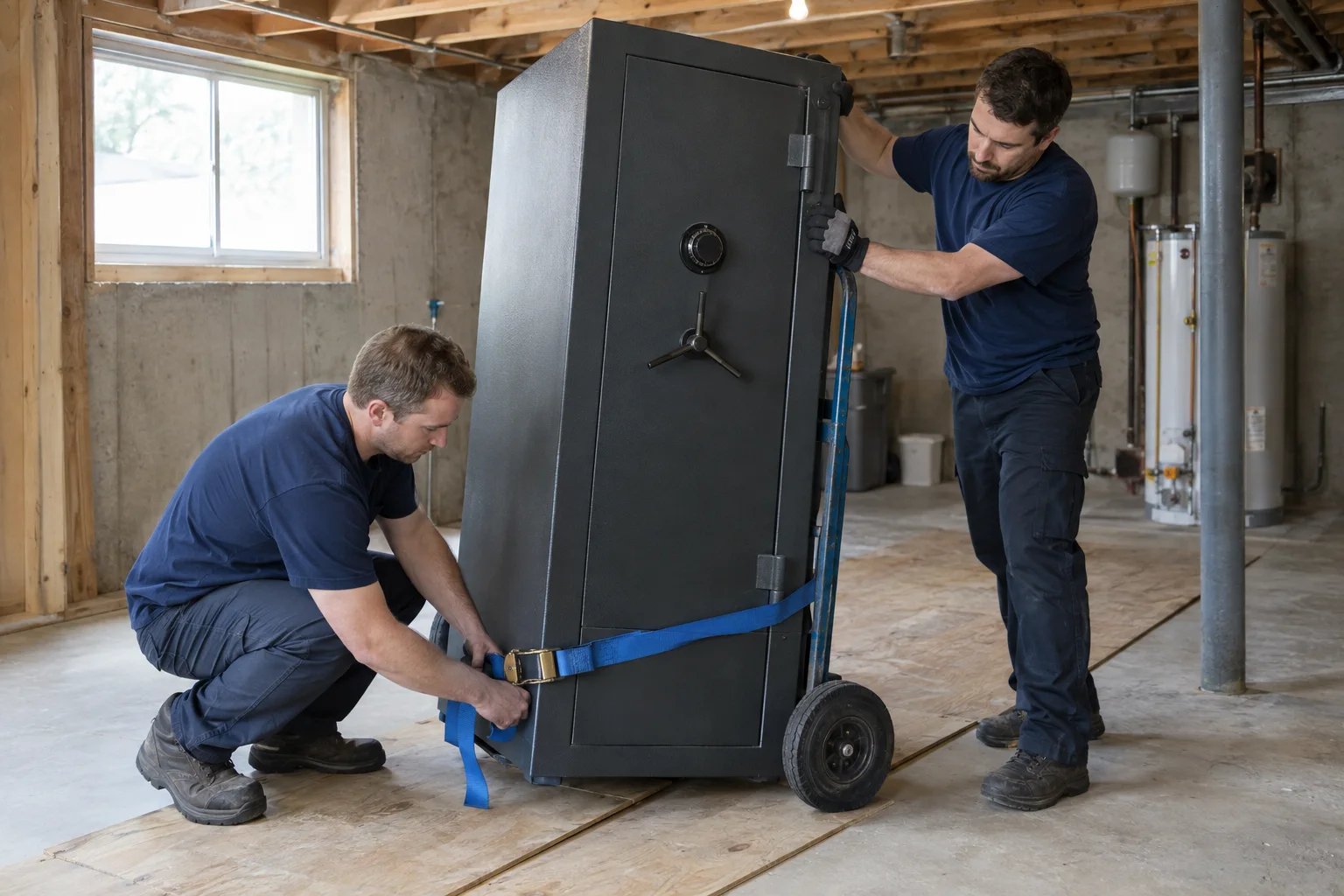
Empty it, lock the door, unbolt it, protect the floors, and roll it upright on a heavy-duty dolly rated well above its weight. Liberty Safe says most of its safes weigh 200 to over 1,000 pounds, while OSHA notes the NIOSH lifting equation tops out at 51 pounds for one person. Stairs need a stair-climbing dolly and trained hands, and the safe should be anchored again afterward.
Get your free moving quote
Tell us where and when. Amenity’s Plainfield office replies directly.
On this page
What a gun safe weighs and why that number drives the plan
Most home gun safes weigh anywhere from a few hundred pounds to well over half a ton, and that number decides how many people, what equipment and which route the move needs. Liberty Safe says most of its safes weigh anywhere from 200 to over 1,000 pounds depending on the model, and its own moving tips note that some of its largest safes reach 3,100 pounds.
Amenity Moving & Storage, the licensed Illinois mover that operates this site, plans safe moves around a range of roughly 300 to 2,000 pounds, and its crews have handled brands such as Stack-On, Browning and Liberty ProVault. Weight depends on the model, so two safes that look about the same from across the garage can be very different jobs.
Compare those figures with what a person can lift. In a 2013 interpretation letter, OSHA explains that the NIOSH lifting equation establishes a maximum load of 51 pounds for one person under ideal conditions, and the recommended limit drops further once twisting, reaching and repetition come in. A 600-pound safe is more than eleven times that figure, which is why every safe move is about rolling, tilting and controlling weight rather than lifting it.
| Reference point | Weight | Source |
|---|---|---|
| Most Liberty home and gun safes | 200 to over 1,000 lb | Liberty Safe, Can I Move My Safe? |
| Safes Amenity plans moves around | Roughly 300 to 2,000 lb | Amenity Moving & Storage |
| Largest Liberty safes | Up to 3,100 lb | Liberty Safe, Tips for Moving a Gun Safe on Your Own |
| One person, ideal lifting conditions | 51 lb maximum | OSHA, citing the NIOSH lifting equation |
Finding your safe's exact weight
Look for a model number on the label inside the door, on the back panel or in the purchase paperwork, then check the spec on the maker’s website. If you can’t find one, measure the height, width and depth with the handle and hinges included. A mover can work from brand and dimensions, but the real weight makes the crew size, the equipment list and the estimate more accurate.
Can you move a gun safe yourself?
You can move a small, light safe across a level floor with a rated hand truck and helpers, but heavy safes, stairs and tight turns are where people get hurt and floors get ruined. Liberty’s own article on moving a safe without professionals says the company never recommends that people try to move a heavy safe on their own, and its Can I Move My Safe? page strongly recommends professional help for safes over 500 pounds or for moves with stairs or tight spaces.
If you still plan a do-it-yourself move, treat the manufacturer’s advice as the minimum. Liberty’s tips call for at least three strong helpers, high-grip work gloves and a heavy-duty hand truck with straps, and for one of its mid-size models the company says that hand truck needs to hold at least 800 pounds. Its relocation guide adds that a heavy safe should never go on stairs with a standard dolly.
Where do-it-yourself safe moves go wrong
- Tipping. Safes are top-heavy. Once one tilts past its balance point, a few people standing beside it can’t catch it, so nobody should ever be on the downhill side.
- Stairs. Each step concentrates the load on one tread and on whoever is below. Liberty warns that some floors and stairs aren’t built to handle that weight.
- Floors. Dragging gouges hardwood, cracks tile and tears vinyl, and narrow wheels dent soft flooring.
- Vehicles. Liberty points out that a heavy safe can wreck a pickup tailgate. A rental truck needs a ramp or liftgate rated for the load, plus a way to strap the safe upright.
- Pinch points. Fingers and toes get crushed at thresholds, door frames and the lip of a truck ramp, which is why crews wear gloves and keep hands off the bottom edge.
If you’re weighing a rental truck against a crew for the whole household, our guide to rental truck vs. hiring movers walks through the trade-offs. A safe is usually the single item that tips that decision.
Prepare the safe and the route before moving day
Most of a safe move is decided before anyone touches the safe. Work through this list a few days ahead, at both the old home and the new one.
- Empty it completely. Liberty’s advice is to remove everything before you even try to shift the safe; contents slide and dent the interior, and every pound you take out is a pound the crew doesn’t have to tilt.
- Take out loose shelves, door-panel organizers and dehumidifier rods so nothing rattles loose inside.
- Write down the combination or find the keys, then lock the door for the move. Liberty recommends locking it during transport so the door can’t swing open.
- Check whether the safe is bolted down. On many full-size safes the anchor bolts sit under a floor panel or caps inside, and they have to come out before the safe can move.
- Measure the safe, then every doorway, hallway, gate and stair width on both routes.
- Pick the new spot and a backup spot, in case the first one doesn’t fit or its floor isn’t suitable.
- Clear the path, pull up throw rugs and loose runners that can catch dolly wheels, and move fragile pieces out of the way.
- Photograph the safe’s finish and the floors along the route so you have a before-and-after record.
Firearms and ammunition travel with you
Remove every firearm and all ammunition before the crew arrives and keep them in your own possession. The Illinois State Police publishes a firearms transportation guide with general guidance on carrying firearms and ammunition, including the FOID card requirement. Our guide to what movers will not move covers other things to set aside.
Ready for a straight answer on your move?
Book a free, no-obligation in-home estimate with Amenity’s Plainfield team.
How professional crews move a gun safe
A trained crew moves a safe in a fixed order: protect, tilt, strap, roll and set. The details change with the safe and the house, but the sequence doesn’t.
- Walk the routeThe crew lead looks at the safe, the floor under it, every turn and step, and where the truck will park, then decides where the safe can safely pause along the way.
- Protect floors and framesHard floors get plywood, hardboard or runners, the same protection Liberty recommends, and door frames and banister posts get padded.
- Tilt it onto the dolly and strap itThe safe is tipped just enough to slide a heavy-duty or powered dolly underneath, then cinched tight so the safe and dolly move as one unit. Liberty advises keeping the safe upright whenever possible and secured to the dolly.
- Take the stairs one step at a timeOn stairs, crews use stair-climbing or power dollies that carry the weight down or up a step at a time, with crew members guiding from the sides rather than bracing underneath. Liberty calls a stair-climbing dolly crucial when stairs are involved.
- Load and secure itThe safe goes up a ramp or liftgate, stands upright against a wall of the truck, and is strapped so it can’t shift when the truck brakes or turns.
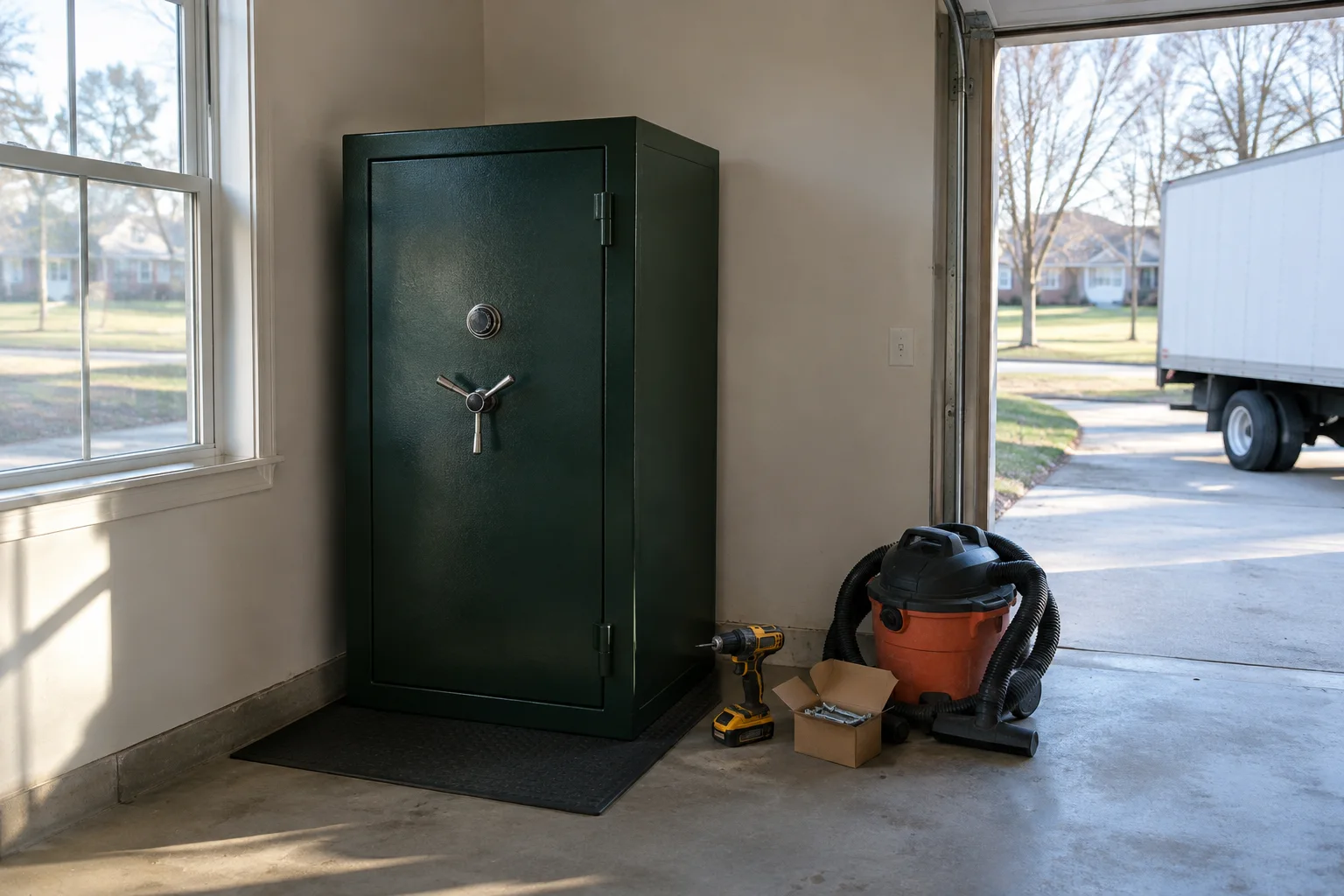
- Set, level and anchorAt the new home the safe is rolled to its spot, lowered off the dolly and leveled, and anchored if that has been arranged.
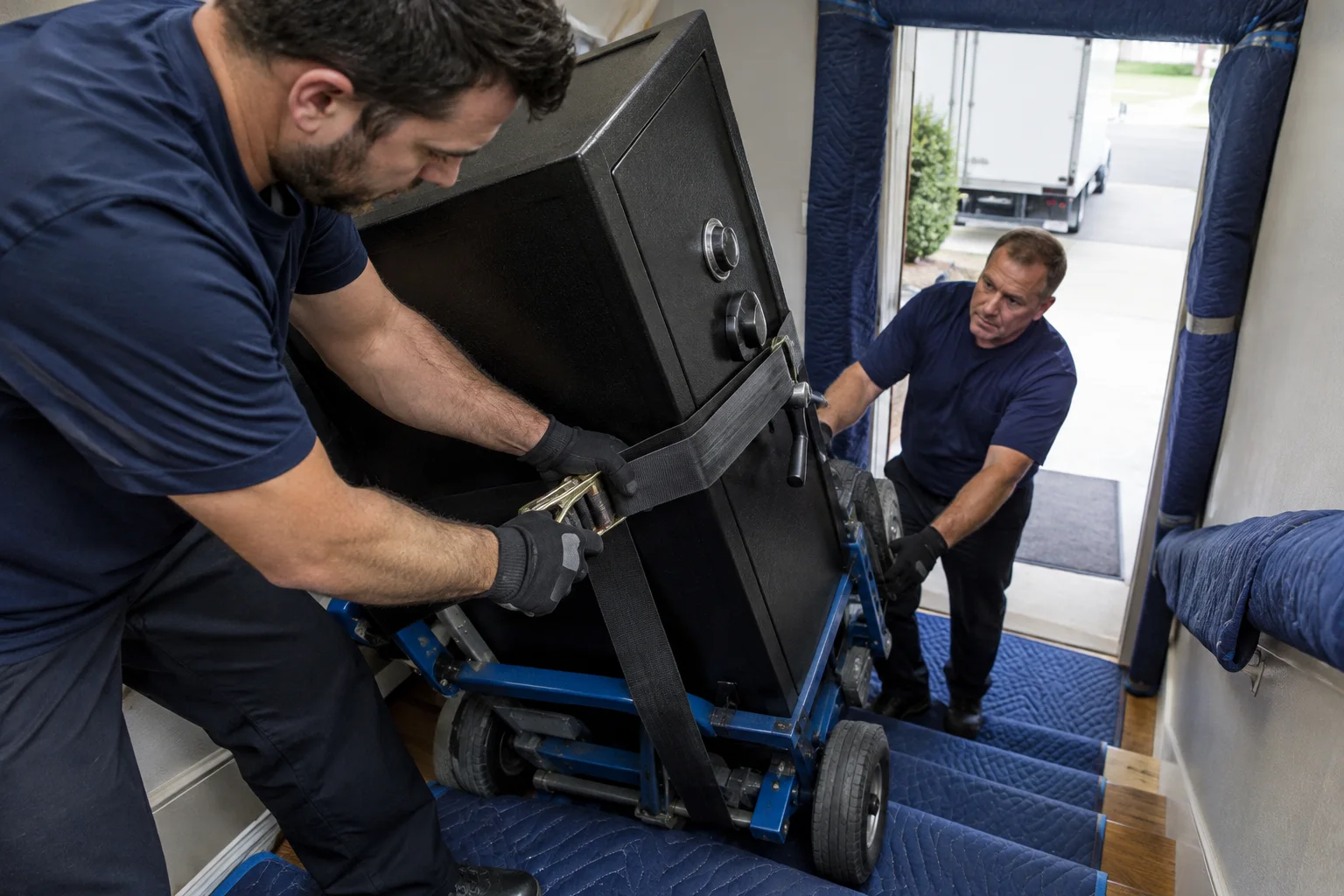
Amenity’s crews work with power dollies and high-quality moving equipment, and have moved safes from makers including Stack-On, Browning and Liberty ProVault. Our gun safe moving service page explains how those jobs are scheduled, and the specialty moving overview covers the other heavy items Amenity handles.
Stairs, floors and basements: check the structure, not just the path
Before a safe goes up or down a level, find out whether the stairs and the destination floor can carry it. Liberty’s do-it-yourself guidance tells owners to make sure any staircase used is sturdy enough for the safe’s weight, and its installation guidance says that if you’re unsure your floor can handle the load, a building contractor should evaluate the structure underneath it.
Floor types at the new spot
- Concrete slab. Liberty calls concrete a strong choice that can hold a safe of 1,000 pounds or more, which is why basements and garages are common homes for big safes.
- Wood subfloor. Workable with the right anchoring hardware, and Liberty recommends driving lag bolts into the floor joists where you can.
- Ceramic tile. Liberty says bathroom- and wall-type ceramic tile isn’t strong enough to support a safe; the usual fix is removing tile in the safe’s footprint and anchoring to the slab below.
- Carpet. Fine as long as the safe sits level, which may mean a solid base under it.
Upper floors call for extra caution. A second-floor closet is possible, but get the floor checked first, and expect stairs to add time and crew to the job. Tell the estimator about every step, including the two or three at a garage entry or a front stoop.
Garages and basements
Liberty notes that garages and basements often aren’t heated or cooled, that moisture rising from bare concrete can corrode a safe’s base, and that humidity can get past the door seal. Its suggested fixes are sealing the concrete or setting the safe on a rubber mat or thin carpet, and running a dehumidifier or desiccant inside.
In winter, slush and road salt on boots are the bigger threat to floors. Amenity lays floor runners down during winter moves, and our guide to moving in winter around Chicago covers the rest of cold-weather planning.
Anchor the safe again at your new home
An anchored safe is harder to steal and far less likely to tip. Liberty explains that burglars often try to tip a safe onto its back to pry the door, and that the door is the heaviest part of the safe, so opening it shifts the center of gravity forward. On an unanchored, top-heavy safe, the company calls that a severe injury risk, especially to children.
- Concrete: drill through the safe’s anchor holes with a hammer drill and masonry bit (Liberty lists 3/8 or 1/2 inch as typical), make each hole slightly deeper than the anchor bolt, clean out the dust, then set wedge or sleeve anchors.
- Wood: drill pilot holes and drive lag bolts with washers, into the joists where possible.
- Tile over concrete: anchor to the slab, not the tile.
Liberty’s guidance is to follow the maker’s installation instructions with hardware matched to the floor type. Tell your estimator now whether the safe is bolted where it sits and whether it needs to be anchored at the new home, so the plan covers who removes the old bolts and who sets the new ones.
What to tell the estimator about your safe
A safe quote is only as good as the details behind it. Amenity offers free, no-obligation in-home visual estimates, so an estimator can see the safe, the stairs and the floors instead of guessing. Have these answers ready:
- Make and model, or the height, width, depth and weight
- Where it sits now (house or garage, which level) and where it’s going
- Whether it’s bolted down now and whether it needs anchoring after the move
- How many stairs at each end, inside or outside, with any turns or landings
- The narrowest door, gate or hallway on each route
- Whether it moves with the rest of the household, and whether it needs storage
Pricing follows the work: weight, stairs, distance, access and time. Rather than quote a flat price sight unseen, Amenity prices the move after that visit. Our guide to what happens during an in-home moving estimate explains what the estimator checks.
Amenity names Aurora, Plainfield, Naperville and Joliet among the communities it serves most, and its office and warehouse sit on the north side of Plainfield.
Storing a safe or taking it out of state
When closing dates don’t line up, Amenity can store a gun safe in its 12,000-square-foot Plainfield warehouse. The space is climate-controlled, protected by an alarm system, an outdoor security camera and a well-lit yard, and only Amenity personnel have access. Every stored item goes into an inventory database and you get a detailed list. The moving and storage page explains how storage works.
For a move to another state, Amenity works as an authorized agent of Wheaton World Wide Moving, and the shipment travels under the federal authority of Wheaton Van Lines, Inc. (USDOT 70719). On interstate moves, the no-extra-charge Released Value option is limited to 60 cents per pound per article under federal rules, so a 600-pound safe that cost several thousand dollars would be covered for no more than $360. Read our guide to Full Value Protection vs. Released Value before you choose, and see long-distance moving for how those moves run.
Keep reading
- How to Move a Hot Tub
- How Pianos Are Moved
- Self-Storage vs. Moving-Company Storage
- What Movers Will Not Move
Browse the full moving guide library or see every moving service.
Frequently asked questions
How much does a gun safe weigh?
Most home gun safes weigh from a few hundred pounds to more than 1,000. Liberty Safe says most of its models weigh 200 to over 1,000 pounds, with its largest reaching 3,100 pounds, and Amenity plans safe moves around a range of roughly 300 to 2,000 pounds. Check the model number inside the door or in your paperwork for the exact figure before you book.
How many people does it take to move a gun safe?
For a do-it-yourself move, Liberty Safe’s tips call for at least three strong helpers plus a hand truck rated for the weight. Liberty strongly recommends professional help for safes over 500 pounds or for moves with stairs or tight spaces. A moving crew’s size depends on the safe and the route, which is what the in-home estimate is for.
Do I need to empty my gun safe before the movers come?
Yes. Liberty Safe advises removing all contents before you try to move a safe, because contents shift and damage the interior and the extra weight makes the move harder. Take out firearms, ammunition, documents and valuables and keep them with you, then lock the empty safe so the door can’t swing open in transit.
Can movers take a gun safe down basement stairs?
Usually, if the stairs are strong enough and the turns allow it. Crews use stair-climbing or power dollies that move the safe one step at a time; Liberty warns never to take a heavy safe on stairs with a standard dolly. Tell the estimator how many steps there are, whether there’s a landing or turn, and how wide the narrowest point is.
Should I bolt my gun safe to the floor after moving?
Liberty Safe recommends it. An anchored safe is harder for burglars to tip onto its back and pry open, and it’s less likely to tip forward when its heavy door is open. Concrete takes wedge or sleeve anchors set with a hammer drill; wood floors take lag bolts, ideally into joists. Don’t anchor through ceramic tile.
Will movers transport the guns that were in the safe?
Plan to keep firearms and ammunition in your own possession for the move. The Illinois State Police publishes general guidance on transporting firearms and ammunition, including the FOID card requirement. Our guide to what movers will not move lists other items to set aside before moving day.
Can I store my gun safe between homes?
Yes. Amenity can store gun safes in its climate-controlled, 12,000-square-foot Plainfield warehouse, where only Amenity personnel have access and every item is logged in an inventory database with a list for you. It’s not a self-storage unit, so you don’t get a key; the safe stays with Amenity until delivery.
Is it cheaper to move a gun safe myself?
The rental equipment and helpers can cost less than a crew, but the risks are injury, floor and stair damage, and a damaged safe or vehicle. Liberty Safe never recommends moving a heavy safe on your own. Get a free estimate first so you can compare a real number against the equipment, time and risk of doing it yourself.
Sources
- Can I Move My Safe? — Liberty Safe
- Tips for Moving a Gun Safe on Your Own — Liberty Safe
- Preventing Safe Tipping: Best Practices for Anchoring Gun Safes — Liberty Safe
- Where Can I Install My Gun Safe? | What Type of Flooring Can it Go On? — Liberty Safe
- OSHA procedures for safe weight limits when manually lifting — U.S. Occupational Safety and Health Administration
- Appendix A to Part 375—Your Rights and Responsibilities When You Move — FMCSA regulations, 49 CFR Part 375 (GovInfo)
Who handles your move
Local Moving Specialists is operated by Amenity Moving & Storage Inc., 10028 Mandel St, Plainfield, IL 60585 — a family-run Illinois mover since 1986. Illinois household goods license ILCC 73744 MC-C. Interstate moves are transported under the authority of Wheaton Van Lines, Inc. (USDOT 70719, MC-87113), for which Amenity is an authorized agent. See licenses & disclosures.
Last reviewed November 11, 2026 against Amenity Moving & Storage’s published service details and the public sources listed above.
Ready for a straight answer on your move?
Book a free, no-obligation in-home estimate with Amenity’s Plainfield team.