How pianos are moved, and what sets the cost
Published weights from Steinway and Yamaha, how crews handle uprights and grands, and why the tuning should wait until the piano settles into its new room.
- Uprights and grands
- Climate-controlled storage
- Free in-home estimates
- ILCC 73744 MC-C
How much does it cost to move a piano?
There’s no flat price, because the job changes with the piano and the house: an upright on a ground floor is a different job from a grand coming up basement stairs. Cost follows the piano’s type and weight, the steps and turns at both ends, distance, disassembly and any storage. A free in-home visual estimate is the reliable way to get a real number.
Get your free moving quote
Tell us where and when. Amenity’s Plainfield office replies directly.
On this page
What sets the price of a piano move
The price of a piano move comes from the work involved, not the name on the fallboard. A spinet rolling from a ground-floor living room out a level front door is a short job; a grand coming up from a basement with a turn at the landing is a long one. These are the factors a mover prices:
- Type and size. Spinet, console, studio upright, baby grand or concert grand, plus the measured height, width and depth.
- Weight. The uprights and grands in the table below run from about 425 to 1,064 pounds.
- Stairs and turns. The number of steps at each end, inside or outside, and any landings or tight corners.
- Access. Long walks from the truck, narrow doors, elevators, slopes and parking.
- Disassembly. Grands have their legs and pedal lyre removed and put back.
- Distance and timing. Local or long-distance, and whether the piano travels with the household or on its own trip.
- Storage. Holding the piano between homes adds warehouse time and a second delivery.
On interstate moves, federal rules treat piano handling as an extra service. The FMCSA consumer booklet, published as Appendix A to 49 CFR Part 375, lists piano carrying among its examples of accessorial (additional) services, so expect to see it as its own line on an interstate estimate.
What to have ready when you ask for a quote
- The brand and type of piano, and its height, width and depth (or a grand’s length)
- A count of the steps at both homes, with photos of any turns or landings
- The room the piano is going to, and which wall it should stand against
- Whether the piano is the only item moving or part of a full household move
- Your move date, how flexible it is, and whether storage might be needed in between
The reliable way to get a real number is a free, no-obligation in-home visual estimate, which Amenity Moving & Storage, licensed by the Illinois Commerce Commission as ILCC 73744 MC-C, provides. Our guide to how moving costs are calculated in Illinois explains how local and long-distance pricing differ.
How much pianos weigh, by type
Pianos weigh hundreds of pounds, and the manufacturers’ own spec pages show how wide the range is. Here are published net weights for common uprights and grands from Yamaha and Steinway & Sons:
| Piano | Size | Weight | Source |
|---|---|---|---|
| Yamaha b1 upright | 43 in. tall | 425 lb (193 kg) | Yamaha |
| Yamaha U1 upright | 47¾ in. tall | 503 lb (228 kg) | Yamaha |
| Yamaha U3 upright | 51½ in. tall | 542 lb (246 kg) | Yamaha |
| Steinway Model S grand | 5 ft 1 in. long | 579 lb (263 kg) | Steinway & Sons |
| Steinway Model M grand | 5 ft 7 in. long | 603 lb (274 kg) | Steinway & Sons |
| Steinway Model D concert grand | 8 ft 11¾ in. long | 1,064 lb (483 kg) | Steinway & Sons |
You can check these figures yourself on Yamaha’s b series and U series spec pages and Steinway’s Model S, Model M and Model D pages.
Weight is only part of the problem. A piano’s cast-iron plate and strings make an upright top-heavy, and a grand stands on three legs that are built to carry weight straight down, not to be shoved sideways across a floor.
If your piano has no visible model number, measure its height, width and depth, note the brand and roughly how old it is, and give the estimator those details. For a grand, the length from keyboard to tail and the width across the keyboard are the two numbers that matter most.
Upright or grand: how each kind is moved
Uprights, consoles and spinets
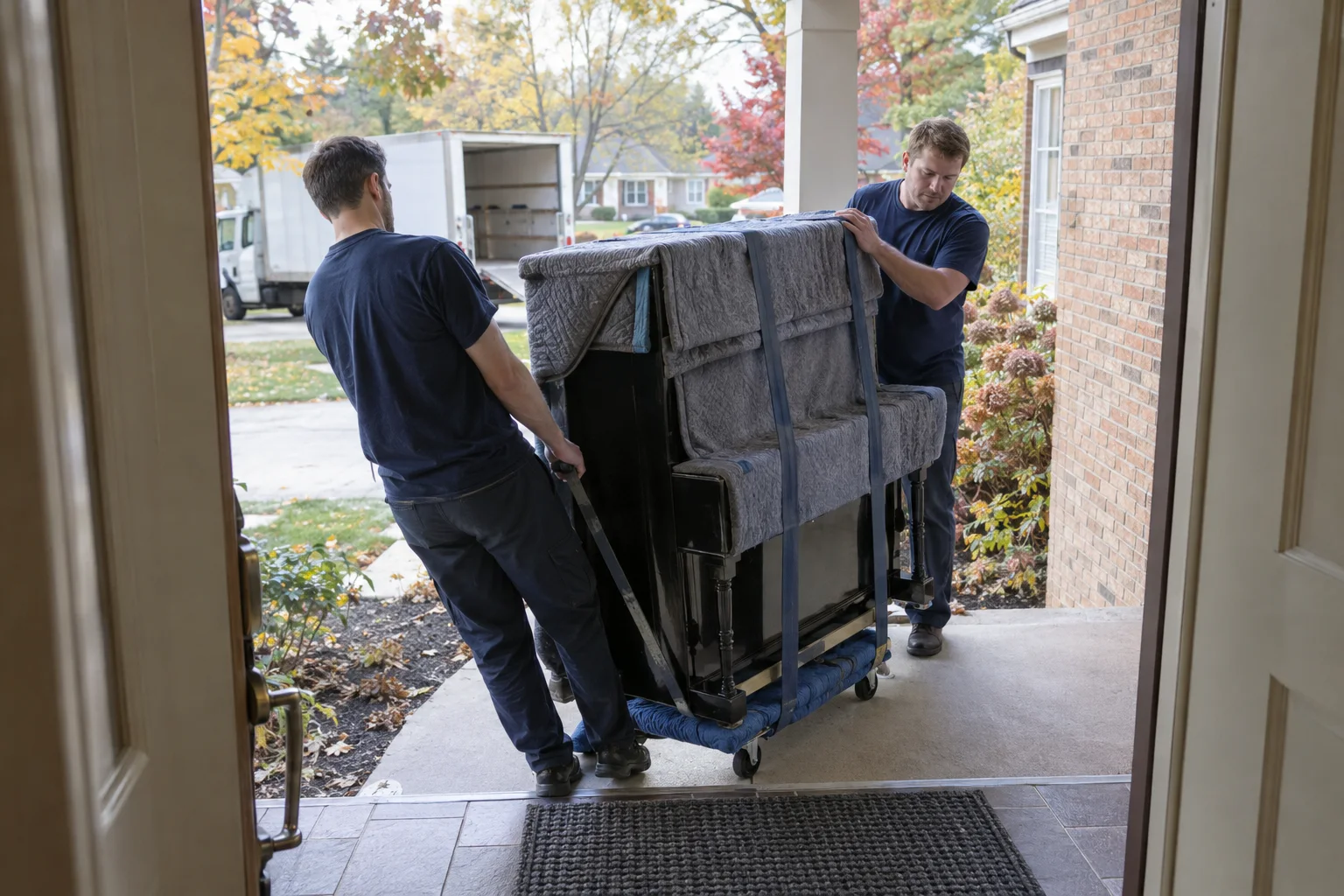
An upright moves standing up. The crew closes and secures the fallboard over the keys, wraps the case in thick pads, and straps the piano to a dolly so it rolls as one unit. Two or more movers control it front and back, and on stairs it is walked one step at a time, with the people on the low side guiding rather than carrying.
Baby grands and grands
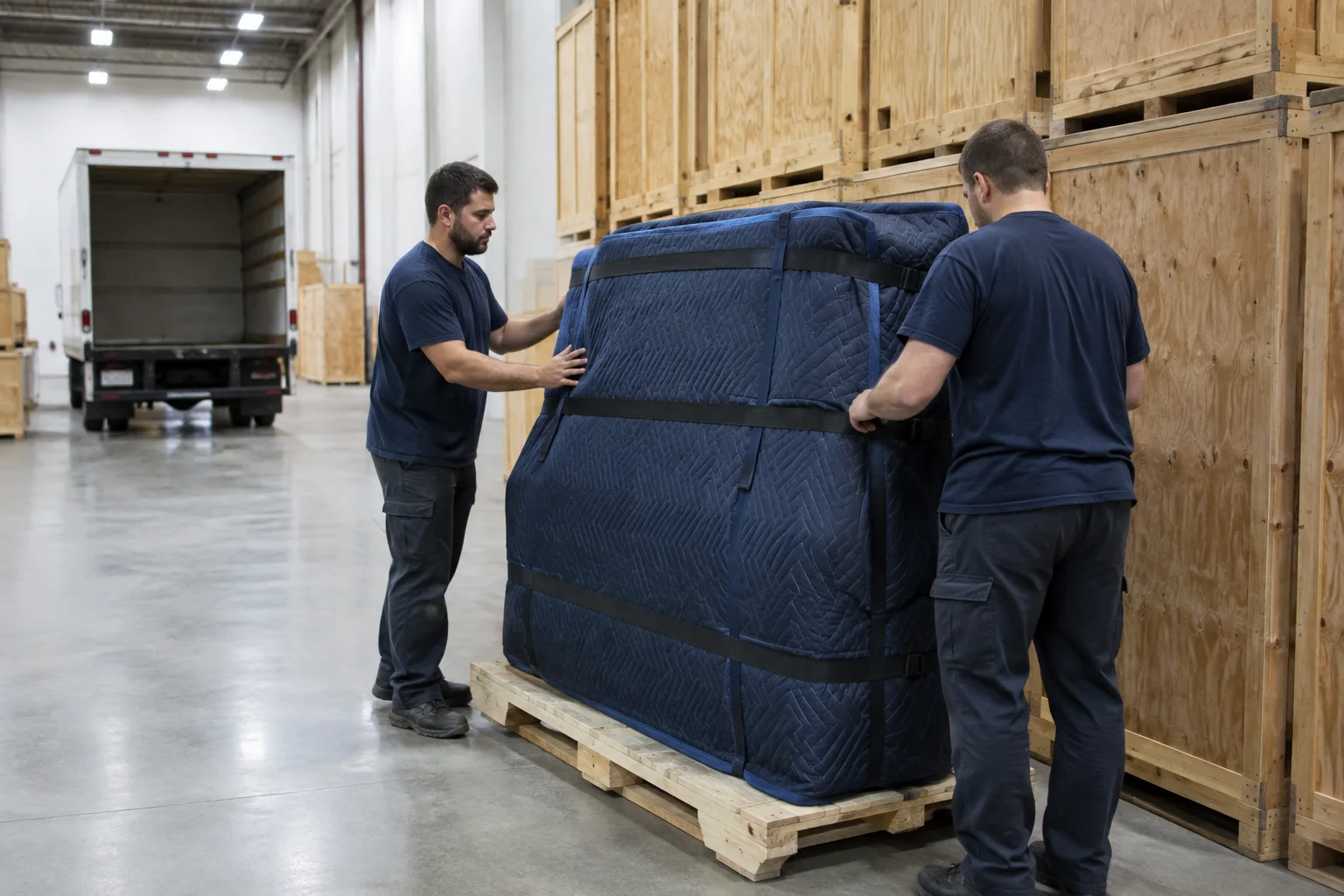
A grand can’t fit through a doorway standing on its legs, so the crew turns it into a narrower package. Typically the lid is closed and secured, the music desk comes off, and the pedal lyre and the legs are removed. The body is then laid on its straight side onto a padded piano board, often called a skid, wrapped and strapped down, and the board rides on a dolly to the truck. At the new home the steps reverse: legs and lyre go back on, the piano is set on its feet, and the pedals are checked.

Amenity’s crews move pianos from makers including Steinway, Baldwin, Kawai, Young Chang and Yamaha. Our piano moving service page lays out how those jobs are planned, with local pages for piano movers in Naperville and piano movers in Aurora.
Ready for a straight answer on your move?
Book a free, no-obligation in-home estimate with Amenity’s Plainfield team.
Why moving a piano yourself rarely saves what it costs
The Piano Technicians Guild, the professional association for piano technicians, tells owners to use only a professional piano mover and says doing so avoids injury to yourself, your instrument and your home. The numbers back that up: OSHA notes that the NIOSH lifting equation sets a 51-pound maximum for one person under ideal conditions, and even the lightest piano in the table above weighs more than eight times that.
- Casters aren’t for moving. The small wheels on many pianos are meant for minor adjustments, and rolling a piano across a room on them can gouge floors or break them off.
- Uprights tip. A top-heavy upright can go over when a wheel catches a threshold or a rug edge.
- Grand legs crack. Pushing a grand sideways while it stands on its legs puts force where the legs and joints weren’t built to take it.
- Stairs multiply the load on whoever is on the lower side.
- Ramps shift weight. On a rental truck ramp, the load slides toward the people at the bottom.
How to keep a piano move affordable
If budget is the worry, cut the work rather than the crew:
- Measure doors, stairs and the new spot before the estimate so nothing surprises anyone on moving day.
- Clear the path yourself: rugs, plants, side tables and anything on the stairs.
- Choose a spot at the new home that needs fewer stairs, when the room allows it.
- Move the piano with the rest of the household rather than as a separate trip.
- If you aren’t sure the piano is worth moving, have a technician evaluate it first.
Weighing a truck rental against a crew for the whole household? Our page on renting a truck or hiring movers lays out the trade-offs, and a piano usually settles the question.
Stairs, doors and tight turns
Stairs change a piano job more than almost anything else, so count them carefully at both homes. Note these for the estimator:
- The number of steps inside and outside, including stoops, garage steps and deck stairs
- Landings, turns and any spot where the stairway narrows
- Railings or newel posts that could come off temporarily
- Door widths, including storm doors that can be removed
- Low ceilings over basement stairs
- Elevator size and building move-in rules for condos and apartments
- Slopes, retaining walls or soft ground between the door and the truck
Split-levels and raised ranches tend to put short runs of stairs and tight landings right inside the front door, while condos and apartments add elevators and shared hallways. Our apartment and condo moving page covers building rules, and Amenity’s crews work throughout the area from its warehouse in Plainfield, including Joliet and the towns around it.
Moving day for a piano, step by step
- Walk the routeThe crew looks at the piano, both paths and the truck position, and agrees on where it can pause on the way out.
- Protect the piano and the houseThe case gets wrapped in pads, door jambs and banisters get padded, and floor runners go down; Amenity lays runners during winter moves to keep slush off floors.
- Prepare the pianoThe fallboard and lid are closed and secured. A grand’s music desk, lyre and legs come off and it goes onto its board.
- Roll it outThe piano is strapped to its dolly or board and moved out, one step at a time on stairs, with someone calling each move.
- Secure it in the truckAn upright stands against a truck wall and is strapped in place; a grand stays on its board, strapped so it can’t shift.
- Set it in placeAt the new home, a grand is reassembled and set on its legs, the pedals are checked, and the piano goes where it will be protected from vents, windows and direct sun.
Tuning and humidity after the move
Plan to tune the piano after it has settled into its new room, not the day it arrives. The Piano Technicians Guild explains on its servicing and maintenance page that a piano functions most reliably under consistent conditions, gives about 68°F and 42 percent relative humidity as optimal, and notes that changes in humidity are generally the biggest factor in how often a piano needs tuning. A move changes all of that at once.
PTG also notes that ordinary homes can see fairly drastic changes from season to season. The manufacturer recommendations collected on that page differ: Kawai recommends at least two tunings a year, and Young Chang suggests a minimum of once a year after a piano’s first two years. Ask your technician how long they want the piano to acclimate before its first post-move tuning.
Placing the piano in the new room
PTG’s basic rules of piano care give a short list for picking the spot:
- A room with a fairly even temperature, away from drafts and dampness
- Away from heating registers, air-conditioning vents and fireplaces
- Away from windows and doors that are opened often
- Out of direct sunlight
To find someone to tune it, PTG’s Find a Technician tool searches for technicians near your new address.
Storing a piano or moving it out of state
If the new home isn’t ready, a piano belongs in climate-controlled storage rather than a garage or an unheated unit, given how much humidity swings affect it. Amenity’s Plainfield warehouse offers that: 12,000 square feet of climate-controlled space that only Amenity staff enter, guarded by an alarm and an outdoor camera over a lit yard. Each piece that goes in is logged in an inventory database, and the detailed list comes to you. See moving and storage, or our comparison of self-storage and moving-company storage.
Moving a piano to another state runs through Wheaton World Wide Moving, for which Amenity is an authorized agent; the interstate carrier of record is Wheaton Van Lines, Inc., USDOT 70719. Pay close attention to valuation. Released Value, the option that costs nothing extra, pays at most 60 cents per pound per article, which works out to no more than $300 for a 500-pound upright. Compare it with the higher level of protection in our explainer on how the two valuation options differ, and see how interstate jobs are scheduled on the long-distance moving page.
For a move that stays inside Illinois, the federal interstate rules don’t apply, so ask for the valuation terms in writing before moving day and make sure the piano’s value and any existing damage are noted on the paperwork.
Keep reading
- Self-Storage vs. Moving-Company Storage
- What Movers Will Not Move
- Rental Truck vs. Hiring Movers
- How to Pack for a Move
Browse the full moving guide library or see every moving service.
Frequently asked questions
How much does it cost to move a piano?
It depends on the piano and the route. Type and weight, the number of stairs and turns at both homes, distance, grand disassembly and any storage all change the price. On interstate moves, piano carrying is listed as an additional service in the FMCSA consumer booklet. A free in-home visual estimate lets the mover see the piano and the stairs before giving you a number.
How much does a piano weigh?
Published specs give a sense of the range. Yamaha lists its 43-inch b1 upright at 425 pounds and its 51½-inch U3 at 542 pounds. Steinway lists its 5-foot-1 Model S grand at 579 pounds and its Model D concert grand at 1,064 pounds. Check your own model’s spec page, or measure it and give the dimensions to your mover.
Should you tune a piano after moving it?
Yes, but give it time first. The Piano Technicians Guild says tuning stability depends on temperature and humidity and lists about 68°F and 42 percent relative humidity as optimal. A move changes the piano’s environment, so let it settle into the new room and ask your technician how long to wait before tuning.
Can a piano be kept in a garage during a move?
It’s not a good idea. PTG recommends keeping a piano in a room with a fairly even temperature, away from drafts and dampness, and garages are rarely like that. If there’s a gap between homes, climate-controlled storage is safer; Amenity’s Plainfield warehouse is climate-controlled and accessed only by Amenity personnel.
Do movers take the legs off a grand piano?
Usually, yes. A grand is too wide to go through most doorways on its legs, so movers typically remove the music desk, pedal lyre and legs, lay the body on its straight side on a padded piano board, and strap it down. The legs and lyre go back on at the new home, and the pedals are checked.
Is it worth moving an old piano?
It depends on its condition, which only a technician can judge. Before you pay to move an older piano, have a technician look at its tuning stability, action and soundboard and tell you whether it’s worth keeping. The Piano Technicians Guild’s Find a Technician tool lists technicians by location.
How do you move a piano cheaply?
Cut the work, not the safety. Measure doors and stairs ahead of time, clear the path yourself, choose a spot with fewer stairs at the new home, and move the piano with the rest of the household instead of on its own trip. The Piano Technicians Guild recommends using only a professional piano mover.
What piano brands does Amenity move?
Amenity’s crews move pianos from makers including Steinway, Baldwin, Kawai, Young Chang and Yamaha. Tell the estimator the brand, the type (upright, console, spinet or grand) and the size, and whether the piano needs storage or is going out of state.
Sources
- Basic Rules of Piano Care — Piano Technicians Guild
- Servicing & Maintenance — Piano Technicians Guild
- Concert Grand Piano – Model D — Steinway & Sons
- U Series – Specs – Upright Pianos — Yamaha Canada
- Appendix A to Part 375—Your Rights and Responsibilities When You Move — FMCSA regulations, 49 CFR Part 375 (GovInfo)
- OSHA procedures for safe weight limits when manually lifting — U.S. Occupational Safety and Health Administration
Who handles your move
Local Moving Specialists is operated by Amenity Moving & Storage Inc., 10028 Mandel St, Plainfield, IL 60585 — a family-run Illinois mover since 1986. Illinois household goods license ILCC 73744 MC-C. Interstate moves are transported under the authority of Wheaton Van Lines, Inc. (USDOT 70719, MC-87113), for which Amenity is an authorized agent. See licenses & disclosures.
Last reviewed November 11, 2026 against Amenity Moving & Storage’s published service details and the public sources listed above.
Ready for a straight answer on your move?
Book a free, no-obligation in-home estimate with Amenity’s Plainfield team.