Moving and Storage in Sealed, Climate-Controlled Crates
Amenity picks up your household, seals it in wooden crates inside a climate-controlled Plainfield warehouse and delivers when you're ready. It's full-service storage, not a self-storage unit.
- Licensed: ILCC 73744 MC-C
- Family-run since 1986
- Wheaton World Wide agent
- Free in-home estimates

What is moving and storage, and how is it different from self-storage?
Moving and storage means the mover picks up your belongings, keeps them in its own warehouse and delivers them later. Amenity wraps furniture, seals it in 8′ x 7.5′ x 5′ wooden crates, logs every item in an inventory database and keeps it in a climate-controlled space in Plainfield. Unlike self-storage, you get no key or unit; only Amenity personnel handle and access your goods.
Get your free moving quote
Tell us where and when. Amenity’s Plainfield office replies directly.
On this page
How moving and storage works with Amenity
Moving and storage puts one company in charge of your belongings from the day they leave your home until the day they’re delivered: Amenity picks up (or you drop off), stores everything in its own 12,000-square-foot warehouse in Plainfield, and brings it back when you’re ready. Here is the sequence.
- Free in-home estimateAn estimator looks at what’s going into storage, how it should be packed and roughly how long it will stay. The visual estimate is free and carries no obligation, and it’s where specialty pieces such as a gun safe or hot tub get planned.
- Packing, if you want itAmenity can pack the whole household or only the fragile rooms, bringing the materials to the job. Optional liability valuation coverage is available on items Amenity packs.
- Pickup or drop-offA crew collects from your home, or you bring items to the warehouse at 10028 Mandel St in Plainfield.
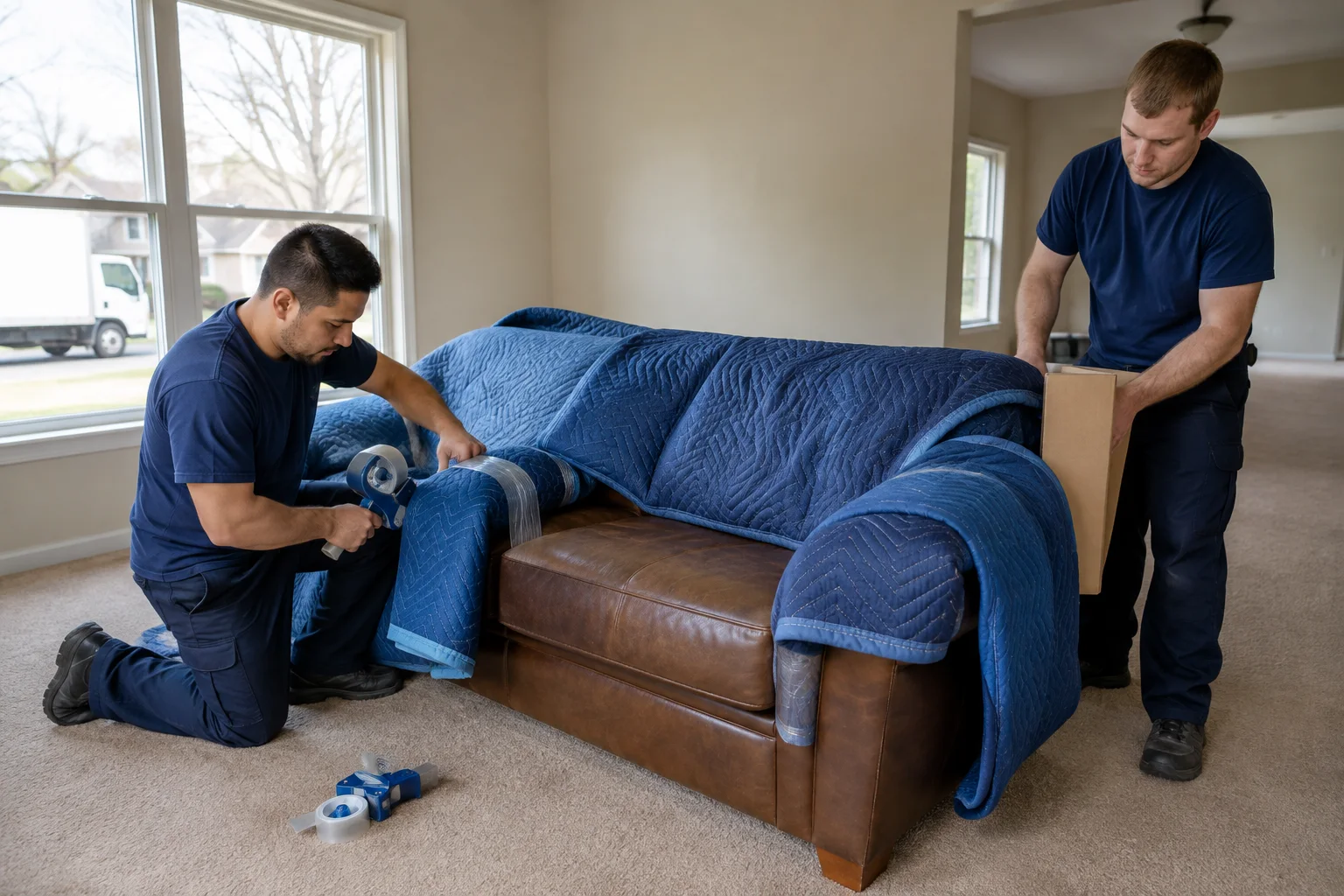
- Wrapping and cratingFurniture is wrapped in pads and cardboard, then packed and sealed in wooden crates measuring 8′ x 7.5′ x 5′. Sofas are stored on sofa racks.
- InventoryEvery item is entered in Amenity’s inventory database, and you receive a detailed list of everything stored.
- Storage termAmenity stores for anything from one day to several years.
- DeliveryWhen you’re ready, a crew delivers locally; for a move out of state, Amenity arranges it as an authorized agent of Wheaton World Wide Moving.
The point of the arrangement is fewer handoffs. A do-it-yourself move into storage usually means loading a truck, unloading into a unit, then repeating both steps months later. With warehouse storage and a local delivery, the company that pads your dresser is the same one that sets it down in the new bedroom, and the inventory list follows the goods the whole way.
Warehouse storage is not self-storage
Full-service warehouse storage and self-storage solve different problems, and plenty of storage searches around Naperville, Aurora and Plainfield are really looking for a rented unit with a key. Amenity doesn’t rent units. Here is the honest difference.
| Question | Full-service warehouse storage (Amenity's model) | Self-storage unit |
|---|---|---|
| Who moves and handles your things | Amenity crews wrap, crate, load and deliver | You, or helpers you hire, load and unload |
| Access | No key or unit; only Amenity personnel enter the warehouse | You come and go with your own lock, within the facility’s hours |
| How goods are kept | Wrapped, then sealed in 8′ x 7.5′ x 5′ wooden crates; sofas on sofa racks | However you stack them in the unit |
| Record of what’s stored | Item-by-item inventory database and a detailed list for you | Whatever list you keep yourself |
| Climate | Climate-controlled space | Varies by facility and unit; ask |
| Illinois law | The ICC requires a Personal Property Storage Registration from companies that store personal property for pay where access is controlled; verify any provider in the ICC’s Entity Search | Under the Self-Service Storage Facility Act the facility is not a warehouse under UCC Article 7, and care, custody and control stay with the renter until any lien sale |
| Moving included | Yes: pickup and delivery are part of the job | No; you arrange a truck both ways |
| Good fit for | A full household between homes, a long stay, heavy or valuable pieces | Seasonal items, frequent access, a few boxes |
The legal row matters more than it looks. Illinois’s Self-Service Storage Facility Act defines self-storage as space rented to occupants who have access to it, says such a facility is not a warehouse for purposes of the Uniform Commercial Code, and keeps the exclusive care, custody and control of the stored property with the renter until a lien sale. The act doesn’t apply at all if the owner issues a warehouse receipt or bill of lading. In plain terms, at a self-storage facility you are the custodian of your things; with warehouse storage, the company is.
Self-storage is the right call in some situations: holiday decorations you need every December, a few boxes you’ll visit often, or business stock you restock every week. If you need regular access, a unit with your own key fits better than sealed crates. The side-by-side guide to self-storage and moving-company storage goes deeper.

Inside crated storage: pads, crates and sofa racks
Crated storage, often called vault storage, means your goods are packed into closed wooden containers inside the warehouse instead of sitting loose on open shelves or in an open room.
At Amenity, each crate measures 8′ x 7.5′ x 5′, which works out to 300 cubic feet. Furniture is wrapped in pads and cardboard before it goes in, and the crate is sealed once it’s packed. Sofas are handled differently: they’re stored on sofa racks so they can’t be crushed or compacted under other items, which protects frames, springs and cushions over a long stay.
The wrapping matters as much as the crate. Pads cushion finishes against the crate walls, the cardboard adds a layer against dust and scrapes, and sealing the crate closes the load. That’s also why the time to decide what goes in is before the crew starts: once a crate is closed and lifted into place, adding a forgotten lamp is a bigger job than it sounds.
What can go into storage
Household furniture and boxed goods are the core of it, but Amenity also stores two kinds of items few people can move into a self-storage unit on their own: gun safes, which Amenity notes typically weigh roughly 300 to 2,000 pounds, and hot tubs and spas. See gun safe moving and hot tub moving for how those are handled.
Ready for a straight answer on your move?
Book a free, no-obligation in-home estimate with Amenity’s Plainfield team.
What climate control protects
Climate control protects anything that reacts to swings in temperature and humidity, and over an Illinois year that covers much of a household: wood furniture, leather, rugs and carpets, art and musical instruments.
Wood is the clearest example. The Canadian Conservation Institute explains that wood absorbs moisture and swells a little when humidity rises, then gives off moisture and shrinks when the air dries, and those changes can split or crack wood and damage its finish. Its basic advice for furniture is to keep the environment stable, and it names attics, basements and garages as poor storage spots because conditions there fluctuate. A storage container parked on a driveway sees the same swings as the yard around it.
Amenity’s storage space is climate-controlled, and the company says proper boxing, wrapping and packing, combined with that space, guard stored goods against dust and humidity. When you compare any climate-controlled option, ask what is actually controlled (temperature, humidity or both) and how the space is monitored, so you’re comparing like with like.
- Wood furniture and cabinets: swelling and shrinking can split wood and damage finishes.
- Leather: sofas, chairs and bags kept away from damp and dust.
- Rugs and carpets: kept off a damp garage floor and away from dust.
- Art and mirrors: frames and backings are often wood and paper.
- Musical instruments: most are built largely of wood, which responds to humidity.
Security, inventory and getting your things back
Stored goods are protected by restricted access and a written record. Nobody but Amenity personnel goes into the warehouse, and the property is guarded by a well-lit yard, an alarm system and an outdoor security camera.
The inventory is the other half. Every stored item goes into Amenity’s inventory database and you receive a detailed list; a formal inventory is standard for anything Amenity stores, and inventory forms are available on request for moves as well. Keep that list with your closing papers, because it’s what you check against on delivery day. Amenity can also provide references for its storage facility on request.
Access is the trade-off. You don’t get a key or a unit, and your things are sealed in crates, so warehouse storage isn’t the place for something you’ll need next Tuesday. Decide what stays out before the crew arrives, and ask at the estimate how a mid-storage retrieval would be scheduled if you might need one.
- Passports, birth certificates, titles, closing documents and the storage inventory itself
- Medications, medical devices and a first-aid kit
- Jewelry, cash, keepsakes and irreplaceable photos
- Laptops, chargers, work equipment and tax records
- School clothes, uniforms and enough everyday clothing for the gap
- Coats and boots if the stay runs into winter
- Anything flammable, perishable or living, such as fuel, food and houseplants
Storage in transit on an interstate move
Storage-in-transit, or SIT, is temporary storage that is part of an interstate shipment: the mover holds your goods in a warehouse before final delivery, and federal rules set what happens when that storage ends. You can request it when you book.
Those rules are in the FMCSA’s household goods regulations, 49 CFR 375.609. When a SIT period is nearing its end, the mover must tell you in writing the date the goods convert to permanent storage, that you have nine months after conversion to file claims for loss or damage that happened in transit or during SIT, that the mover’s liability is ending, and that the storage facility’s own rules and charges will then apply. The notice is due at least 10 days before the agreed period or the tariff’s maximum SIT period runs out, or one day before if goods are held fewer than 10 days.
Two protections follow. If the mover fails to send that notice, its liability continues until the end of the day after notice is actually given. And once goods go into permanent storage, they must be held in your name, with your contact information on file.
Amenity handles out-of-state moves as an authorized Wheaton World Wide Moving agent. The federal operating authority on those shipments belongs to Wheaton Van Lines, Inc. (USDOT 70719, MC-87113), and Amenity says its Wheaton ties reach more than 300 agents around the country. If storage is part of a long-distance plan, ask at the estimate whether it will be booked as storage-in-transit on the shipment, and get the end date in writing. The long-distance moving page covers the rest of the process.
Valuation and insurance while goods are stored
Valuation sets how much a mover owes if something is lost or damaged, and it is a separate question from your own insurance, so settle both before the crates close.
For interstate shipments, the federal Your Rights and Responsibilities rules describe two levels. Released value costs nothing extra, but the mover’s liability is capped at $0.60 per pound per article, so a 100-pound dresser is covered for no more than $60 whatever it cost. Under full value protection, the mover can replace a lost or damaged item with one of like kind and quality or pay what it costs to replace it. The same rules ask you to tell the mover in writing about any item worth more than $100 per pound, such as jewelry or collections. The guide to full value protection vs. released value walks through the choice.
For goods in local storage, ask for the written terms that apply while items sit in the warehouse: which valuation level covers them, how values are declared, and when coverage starts and stops. Amenity describes itself as fully bonded, licensed and insured, and offers optional liability valuation coverage on items it packs. Then call your homeowner’s or renter’s insurer and ask whether your policy covers belongings stored away from home, for how long, and with what limits.
Check the license first
Before storing with any company, look it up in the Illinois Commerce Commission’s Entity Search. The ICC’s warehousing rules cover companies that store personal property for pay where access is controlled, and its household goods rules cover movers. Amenity’s Illinois household goods license is ILCC 73744 MC-C; the guide on checking a moving company’s license shows each lookup step by step.
When moving and storage makes sense
Warehouse storage fits when there’s a gap between leaving one place and settling into the next, or when part of a household has to wait while the rest moves.
- Closings that don’t line up: you sell on the 15th and the next house closes on the 30th.
- New construction: the builder’s date slips and the new house isn’t ready.
- Downsizing: moving into a smaller home or senior community and deciding later what to keep; see senior moving and downsizing.
- A furnished place in between: a corporate apartment or rental that already has furniture and appliances.
- No destination yet: the lease is up but the next city or address isn’t settled.
- Remodels and listings: emptying rooms for a renovation or for listing photos.
Because the warehouse is in Plainfield, delivery to nearby towns such as Bolingbrook, Oswego or Yorkville is a local move from the same building. Pairing storage with professional packing means the boxes going into the crates are packed for a long stay, not just a short drive.
How storage is priced
Storage pricing isn’t one flat number. The cost of moving and storage depends on how much space your goods take, how long they stay, how much packing you want and the moving at each end, which is why it starts with a free, no-obligation in-home estimate. Ask for storage charges and moving charges to be listed separately, so you can see exactly what changes if the stay runs longer than planned.
Where we provide moving & storage
- Naperville
- Plainfield
- Aurora
- Lisle
- Bolingbrook
- Oswego
- Yorkville
- Batavia
- Minooka
- Lockport
- Montgomery
- Plano
- Romeoville
- Warrenville
- Woodridge
- North Aurora
- Winfield
- Elburn
- Moving & Storage in Joliet
- Moving & Storage in Aurora
- Moving & Storage in Bolingbrook
- Moving & Storage in Frankfort
- Moving & Storage in Plainfield
- Moving & Storage in Wheaton
- Moving & Storage in Orland Park
- Moving & Storage in Romeoville
- Moving & Storage in Lombard
- Moving & Storage in St. Charles
- Moving & Storage in New Lenox
- Moving & Storage in Elmhurst
- Moving & Storage in Yorkville
- Moving & Storage in Tinley Park
Related moving services
Frequently asked questions
Is moving company storage the same as self-storage?
No. With self-storage you rent a unit, keep the key, and load and unload everything yourself. With Amenity’s warehouse storage, the crew picks up, wraps and seals your goods in wooden crates, logs every item in an inventory, and delivers later. There’s no key or unit, and only Amenity personnel access the warehouse. Illinois law treats self-storage renters as the custodians of their own property.
Can I get to my things while they're in storage?
Not the way you would at a self-storage unit. Goods are sealed in crates and only Amenity personnel enter the warehouse, so plan what stays out before pickup: documents, medications, work gear and the clothes you’ll need during the gap. If you may need something mid-stay, ask at the estimate how a retrieval would be scheduled.
How long can I keep belongings in Amenity's warehouse?
Amenity stores for anything from one day to several years. That covers a short gap between closings, a builder’s delay of a few months, or a longer stay while you decide what a smaller home can hold. Ask for the storage charge to be listed separately from the moving charges, so a longer stay is easy to price.
Is climate-controlled storage worth it for furniture?
For wood, leather, rugs, art and instruments, usually yes. The Canadian Conservation Institute notes that wood swells and shrinks as humidity changes, which can crack wood and damage finishes, and it warns against garages, attics and basements for that reason. A container on a driveway sits outdoors through every season, so it sees those swings directly.
What is storage-in-transit?
Storage-in-transit, or SIT, is temporary warehouse storage during an interstate move, before final delivery. Federal rule 49 CFR 375.609 requires the mover to notify you in writing before SIT converts to permanent storage, including the conversion date, your nine months to file claims and the end of the mover’s liability. If notice isn’t given, the mover’s liability continues until the day after it is.
Who is responsible for my things while they're in storage?
It depends on the kind of storage. Under Illinois’s Self-Service Storage Facility Act, a self-storage renter keeps care, custody and control of the stored property. In warehouse storage, the company has custody, controls access and keeps the inventory. Either way, get the valuation terms for stored goods in writing and ask your insurer whether your policy covers belongings kept away from home.
Can you store a gun safe, a hot tub or a piano?
Gun safes and hot tubs or spas can both be stored with Amenity. Safes are moved with power dollies, and Amenity notes they typically weigh roughly 300 to 2,000 pounds. For a piano or another specialty item, describe it at the estimate so the crew can plan how it will be moved, protected and stored.
How much does moving and storage cost?
There’s no single rate, because the cost depends on how much you store, how long it stays, how much packing you want, and the moving at both ends. Amenity prices each job after a free, no-obligation in-home visual estimate, so the quote reflects your actual household rather than a guess based on room count.
Sources
- Your Rights and Responsibilities When You Move — Federal Motor Carrier Safety Administration
- Liability & Protection — Federal Motor Carrier Safety Administration
- 49 CFR § 375.609 – What must I do for shippers who store household goods in transit? — Legal Information Institute (Cornell Law School)
- Warehousing — Illinois Commerce Commission
- Self-Service Storage Facility Act (770 ILCS 95) — Illinois General Assembly
- Basic care – Furniture and objects made of wood — Canadian Conservation Institute, Government of Canada
Who handles your move
Local Moving Specialists is operated by Amenity Moving & Storage Inc., 10028 Mandel St, Plainfield, IL 60585 — a family-run Illinois mover since 1986. Illinois household goods license ILCC 73744 MC-C. Interstate moves are transported under the authority of Wheaton Van Lines, Inc. (USDOT 70719, MC-87113), for which Amenity is an authorized agent. See licenses & disclosures.
Last reviewed November 11, 2026 against Amenity Moving & Storage’s published service details and the public sources listed above.
Ready for a straight answer on your move?
Book a free, no-obligation in-home estimate with Amenity’s Plainfield team.