Orland Park Movers, From the Route In to the Last Box
Orland Park sits about 21 miles from Amenity's Plainfield warehouse. This page covers the drive, the village rules that touch moving day, and the homes people move here.
- Plainfield warehouse ~21 mi away
- Illinois license ILCC 73744 MC-C
- One household per truck locally
- Free in-home estimates

Who moves households in Orland Park, and how is the price worked out?
Amenity Moving & Storage, a licensed Illinois household goods mover (ILCC 73744 MC-C) founded in 1986, serves Orland Park from its Plainfield warehouse about 21 miles west, using its own crews and one household per truck on local moves. Price depends on how much you’re moving, packing, access, stairs, distance and the date, so Amenity sets it after a free in-home visual estimate.
Get your free moving quote
Tell us where and when. Amenity’s Plainfield office replies directly.
On this page
Source: U.S. Census Bureau, American Community Survey 2020–2024 5-year estimates (data.census.gov profile for Orland Park). About 21 miles straight-line from Amenity’s Plainfield warehouse.
Getting from the Plainfield warehouse to Orland Park
The run from Amenity’s warehouse at 10028 Mandel St in Plainfield to Orland Park covers about 21 miles in a straight line (20.7), which puts the village toward the far edge of the area Amenity serves locally. The village itself sits about 25 miles southwest of Chicago’s Loop.
A typical route from the west uses I-355, which has interchanges at 143rd Street and 159th Street on the western edge of neighboring Homer Glen, and then head east. Inside the village, LaGrange Road (U.S. Route 45) is the main north-south spine, and the stretch of 143rd Street near the old downtown carries Illinois Route 7. Travel time is part of every local move, so where in the village you live, and any construction on the route, are worth raising at the estimate.
Construction to plan around in 2026 and 2027
Several projects affect approaches to Orland Park right now. On Southwest Highway (IL-7) between 131st and 135th Streets, an IDOT drainage project stalled in October 2025 over poor soil conditions, restarted in May 2026 and is set to continue into 2027. The detour sends southbound drivers west to LaGrange Road, south to 135th Street and back east to IL-7, and a further closure south of 135th Street was pushed to Oct. 28, 2026.
At 143rd Street and John Humphrey Drive, an IDOT intersection rebuild cut traffic to a single lane in each direction starting April 10, 2026, with about a year of construction expected and delays from utility relocations. On the south side, a roundabout serving Costco and an extension of Ravinia Avenue to 161st Street are adding lanes and a new signal at 161st. Cook County has also listed Wolf Road at 143rd Street, 104th Avenue, 151st Street, 153rd Street and 80th Avenue for pavement rehabilitation. Check the village’s road work page the week of your move.
Commuting after the move
If the move is for a Chicago job, Metra’s SouthWest Service stops three times in the village: Orland Park 143rd Street (143rd St. and Southwest Hwy.), Orland Park 153rd Street (10499 W. 153rd St.) and Orland Park 179th Street (179th St. and Southwest Hwy.), on the line between Manhattan and Union Station with weekday and weekend service. Pace routes 364 and 379 also serve the village. The village’s Metra lots switch to a winter configuration from Dec. 5 through March 31.
Village rules that shape moving day
The Orland Park rules that matter most on a moving day are the winter parking ban and the Waste Management collection rules for move-out clutter. Each is summarized below with what it means for your move.
| Rule | What it means for your move | Source |
|---|---|---|
| Winter parking ban once 2 inches of snow falls (Ordinance 9-7-6) | No parking on any village-owned street for more than 3 minutes to load passengers or 30 minutes to load or unload property, until 8 hours after the snow stops or the street is cleared. A full house can’t be loaded at the curb in 30 minutes, so a snowy-day truck needs the driveway. | Snow Removal |
| Everything at the curb by 6 a.m. on collection day | Refuse, recycling and yard waste must be out by 6 a.m., with carts about 3 feet apart and handles facing away from the street; carts come back in by the evening of collection day. | Waste Management |
| One bulk item per weekly pickup | WM defines a bulk item as something you’d take with you if you moved out, such as a couch, small table or mattress, so big discards need to be spread across several weeks. | Waste Management |
| Appliances need a call first | Refrigerators, washers, dryers, water heaters, dishwashers, AC units and dehumidifiers go to the curb for recycling only after a call to WM at (800) 964-8988. | Waste Management |
| Carpet in 4-foot rolls, up to 8 a week | Each roll of carpet or padding must be taped or tied and weigh no more than 50 pounds. | Waste Management |
| Electronics are banned from landfills | TVs, monitors, computers, printers and game consoles can’t go in the cart. WM’s At Your Door program picks up electronics, paint, motor oil and batteries by appointment. | Waste Management |
| Water accounts run through Utility Billing | If you move within Orland Park, call (708) 403-6175 for an updated Account-Customer ID. | Water Billing Information |
The snow rule is the one with real teeth. Village crews plow main streets first, then side streets and cul-de-sacs, and police may tow a vehicle that violates the ban. If snow is in the forecast, clear the driveway so the truck can back in, keep cars in the garage or at a neighbor’s driveway, and don’t push snow from the driveway into the street, which the village fines.
Waste Management also takes up to three cubic yards of refuse a week, with extra bags or cans of no more than 45 gallons and 50 pounds each. Paint goes out only when dried in the can, and only latex paint belongs in regular trash. Fuel, propane and pool chemicals can’t ride on a moving truck either, so plan their disposal early.
Portable storage pods are simpler here than in many towns: under Land Development Code Section 6-304-C.12, a residential pod may sit on a private driveway for up to 30 days from placement with no permit, as long as it stays within 768 cubic feet, 8 feet tall and 5 feet from any lot line (Village of Orland Park). What the village can’t tell you is what your HOA or condo board requires, so get the association’s move rules in writing before you choose a date.
Neighborhoods and housing across the village
Housing here is more varied than in most nearby suburbs, so the home type decides the plan. Census Bureau estimates for 2020 to 2024 count 57,916 residents in 23,256 households. Single-family detached houses make up 57.0% of units, townhomes and other attached homes 21.1%, buildings of 2 to 9 units 12.4% and buildings of 10 or more units 9.4%. Owners occupy 85.8% of homes, and the median home has 6.5 rooms.
What homes look like in Orland Park
Share of housing units by building type
When Orland Park homes were built
Share of housing units by decade built
Source: U.S. Census Bureau, ACS 2020–2024 5-year estimates, table DP04.
Most of the village was built out in the late 20th century: 46.0% of homes date from 1980 to 1999 and 23.6% from 1960 to 1979, with 15.5% from the 2000s, 8.3% from 2010 or later and 6.5% from before 1960. The community itself is much older. The area was first settled in 1834, and the village incorporated in 1892 with Senator John Humphrey as its first village president; the Humphrey House is now one of the village’s heritage sites.
The population skews older than many suburbs. The median age is 46.3, and 24.8% of residents are 65 or over. Plenty of households have stayed put: 27.0% moved in before 2000, while 18.0% arrived in 2020 or later. That combination means many Orland Park moves are downsizing moves out of long-held houses, often into a townhome, a condo or a home in a nearby village such as Tinley Park or Mokena.
Townhomes, condos and HOAs
With about a third of homes in attached or multi-unit buildings, many moves start with association rules: reserved elevator time, permitted move hours, where a truck may park and, in some buildings, a certificate of insurance from the mover. The village doesn’t publish those rules, so ask the management office for them early and bring them to the estimate.
The Main Street Triangle
Near the 143rd Street Metra station, the village code defines the Main Street Triangle as the area bounded by LaGrange Road on the east, 143rd Street on the south and the Norfolk Southern right-of-way on the north and west, with its own one-way streets and parking rules. Moves into buildings there need a plan for where the truck stands and which way it enters.

Moving in or out of Orland Park?
Book a free, no-obligation in-home estimate with Amenity’s Plainfield team.
Senior moves, safes and packing in Orland Park
Three services fit the village’s housing and age profile especially well: downsizing help for older homeowners, heavy safes in basements and finished rooms, and packing. All three are booked through the same office that handles the move.
Senior moving and downsizing
With nearly a quarter of residents 65 or older, many moves here involve deciding what goes to the new place, what goes to family and what stays behind. Amenity’s senior moving and downsizing service builds the plan around the new floor plan, so only furniture that fits makes the trip. The downsizing checklist for seniors helps families sort a long-held house room by room before the estimate.
Gun safes and heavy safes
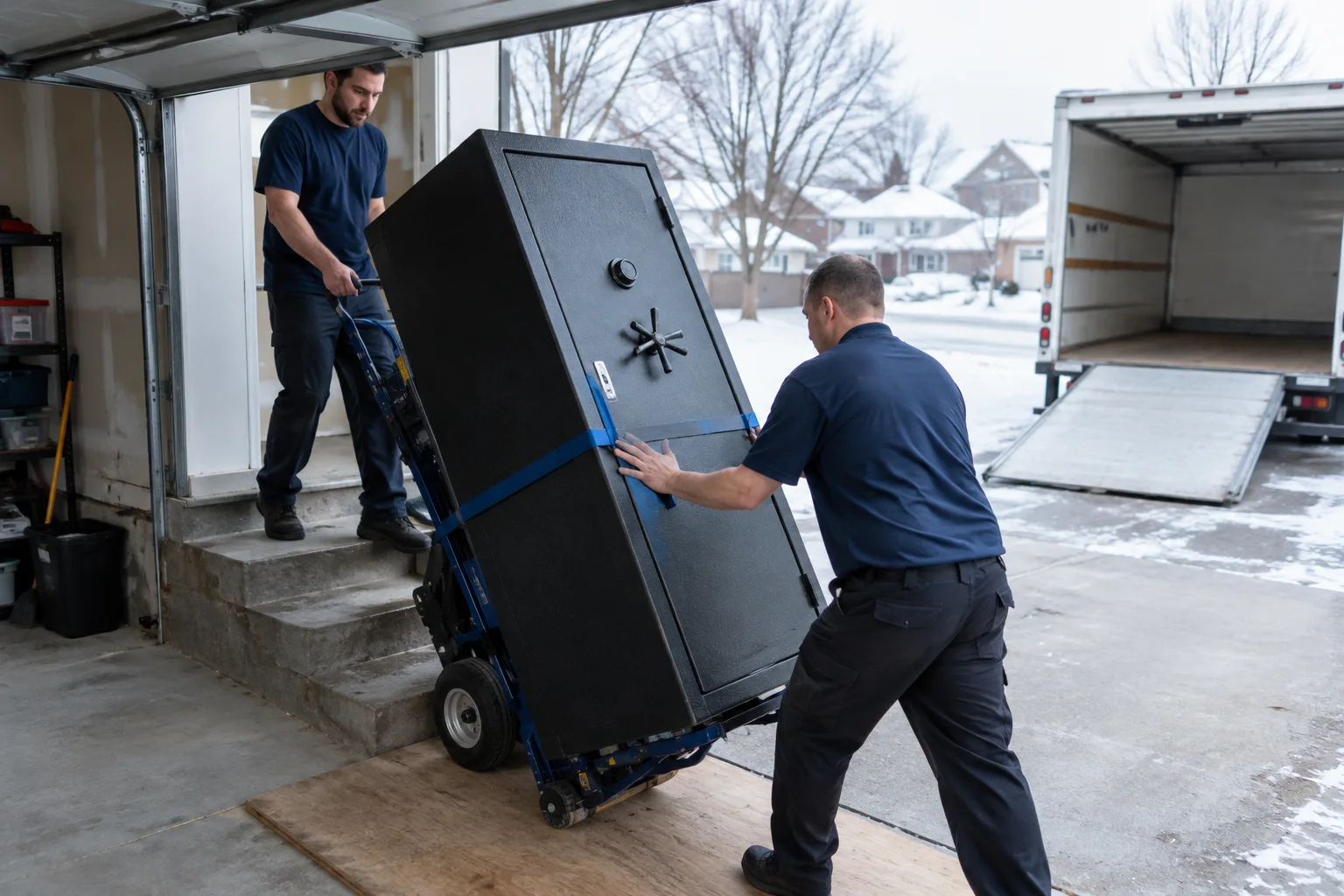
Amenity notes that gun safes typically weigh between about 300 and 2,000 pounds, and its crews have handled brands including Stack-On, Browning and Liberty ProVault using power dollies. A safe in a finished basement or on an upper floor gets its own plan for stairs, door frames and floor protection, and safes can also go into storage if the new home isn’t ready. See gun safe and safe moving for what to tell the estimator.
Packing and unpacking
Amenity packs whole houses or just the hard parts, bringing the right materials in the right quantities. When the calendar gets tight, last-minute packing help may be available, and emptied boxes can be picked up after the move, with some limitations. Optional liability valuation coverage applies to items Amenity packs. The packing and unpacking page explains the options.
A moving-day timeline for an Orland Park home
This sequence fits most houses and townhomes in the village, counting back from the day the truck arrives.
- Seven to eight weeks outSchedule the free in-home estimate. Walk the estimator through every room, the basement and garage, and point out any safe, piano or hot tub. Share HOA rules and closing dates.
- Five weeks outStart clearing out. WM takes one bulk item per weekly pickup, so a basement full of furniture needs several weeks, and appliances need a call to (800) 964-8988 first.
- Three weeks outBook an At Your Door pickup for old electronics, paint, motor oil and batteries; none of them can go in the cart or on the moving truck.
- Two weeks outCall Utility Billing at (708) 403-6175 about the water account, and line up electric, gas and internet changes for the same date.
- The week beforeCheck the village road work page for closures on your route, especially on Southwest Highway and at 143rd Street and John Humphrey Drive.
- The night beforeWatch the forecast. If 2 inches of snow are coming, clear the driveway so the truck can load off the street; curbside loading is limited to 30 minutes during a ban.
- Moving morningDo a final walk-through with the crew lead, mark anything staying behind and let the crew lay floor protection before the first piece moves.
- After deliveryCheck boxes and furniture against the inventory, note any damage on the paperwork before you sign, and set out empty cartons for collection if you arranged it.
How long the day runs depends on volume, stairs and truck access more than on the 21 miles between the warehouse and your door, which is why the estimate is done in person.
Storage when closing dates don't match
When you must leave one home before the next is ready, warehouse storage lets you load once and deliver once, instead of filling a container and hoping the dates line up.
Amenity’s storage is a 12,000-square-foot, climate-controlled warehouse in Plainfield. Your furniture is padded, wrapped in cardboard and sealed into 8′ x 7.5′ x 5′ wooden crates; sofas go on racks; and every item is entered in an inventory database with a copy for you. The crew can pick up in Orland Park, or you can drop items off, and terms run from one day to several years.
Warehouse storage is staff-access only: there’s no key and no unit to visit, and the site is protected by an alarm system, an outdoor camera and a lit yard. That suits a household waiting on a closing. If you need to reach your things every weekend, a self-storage unit may suit you better. The Orland Park specifics are on moving and storage in Orland Park, and the general service is on the moving and storage page.
Checking licenses before you sign
Every mover working in Orland Park should be able to show the right license for the trip. Moves that stay inside Illinois require a Household Goods License from the Illinois Commerce Commission and a published tariff of services and prices; the ICC’s Entity Search confirms whether a license is active. Amenity’s is ILCC 73744 MC-C.
Out-of-state moves are hauled under the authority of Wheaton Van Lines, Inc. (USDOT 70719, MC-87113), which Amenity represents as an authorized agent of Wheaton World Wide Moving. Federal rules for interstate moves cap what a mover can demand at delivery on a non-binding estimate at 110 percent of that estimate, and released value limits liability to 60 cents per pound per article. The long-distance moving page covers inventories, loading and tracking, and the Cook County moving page covers nearby communities.
Services we lead with in Orland Park
Nearby towns we move every week
- Movers in Tinley Park
- Movers in Homer Glen
- Movers in Mokena
- Movers in Frankfort
- Movers in Lemont
- Movers in New Lenox
More towns in Cook County · every service area
Frequently asked questions
Can I load a moving truck on my Orland Park street when it snows?
Only briefly. Once 2 inches of snow fall, Ordinance 9-7-6 limits parking on village-owned streets to 3 minutes for passengers and 30 minutes for loading or unloading property, until 8 hours after the snow stops or the street is cleared. A household move takes far longer, so clear the driveway and let the truck load from there during a winter storm.
Will Waste Management pick up furniture I leave behind?
One bulk item is collected with each weekly pickup, such as a couch, small table or mattress, and it must be at the curb by 6 a.m. Appliances are recycled after a call to (800) 964-8988, carpet goes out in taped 4-foot rolls of no more than 50 pounds, and electronics need WM’s At Your Door appointment service instead of the curb.
How far in advance should you hire movers?
For an Orland Park house, six to eight weeks is a comfortable lead time, longer for a summer weekend or a move tied to a closing. Downsizing moves benefit from extra time, because sorting a long-held home usually takes longer than packing it. The guide on how far in advance to book movers has a week-by-week plan.
What are red flags with movers?
Warning signs include a price given only by phone without seeing your things, a request to sign blank or incomplete paperwork, no definite pickup and delivery dates, and no active ICC license for an in-state move. For interstate moves, look the carrier up in FMCSA’s SAFER system. The moving scam red flags guide explains each one.
Are you supposed to empty dressers for movers?
Take out anything fragile, valuable, heavy or liquid, and empty any piece with loose drawers or older runners. Light folded clothes can sometimes stay in a solid dresser, but full drawers add weight on stairs. Ask about specific pieces during the estimate, since the answer depends on the furniture and the route out of the house.
What to throw away before moving?
Start with what can’t travel: dried-out paint, old chemicals, propane and anything leaking. In Orland Park, schedule electronics, paint and batteries for WM’s At Your Door pickup, set out one bulk item per week and call ahead for appliances. Then cut duplicates, outgrown clothes and furniture that won’t fit the new floor plan, which lowers volume and time on moving day.
Should I tip movers in Orland Park?
Tipping is optional and up to you. Many customers tip when a crew handles stairs, a heavy safe or a long day well, and many simply provide water and lunch. If you plan to tip, give it to each crew member directly. The guide to tipping movers explains how people usually decide on an amount.
Which Metra stations serve Orland Park?
Three stops on Metra’s SouthWest Service: Orland Park 143rd Street at 143rd Street and Southwest Highway, Orland Park 153rd Street at 10499 W. 153rd Street, and Orland Park 179th Street at 179th Street and Southwest Highway. The line runs between Manhattan and Chicago’s Union Station with weekday and weekend service, and Pace routes 364 and 379 also serve the village.
Sources
- Snow Removal — Village of Orland Park
- Waste Management — Village of Orland Park
- Road Work — Village of Orland Park
- SouthWest Service (SWS) — Metra
- Household Goods Movers — Illinois Commerce Commission
- 49 CFR Appendix A to Part 375 — Legal Information Institute, Cornell Law School
Who handles your move
Local Moving Specialists is operated by Amenity Moving & Storage Inc., 10028 Mandel St, Plainfield, IL 60585 — a family-run Illinois mover since 1986. Illinois household goods license ILCC 73744 MC-C. Interstate moves are transported under the authority of Wheaton Van Lines, Inc. (USDOT 70719, MC-87113), for which Amenity is an authorized agent. See licenses & disclosures.
Last reviewed November 11, 2026 against Amenity Moving & Storage’s published service details and the public sources listed above.
Moving in or out of Orland Park?
Book a free, no-obligation in-home estimate with Amenity’s Plainfield team.