Piano Movers in Aurora, From Porch Steps to Townhome Stairs
Aurora's pianos live in 19th-century houses, 1990s subdivisions and newer townhomes. Amenity's crews plan each move from a Plainfield warehouse about five miles away.
- Warehouse ~5 mi from Aurora
- Licensed: ILCC 73744 MC-C
- Uprights and grands
- Free in-home estimates

Who moves pianos in Aurora, IL, and what goes into the price?
Amenity Moving & Storage moves pianos in Aurora with its own crews, working from a Plainfield warehouse about 5.1 miles away under Illinois license ILCC 73744 MC-C. Aurora’s homes range from 19th-century houses to recent townhomes, so the price depends on the piano and the route: porch and interior steps, tight turns, grand disassembly, distance and timing, all checked at a free in-home estimate.
Get your free moving quote
Tell us where and when. Amenity’s Plainfield office replies directly.
On this page
A city of old houses and new ones
Aurora’s housing spans well over a century, and a piano move here changes with the age of the house it starts or ends in. The same upright can be a simple roll across a level entry or a slow trip down a porch and a turning staircase.
Census Bureau estimates for 2020 to 2024 show how mixed the stock is: 24.9% of Aurora’s housing units were built before 1960, 17.6% between 1960 and 1979, 32.7% between 1980 and 1999 and 19.7% in the 2000s, with just 5.1% from 2010 on. Detached single-family houses make up 58.7% of units and townhomes or other attached houses 16.6%. The median home has 5.7 rooms, and 33.6% of households rent.
That mix produces three kinds of piano jobs. Older houses in and around the historic districts bring porches, original doors and staircases that deserve a tape measure. Subdivisions from the 1970s through the 2000s bring basements and two-story rooms. Townhomes, apartments and condos bring interior stairs, shared hallways and elevators. The sections below take them one at a time, and the Aurora movers page covers the rest of a household move here.
Pianos in Aurora's historic neighborhoods
Aurora has four locally designated historic districts: Near Eastside, which the City Council made the first in 1981, Riddle Highlands in 1989, Tanner in 1998 and Palace Street in 1999. The Westside district was listed on the National Register in 1986, and the city says most of its buildings went up between 1850 and 1920.
The city’s own descriptions of those houses read like notes for a piano crew. Near Eastside entries mention a deep front porch, double front doors with etched glass and a side stairwell bay. The third floor of the Beaupre House on the near east side was used as a ballroom, and so was the top floor of the Hurd House in the Westside district. Styles run from Greek Revival and Italianate through Queen Anne, Prairie and Four-Square.
In a house from that era, these are the things to check before the estimate:
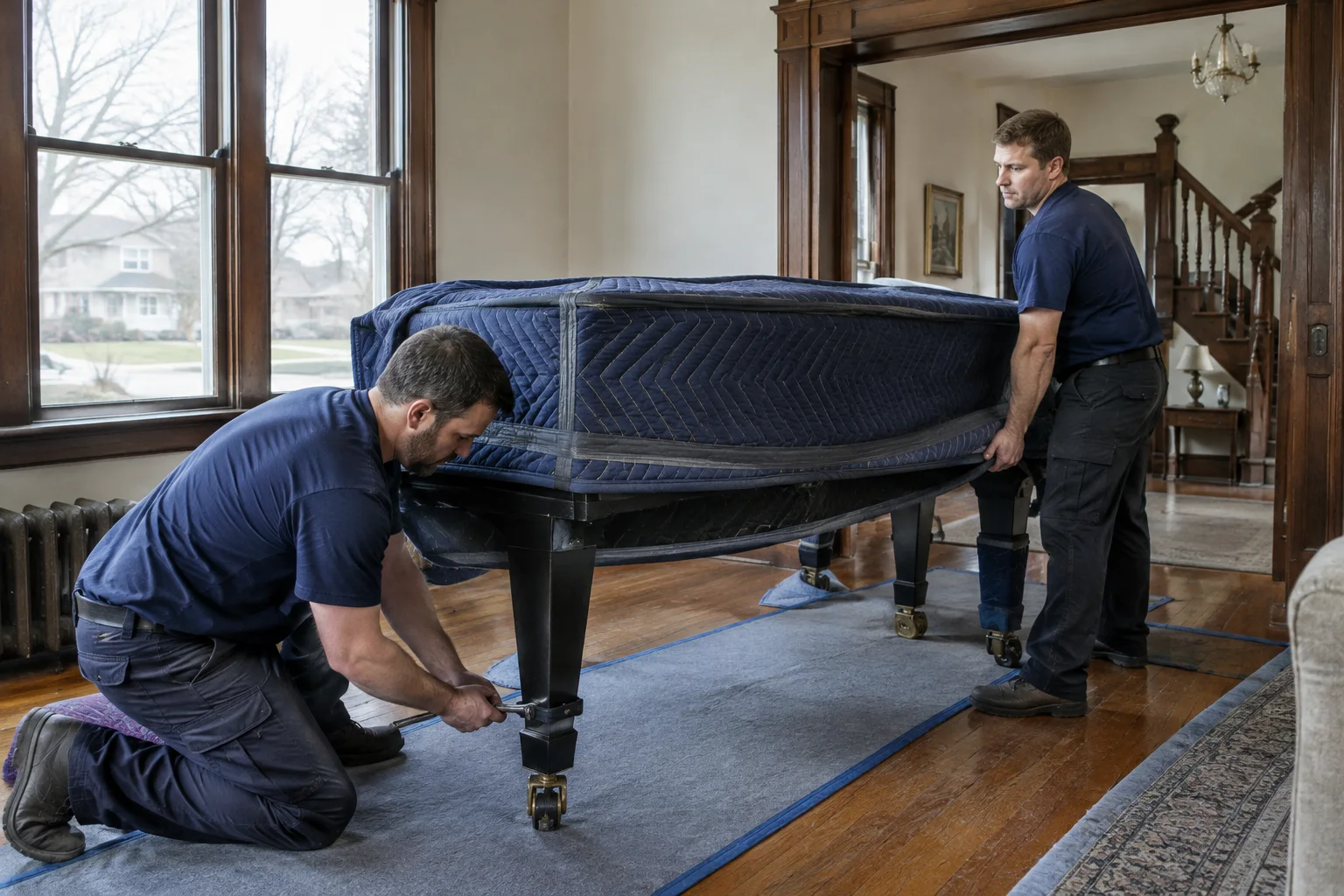
- Porch steps and the porch floor. Count the steps from the walk, and check that the porch boards are sound before a 500-pound upright rolls across them.
- Original doors. A pair of front doors may open wider than a single door, but old hinges, hardware and glass need padding and patience.
- Turning staircases. Measure the tightest point on any stair that turns at a landing or winds, and the headroom above it.
- Upper floors. A piano on the second or third floor of a large old house means one or two full flights, which changes the crew size.
- Trim, banisters and floors. Point out anything original you want protected beyond the usual pads and runners.
Basements, great rooms and townhome stairs in newer Aurora
Newer parts of the city bring a different set of obstacles: lower levels, open two-story rooms and interior stairs in attached homes.
Start with the basement. The Census Bureau’s Survey of Construction shows that from 2000 through 2009, between 70% and 79% of new single-family houses completed in the Midwest each year had a full or partial basement, and in the 1970s the share ran from 72% to 83%. Those are regional figures, but with 19.7% of Aurora’s homes built in the 2000s and 17.6% in the 1960s and 1970s, the first thing to tell the estimator is whether your piano sits upstairs, downstairs or on the main floor.
Townhomes and attached houses, 16.6% of the city’s units, often split living space across levels joined by an interior staircase from the entry or garage. Measure that staircase and any turn near the top, because it may be the narrowest point on the whole route. Apartments and condos add the elevator’s inside dimensions, a reservation and the building manager’s move-in hours.
Open great rooms cut both ways. A two-story family room gives plenty of headroom once the piano is inside, but the doorway into it and the hallway leading there still set the limits. Hardwood and luxury vinyl get runners, and dollies roll only over protected floors.
Moving in or out of Aurora?
Book a free, no-obligation in-home estimate with Amenity’s Plainfield team.
Piano weights, and why the shape matters more
The four common pianos below weigh between 459 and 688 pounds, but a crew plans around shape before weight. These are the manufacturers’ published figures:
| Model | Type | Size (manufacturer) | Weight |
|---|---|---|---|
| Kawai K-200 | Upright | 45 in tall, 59 in wide, 22.5 in deep | 459 lb |
| Kawai K-500 | Upright | 51 in tall, 59 in wide, 24.5 in deep | 525 lb |
| Steinway Model S | Baby grand | 5 ft 1 in long, 57¾ in wide | 579 lb |
| Kawai GL-30 | Grand | 5 ft 5 in long, 59 in wide | 688 lb |
On a porch stair, the difference between shapes shows. A 51-inch upright stays vertical the whole way down, so the crew controls it from above and below as it drops one step at a time. A grand turned on its side on a padded board sits lower but runs longer, so a landing that an upright clears easily can stop a 5-foot-5 grand. That’s why the estimate records the piano’s measurements and the route’s tightest turn side by side.
Amenity’s crews move Steinway, Baldwin, Kawai, Young Chang and Yamaha pianos, among other makers. The step-by-step method is in our guide to how pianos are moved, and the way Amenity plans piano jobs across the suburbs is on the piano moving services page.
Moving a piano for a congregation, school or senior community
A piano bound for a church, a school or a retirement community needs more coordination than one going to a house, because another organization’s schedule and rules apply. Settle these points before the estimate:
| Destination | Questions to answer first |
|---|---|
| House of worship | Who approves the move and opens the building; which entrance has the fewest steps; whether the piano goes to the main floor, a platform or a loft; which service or event days to avoid; whether insurance paperwork is needed |
| School | The facilities contact and building hours; the loading dock or nearest door; any elevator, stage lift or stage stairs; floors that need protection, such as a gym; vendor paperwork the district requires |
| Senior living | Whether pianos are allowed in apartments and when quiet hours start; the elevator’s size and reservation rules; move-in hours and entrance; the wall the piano will stand against; any certificate of insurance |
| Donated piano | Whether a technician has inspected it; who owns it on moving day; who arranges the tuning afterward |
Aurora’s median age is 35.2, and 11.1% of residents are 65 or older, according to Census estimates. When a piano goes along on a move into a smaller apartment, decide early whether it fits the room and the building’s rules; senior moving and downsizing covers the rest of that process.
For a donation, have the piano evaluated before anyone pays to move it. Kawai notes that a piano’s lifespan depends on how it was built, how much it was played, the temperature and humidity it lived in, and its maintenance and repairs, so two instruments of the same age can be in very different condition.
About five miles from the Plainfield warehouse
Amenity’s warehouse at 10028 Mandel St in Plainfield is about 5.1 miles in a straight line from Aurora, so a local piano move here spends most of its time inside the two buildings rather than on the road. Local moves run one household per truck, and the piano can ride with the rest of your furniture.
Moves between Aurora and North Aurora, Montgomery, Oswego or Batavia leave from the same building, and the Naperville piano movers page covers the city next door. Aurora’s primary county has its own Kane County moving page.
When the next house isn’t ready, ask about keeping the piano in Amenity’s warehouse. The storage space is climate-controlled, entered only by Amenity personnel and protected by an alarm system and an outdoor camera, and each item is logged in an inventory database with a list for you. The Aurora moving and storage page explains how pickup and delivery work.
Winter moves get floor runners, and if snow or ice makes porch steps unsafe the date can be moved, subject to availability. Our guide to moving in winter around Chicago covers the rest of the cold-weather planning.
Tuning, technicians and the first winter in a new house
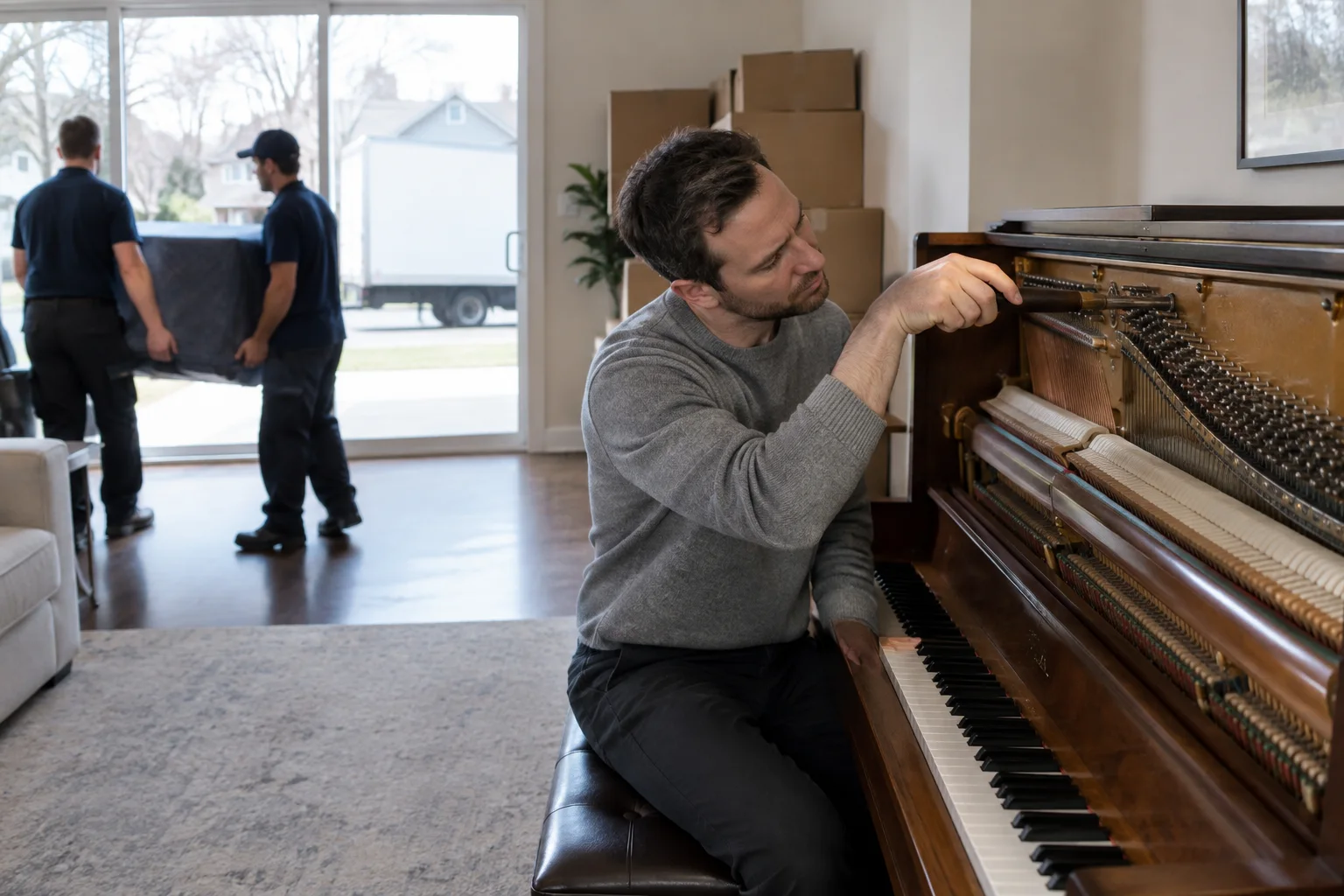
Book a tuning after the piano has spent some time in its new room, and expect the season to matter. The Piano Technicians Guild’s humidity guidance lays out the mechanism: damp air swells the soundboard’s crown, which pushes the bridge harder against the strings and raises pitch, while dry air shrinks the crown and lets pitch fall, with the biggest change in the center of the keyboard.
PTG notes that relative humidity is very low during the cold winter season, so a move into a freshly heated house in December asks a lot of the instrument. It advises keeping a piano away from extremes of temperature and humidity, calls direct sunlight especially damaging, and prefers an interior wall to an outside wall in a house that isn’t well insulated, a point worth weighing in an older home.
To find a technician near your Aurora address, PTG’s search tool takes a ZIP code and a radius, and can also search by PTG chapter or by special services offered. Look for the RPT designation. A Registered Piano Technician has passed a written exam on piano design, tuning theory and repair, a tuning exam that includes tuning by ear without electronic aids, and a technical exam on assembling and regulating actions and making common repairs. PTG says the credential marks a technician ready for normal service and repair; rebuilding is a separate specialty.
Tell the technician the piano was just moved, and ask how long it should acclimate before the first visit.
Details that make an Aurora piano quote accurate
Amenity prices piano moves after a free, no-obligation in-home visual estimate instead of a flat rate, because the route usually changes the job more than the piano does. These details make the estimate accurate:
- Brand, type and size: height, width and depth for an upright, or length and width for a grand.
- The number of steps at each address, counting porch steps, stoops, garage steps and landings.
- Which floor the piano is on now and which floor it’s going to.
- Photos of the tightest turn and the narrowest door on each route.
- For an older house, anything original you want protected, such as a banister, trim or a leaded-glass door.
- For a townhome or apartment, the elevator size, the building’s move hours and the manager’s contact.
- Whether storage, a full household move or an out-of-state delivery is part of the plan.
Ask about valuation before you sign. On an interstate move, the no-cost released value option caps the mover’s liability at 60 cents per pound per article under the federal Your Rights and Responsibilities rules, which comes to about 315 dollars for a 525-pound upright. For a move inside Illinois, get the valuation terms in writing. Out-of-state piano moves run through Amenity’s role as an authorized Wheaton World Wide Moving agent, under Wheaton Van Lines, Inc. (USDOT 70719). When your details are ready, request a free quote.
Back to all moving services in Aurora · Piano Moving across the suburbs
Frequently asked questions
What does it cost to move a piano in Aurora, IL?
The price depends on the job, not a rate card. A console on a level main floor is quick; a grand coming down from the second floor of a Victorian house, across a porch and down its steps takes more crew, equipment and time. Amenity sets the price after a free in-home visual estimate that covers the piano, both routes, the distance and your date.
Can a piano be moved down the porch steps of an old house?
Usually, with planning. The crew counts the steps, checks that the porch floor and steps are sound, and controls an upright from above and below as it drops one step at a time; a grand goes down on its board. If the steps are icy or crumbling, the date or the route may need to change, and the estimator will flag that early.
How do I find a good piano tuner in Aurora?
Start with the Piano Technicians Guild’s Find a Technician search, which lists technicians by ZIP code and radius. Look for the RPT designation: a Registered Piano Technician has passed PTG’s written, tuning and technical exams. Tell the technician the piano was just moved, and ask how long it should settle before the first tuning.
Why does my piano go out of tune every winter?
Dry air. The Piano Technicians Guild explains that the soundboard’s crown shrinks as it dries, easing pressure on the strings so pitch drops, mostly in the middle of the keyboard. PTG says relative humidity is very low in the cold winter season. Placing the piano away from heating vents and asking a technician about an in-piano humidity control system both help.
Should my piano stay in the garage while we renovate?
It’s better not to. PTG advises keeping a piano away from extremes of temperature and humidity, and a garage usually follows the outdoor weather. If the house will be torn up for weeks, ask about storing the piano in Amenity’s climate-controlled Plainfield warehouse, where only Amenity personnel go inside and every stored item is logged.
Can you move a piano into a senior apartment or a church?
Yes, within the building’s rules. Before the estimate, find out whether pianos are allowed, the elevator’s size and reservation process, the hours set aside for moves, which entrance has the fewest steps, and whether a certificate of insurance is required. For a church, also ask which days services or events rule out.
How far is your warehouse from Aurora?
About 5.1 miles in a straight line. Amenity’s warehouse is at 10028 Mandel St in Plainfield, so moves within Aurora and to nearby towns such as North Aurora, Montgomery, Oswego and Batavia are short local trips. Most of the time on a piano move is spent on the stairs and doors at each end.
Is an old upright worth moving?
Sometimes, and only an inspection will tell you. Kawai says a piano’s lifespan depends on how it was built, how much it was played, its temperature and humidity, and its maintenance and repairs. Have a Registered Piano Technician look at an older upright before you pay to move it, then share the verdict at the estimate.
Sources
- Zoning and Planning FAQs (historic districts and HCOA) — City of Aurora, Illinois
- Near Eastside Historic District — City of Aurora, Illinois
- Type of Foundation in New Single-Family Houses Completed — U.S. Census Bureau, Characteristics of New Housing
- Humidity Control — Piano Technicians Guild
- What Is An RPT? — Piano Technicians Guild
- Appendix A to Part 375 – Your Rights and Responsibilities When You Move — Legal Information Institute (Cornell Law School)
Who handles your move
Local Moving Specialists is operated by Amenity Moving & Storage Inc., 10028 Mandel St, Plainfield, IL 60585 — a family-run Illinois mover since 1986. Illinois household goods license ILCC 73744 MC-C. Interstate moves are transported under the authority of Wheaton Van Lines, Inc. (USDOT 70719, MC-87113), for which Amenity is an authorized agent. See licenses & disclosures.
Last reviewed November 11, 2026 against Amenity Moving & Storage’s published service details and the public sources listed above.
Moving in or out of Aurora?
Book a free, no-obligation in-home estimate with Amenity’s Plainfield team.