How to move a hot tub to a new house
Power, water, weight and the new pad: the order of operations spa makers recommend, and where an electrician and a moving crew each fit in.
- Hot tubs and spas
- Storage available
- Free in-home estimates
- ILCC 73744 MC-C
How do you move a hot tub?
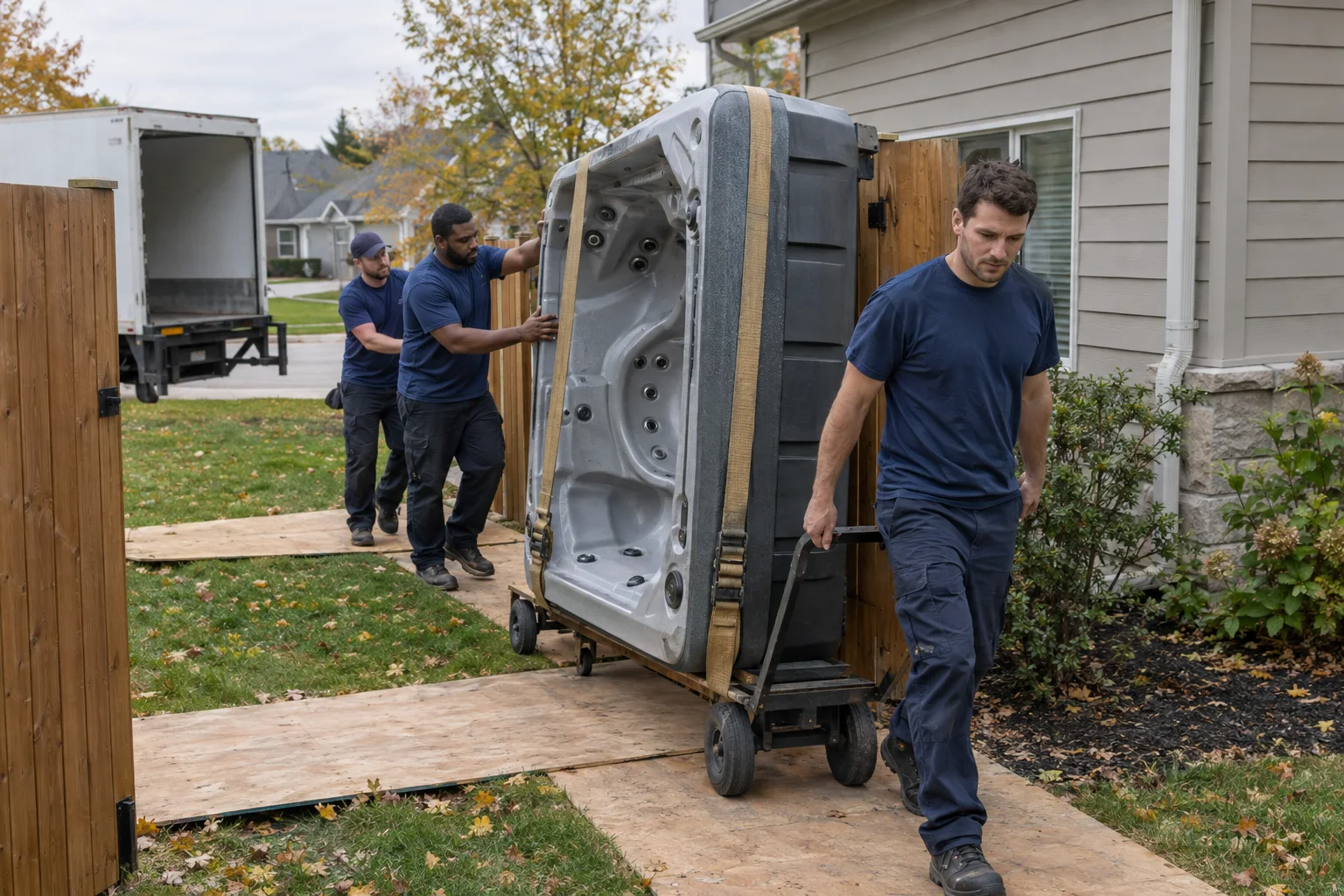
Shut off power at the breaker, drain and dry the spa, and have an electrician or spa technician disconnect a hardwired unit. The tub is then tipped onto its side, strapped to a spa cart and rolled out to the truck. Bullfrog Spas puts a small empty spa near 500 pounds and large ones at 900 to 1,250 pounds, so plan on a trained crew.
Get your free moving quote
Tell us where and when. Amenity’s Plainfield office replies directly.
On this page
How much a hot tub weighs, empty and full
An empty hot tub usually weighs somewhere between 500 and 1,250 pounds, and a filled one weighs several tons. Bullfrog Spas says a small two-to-three-person spa typically weighs about 500 pounds empty and roughly 3,000 pounds filled, while a large nine-to-ten-person spa runs roughly 900 to 1,250 pounds dry and up to 8,000 pounds filled.
The two numbers answer different questions. Dry weight is what the movers handle, because a spa only moves empty. Filled weight is what the new pad or deck has to carry once hundreds of gallons of water and the people using it are added, which is why the foundation at the new house matters as much as the move itself.
| Spa size | Empty (dry) weight | Filled weight | Source |
|---|---|---|---|
| Small, 2–3 people | About 500 lb | About 3,000 lb | Bullfrog Spas |
| Large, 9–10 people | About 900–1,250 lb | Up to about 8,000 lb | Bullfrog Spas |
| One person lifting, ideal conditions | 51 lb maximum | Not applicable | OSHA, citing the NIOSH lifting equation |
Even the lightest empty spa is about ten times the 51-pound maximum that OSHA says the NIOSH lifting equation sets for one person under ideal conditions. A spa is also wide, awkward to grip and wrapped in a cabinet that isn’t built to carry its own weight. Find your model’s exact numbers on its spec sheet, in the owner’s manual or on the label by the equipment bay before you book anything.
Should you move a hot tub yourself?
Spa manufacturers advise against it. Hot Spring’s guide to moving a spa tells owners not to attempt to move a hot tub themselves and says the safest way is with a trained spa mover, and Bullfrog says it is always safer to hire professionals to move, deliver and install a spa.
Warranty is the second reason. Hot Spring warns that moving a spa on your own may void the warranty, and Bullfrog suggests checking whether a do-it-yourself move would void a warranty that’s still in force. If yours is active, call the dealer or manufacturer and ask what the warranty requires when the spa is relocated, before anyone unplugs it.
What goes wrong on do-it-yourself spa moves
- Cabinet and equipment damage. Bullfrog warns never to let the equipment door or front panel bear the spa’s weight during a move. Tip the spa onto the wrong side and the panel that hides the pumps and controls takes the load.
- Shell and plumbing stress from dropping one corner or twisting the spa across uneven ground.
- Injuries at gates, steps and trailer ramps, where the load shifts all at once and people end up on the downhill side.
- Electrical hazards when wiring is disconnected by someone without the training the manual calls for.
- Freeze damage when water left in the lines freezes before the spa is refilled.
A rented trailer and a few friends can look cheaper on paper, but the spa usually ends up being the item that changes the math. Our rental truck vs. hiring movers guide compares the full costs of each approach for a household move.
Shut off and disconnect the power
Power comes off before any water is drained. Hot Spring’s moving guide says to turn the spa’s breaker to the off position at the circuit box, and a plug-in 110-volt model simply gets unplugged from the wall. Leave it off until the spa is set, refilled and reconnected at the new house.
Hardwired spas are a different job. Hot Spring says spas wired directly to the power supply require an electrician and/or a spa service representative to disconnect them, and its installation requirements page says a 220–240-volt spa needs a certified electrician to run wiring from the panel at the new home. Book that electrician early, because the spa can’t be filled and heated until the new circuit is ready.
Electrical work is a separate trade
Disconnecting and reconnecting a spa’s power isn’t moving work. Follow your owner’s manual, and wherever it or the spa maker calls for an electrician or a spa technician, hire one. Schedule the disconnect for a day or two before the move and the reconnect for after the spa is sitting level on its new base.
Ready for a straight answer on your move?
Book a free, no-obligation in-home estimate with Amenity’s Plainfield team.
Drain, dry and prep the spa
A spa has to be completely empty before it moves. Hot Spring notes that a submersible pump can drain one in about 10 to 15 minutes, and that a wet-dry vacuum should then clear the water left in the footwell and seats, a step it calls especially important when temperatures drop below freezing.
Before you pump, find out where the water is allowed to go. Spa water carries sanitizer, so call your village or city public works department and ask where you can discharge it before you aim a hose at a street drain.
- Remove the cover and cover lifter; they travel separately, flat and protected from punctures.
- Take out the filters and any loose pillows, steps or accessories.
- Clean the shell once it’s empty so residue doesn’t dry onto the surface; you can clean it again after setup.
- Close the drain valve and make sure access panels are fastened so nothing swings open on the cart.
- Write down the make, model, dimensions and weight for your mover.
- Photograph the cabinet on all four sides as a condition record.
Measure the route and get the new site ready
A hot tub travels on its side, so the opening it has to pass through is set by how tall the spa is, not how wide it is. Hot Spring’s installation guidance says you need an access point into the backyard at least as wide as the hot tub is tall, and that the crew sets the tub on its side on a hot tub cart and rolls it to the install spot.
Measure the spa’s height, width and length, then every gate, side yard, door and step along both routes. Hot Spring adds that the dolly’s own height counts when you check clearance under house eaves. Where no path is wide enough, the fallback is a crane lifting the spa over the house, which is a separate specialty service you want identified during planning, not on moving day.
Preparing the new foundation
The base has to be finished and level before the spa arrives. Bullfrog recommends concrete at least 4 inches thick reinforced with rebar or mesh, says a wood or vinyl deck is usually too weak unless it was engineered for that load, and says it never recommends setting a spa directly on dirt or grass. Hot Spring lists a level concrete pad or a reinforced deck as the most common surfaces and says some models can sit on pavers or modular pads, so check your model with the dealer.
Line up the electrician for the new circuit at the same time, and keep a garden hose within reach of the pad for the refill. Hot Spring counts unrestricted access, a solid and level base, electricity and a nearby hose as the basic installation requirements.
How a crew moves a hot tub, step by step
- Confirm it's empty and disconnectedThe crew checks that the breaker is off, that any hardwired connection has been undone by the electrician or technician, and that the spa is drained and dry.
- Protect the pathPlywood, heavy cardboard or a slip sheet goes down over lawn, pavers and thresholds so the cart doesn’t rut turf or chip stone.
- Tip it onto the correct sideWith several people controlling it, the spa is tilted onto a padded side that isn’t the equipment door or the front panel, following Bullfrog’s warning that neither should bear the weight.
- Strap it to the spa cartOn its side, the spa is strapped to a spa dolly or hot tub cart so it rolls as one unit through gates and around corners.
- Load and secure itThe spa goes up a ramp or liftgate into the truck and is strapped in so it can’t slide or tip during braking and turns.
- Set it on the new baseAt the new house it’s rolled to the pad, lowered back onto its base and positioned. Leveling, the electrical reconnect and the refill follow, with the electrician or spa technician handling the power.

Amenity Moving & Storage, a licensed Illinois mover based in Plainfield and the company behind this site, moves hot tubs and spas, and its estimator can look at the spa, both routes and the new pad during a free, no-obligation in-home visual estimate. Our hot tub and spa moving page explains how those moves are booked, and the specialty moving overview covers safes, pianos and other heavy items.
Timing a hot tub move around Illinois weather
Freezing weather is the main timing risk. Hot Spring flags clearing every bit of remaining water as especially important below freezing, because water left in the plumbing can freeze before the spa is refilled. If your move falls in the cold months, drain and vacuum the spa on the day it’s disconnected instead of leaving it partly full for the movers.
Snow, ice and spring mud all make a spa cart harder to control on lawns and side yards, and the new pad needs to be finished before the ground freezes or after it thaws. Amenity lays floor runners during winter moves and can change dates when weather turns, subject to availability.
If you have a choice, schedule the spa for a day when the new pad is complete and the electrician is booked for the reconnect. Our guides on what time of year to move in the Chicago suburbs and moving in winter around Chicago cover the rest of the calendar.
Storing a hot tub between homes
When the new house or its pad isn’t ready, a spa can wait in storage instead of a driveway. Amenity stores hot tubs and spas in its Plainfield warehouse: 12,000 square feet, climate-controlled, closed to everyone but Amenity staff, and covered by an alarm, an outdoor camera and yard lighting. The spa goes into Amenity’s inventory database with everything else you store, and you get the list.

Keep the spa fully drained and the cover stored flat and dry. Our comparison of self-storage and moving-company storage explains the trade-offs between the options, and the moving and storage page covers how Amenity’s warehouse works.
What to tell the estimator about your spa
The more the estimator knows, the fewer surprises on moving day. Have these details ready:
- Make, model, and the spa’s length, width, height and dry weight
- Where it sits now (patio, deck, sunken, indoors) and where it’s going
- The narrowest gate or opening on each route, and any steps, slopes or decks
- Who is handling the electrical disconnect and reconnect, and when
- Whether the new pad is finished, and whether the spa needs storage in between
- Whether it moves along with the rest of the household
Pricing follows the work: the spa’s size and weight, the access at both ends, distance and timing. Rather than quote a spa move sight unseen, Amenity prices it after the visit; the in-home estimate guide walks through that visit. If you’re also moving a safe, our guide on how to move a gun safe covers the other heavy item people most often ask about.
Amenity’s crews work from its Plainfield warehouse across the western and southwestern suburbs, including Naperville, Plainfield, Oswego and Yorkville, so the estimate can happen at the spa itself.
Keep reading
- How Pianos Are Moved
- Self-Storage vs. Moving-Company Storage
- What Movers Will Not Move
- Rental Truck vs. Hiring Movers
Browse the full moving guide library or see every moving service.
Frequently asked questions
How much does a hot tub weigh empty?
Bullfrog Spas says a small two-to-three-person spa typically weighs about 500 pounds empty, while large nine-to-ten-person spas run roughly 900 to 1,250 pounds dry. Filled, the same spas weigh roughly 3,000 to 8,000 pounds. Your model’s spec sheet or owner’s manual lists its exact dry and filled weights, which your mover and your new pad both depend on.
Can you move a hot tub on its side?
Yes, that’s the standard method. Hot Spring describes delivery crews setting the spa on its side on a hot tub cart, which is why the gate or opening must be at least as wide as the spa is tall. Bullfrog warns never to let the equipment door or front panel carry the weight, so the spa goes onto a different, padded side.
How long does it take to drain a hot tub?
With a submersible pump, Hot Spring says a spa can be drained in about 10 to 15 minutes. If you use the spa’s own drain and a garden hose instead, allow more time. Either way, finish with a wet-dry vacuum to remove the water left in the seats and footwell, which Hot Spring calls especially important when it’s below freezing.
Do I need an electrician to move a hot tub?
For a hardwired spa, yes. Hot Spring says spas wired directly to the power supply require an electrician and/or a spa service representative to disconnect, and a certified electrician to wire a 220–240-volt spa at the new home. A plug-in 110-volt spa just gets unplugged. Always follow what your owner’s manual says.
Can you move a hot tub in winter?
Yes, with extra care. The spa must be drained and vacuumed completely so no water is left to freeze, the route has to be cleared of snow and ice, and the new pad should already be finished. Amenity can change dates when weather turns, subject to availability, and lays floor runners down during winter moves.
Can a hot tub go on a deck at my new house?
Only if the deck was built or reinforced for it. Bullfrog says most wood or vinyl decks aren’t strong enough unless they were engineered for the load, and recommends reinforced concrete at least 4 inches thick. Hot Spring lists a reinforced deck as a common option. Have a contractor or engineer confirm the deck before the spa arrives.
Should I leave the hot tub with the house when I sell?
That’s a decision for you and your real estate agent, and it should be written into the sale contract either way. Moving a spa means paying for the disconnect, the move, a new pad and electrical work at the next house. If those costs outweigh what the spa is worth to you, including it in the sale can make sense.
Can movers store a hot tub?
Yes. Amenity keeps stored spas in its Plainfield warehouse, a climate-controlled building that only company staff enter. Because it isn’t self-storage, you won’t get a unit or a key; the spa is inventoried on the way in and stays put until delivery, ideally once the new pad is finished and the electrician has a date.
Sources
- The Best Way to Move a Hot Tub Safely — Hot Spring Spas
- What Are Hot Tub Installation Requirements? — Hot Spring Spas
- How Much Does a Hot Tub Weigh and Can You Move it By Yourself? — Bullfrog Spas
- OSHA procedures for safe weight limits when manually lifting — U.S. Occupational Safety and Health Administration
Who handles your move
Local Moving Specialists is operated by Amenity Moving & Storage Inc., 10028 Mandel St, Plainfield, IL 60585 — a family-run Illinois mover since 1986. Illinois household goods license ILCC 73744 MC-C. Interstate moves are transported under the authority of Wheaton Van Lines, Inc. (USDOT 70719, MC-87113), for which Amenity is an authorized agent. See licenses & disclosures.
Last reviewed November 11, 2026 against Amenity Moving & Storage’s published service details and the public sources listed above.
Ready for a straight answer on your move?
Book a free, no-obligation in-home estimate with Amenity’s Plainfield team.