Self-storage vs. moving-company storage, and where storage in transit fits
Who loads it, who holds the key, who's responsible if something is damaged, and how each option is billed, with the federal and Illinois rules behind each answer.
- 12,000 sq ft warehouse
- Crated and inventoried
- Climate-controlled
- ILCC 73744 MC-C

What is storage in transit, and how is it different from self-storage?
Storage in transit (SIT) is storage your interstate mover provides as part of the shipment, holding your goods in a warehouse before final delivery; federal rules require written notice before it converts to permanent storage. Self-storage is a unit you rent, load and lock yourself. Moving-company storage sits between them: the mover handles, inventories and warehouses your things, and you don’t get a key.
Get your free moving quote
Tell us where and when. Amenity’s Plainfield office replies directly.
On this page
Three kinds of storage people use during a move
If you need to bridge a gap between homes, you’re usually choosing among three options: a drive-up self-storage unit you load and lock yourself, warehouse storage run by the moving company, or a portable container dropped at the house. Storage in transit, or SIT, is a fourth term you’ll see on interstate paperwork. It’s a federal category for storage the mover provides during the shipment, not a different kind of building.
The real difference between them is responsibility. In a self-storage unit, you keep custody of your belongings and the facility rents you space. In a mover’s warehouse, the mover has your goods and owes a legal duty of care. With a container, you pack and load, and the company moves and keeps the box.
Common reasons to need storage include a closing date that lands after your move-out, a new home still under construction, a downsizing move where not everything fits yet, and a destination that’s already furnished. Each one points toward a different option, as the comparison below shows.
What storage in transit means under federal rules
Storage in transit is temporary storage your interstate mover provides as part of the move, holding your goods in a warehouse before final delivery. The FMCSA consumer booklet, reprinted in federal regulations at Appendix A to 49 CFR Part 375, explains that you may ask your mover to store your household goods before delivering them.
Because SIT is still part of the shipment, the federal rules treat loss or damage during the SIT period as the mover’s responsibility under the valuation you chose. That changes when SIT ends and your goods convert to permanent storage.
The notice your mover owes you
Under 49 CFR 375.609, when the SIT period is about to run out, the mover must notify you in writing at least 10 days before the end of either the storage period you agreed to or the maximum SIT period in its tariff, or one day before the end if the storage is shorter than 10 days. The notice must tell you:
- the date SIT converts to permanent storage;
- that you have nine months after that date to file claims for loss or damage that happened in transit or during SIT;
- that the mover’s liability is ending; and
- that your goods will become subject to the warehouse’s rules, regulations and charges.
The notice has to go by fax, email, overnight courier or certified mail with return receipt. If the mover fails to send it, its carrier liability automatically continues until the end of the day after it actually gives notice. Once goods go into permanent storage, they must be placed in your name with your contact information on file.
SIT is not the same as an early-arrival hold
The same booklet covers a different situation: if the mover is ready to deliver before the first day of your delivery window and you can’t accept the shipment yet, it may store the shipment in a warehouse near your destination. In that case the mover must tell you the warehouse’s name and address and is responsible for the redelivery, handling and storage charges until final delivery.
On interstate shipments, the no-extra-charge Released Value option limits the mover’s liability to 60 cents per pound per article, while Full Value Protection is the higher level; our page comparing Full Value Protection and Released Value explains the choice. Amenity Moving & Storage, which runs this site and holds Illinois household goods license ILCC 73744 MC-C, handles moves to other states as an authorized agent of Wheaton World Wide Moving, under Wheaton Van Lines’ federal authority (USDOT 70719); see long-distance moving.
These federal rules cover interstate moves. For a move that stays inside Illinois, get the storage terms, charges and valuation in writing before anything goes into a warehouse.
Drive-up self-storage: you hold the key and the responsibility
Self-storage gives you the most access and the most responsibility. Illinois’s Self-Service Storage Facility Act defines these facilities as property rented out so occupants can store and remove their own belongings, and it states that a self-service storage facility is not a warehouse under Article 7 of the Uniform Commercial Code.
In practice, the facility is renting you space, not taking care of your goods. The Act says that, unless the rental agreement provides otherwise and until any lien sale, the exclusive care, custody and control of property in the unit remains with the occupant. If a roof leaks or a badly stacked load topples, what you recover depends on your rental agreement and your own insurance, so read both before you sign.
If the rent goes unpaid
The facility owner has a lien on everything in the unit from the day it’s brought in. Under Section 4 of the Act, enforcing that lien takes a written notice with an itemized claim and a demand for payment no sooner than 14 days after delivery. The sale must then be advertised once a week for two consecutive weeks in a local newspaper and can’t take place sooner than 15 days after the first ad. If the rental agreement allows it, the owner can deny you access while the bill is unpaid, and rent keeps accruing.
The hidden cost is handling
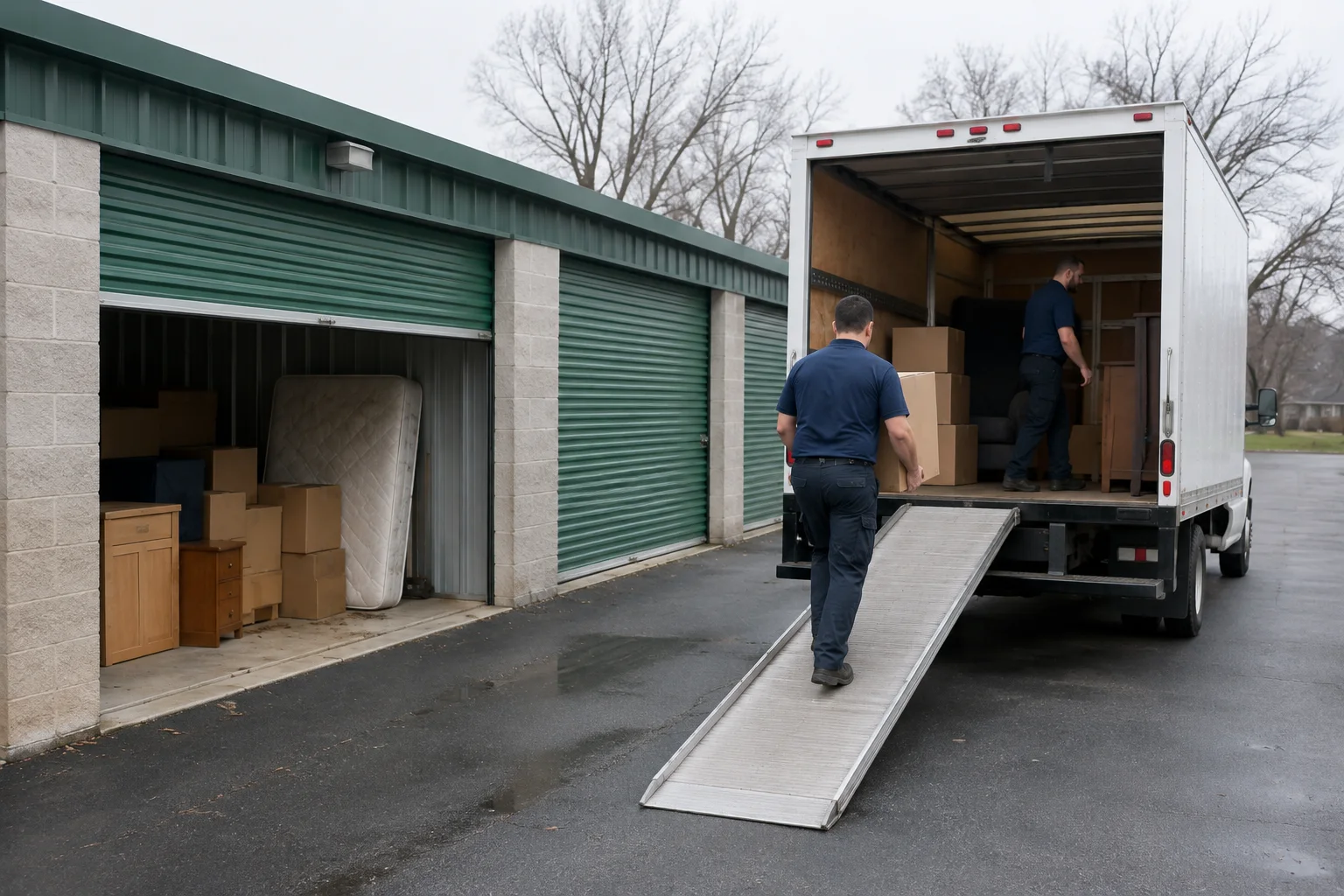
Self-storage usually means four handlings: loading a truck at the old home, unloading into the unit, loading the truck again later and unloading at the new home. Each one takes a block of your time or paid labor and is another chance for damage. Our guide to rental truck vs. hiring movers breaks down what that labor really involves.
Ready for a straight answer on your move?
Book a free, no-obligation in-home estimate with Amenity’s Plainfield team.
Moving-company warehouse storage: how Amenity's works
Moving-company storage trades personal access for professional handling. Amenity stores household goods in a 12,000-square-foot warehouse in Plainfield, for anywhere from one day to several years. You can drop items off yourself, or Amenity can pick them up and bring them in.
- Furniture is wrapped in pads and cardboard, then packed and sealed in large wooden crates measuring 8′ x 7.5′ x 5′.
- Sofas are stored on sofa racks so they can’t be crushed or compacted.
- Every item is entered in an inventory database, and you get a detailed list of everything stored.
- Only Amenity personnel have access to the warehouse.
- The site has a well-lit yard, an alarm system and an outdoor security camera.
- The storage space is climate-controlled.
It is not drive-up self-storage: there’s no unit and no key for you. That’s the trade. Fewer people touch your furniture, everything is listed, and the crew that moves you also stores you, in exchange for not being able to stop by with your own key. The moving and storage page and the Plainfield moving and storage page explain how it’s arranged.

A warehouse's legal duty of care
A warehouse holding your goods owes a duty of care that a self-storage landlord doesn’t. Under Illinois’s version of the Uniform Commercial Code, 810 ILCS 5/7-204, a warehouse is liable for loss or damage caused by failing to use the care a reasonably careful person would use under similar circumstances.
The same section lets the storage agreement limit the amount of that liability, and lets you ask in writing, when you sign or soon after, for a higher valuation on some or all of your goods, which the warehouse may charge more for. Read the valuation terms in any storage agreement, and ask how they compare with the coverage on the move itself.
Portable containers: you load, they haul
A portable storage container sits between the other two. The company drops a container at your home, you pack and load it, and the company either leaves it with you or hauls it to its own lot, then delivers it when you’re ready.
A container saves the truck rental and cuts the handling to two rounds, loading at the old home and unloading at the new one. The loading is still yours, though, and so is the risk of a poorly stacked load shifting when the container is lifted and driven. Ask where the container will be kept, whether you can get into it there, whether that space is climate-controlled, and what protection the company offers for the contents.
Before a container lands in your driveway or on the street, check with your village and, if you have one, your HOA about where it can sit and for how long. Rules vary from one community to the next.
Side by side: access, handling, protection and cost
| Factor | Drive-up self-storage | Mover's warehouse storage | Portable container |
|---|---|---|---|
| Who loads | You, or labor you hire | The moving crew | You, or labor you hire |
| Times your goods are handled | Usually four, by you or your helpers | The same four moves, done by the crew, with furniture crated in the warehouse | Two: you load at the old home and unload at the new one |
| Access while stored | Whenever the facility is open, with your key or code | No key or unit; at Amenity, only company personnel enter the warehouse | Depends on where the container is kept; ask |
| Inventory | Whatever you write down | At Amenity, every item entered in an inventory database, with a list for you | Whatever you write down |
| Climate | Varies by unit; ask | Climate-controlled at Amenity | Varies by company; ask |
| Who has custody | You; Illinois law leaves care, custody and control with the occupant | The warehouse, under the storage agreement and its UCC duty of care | Depends on the company’s terms |
| How it’s billed | Monthly unit rent, plus your truck, labor, lock and insurance | Storage charges plus pickup, handling and delivery, as set out in the estimate and storage agreement | Delivery and pickup fees plus container rent |
| Makes sense when | You need frequent access to some items | You want one company to move, store and deliver | You have the time and help to pack and load yourself |
No option is automatically cheaper. A self-storage unit’s monthly rent can look low until you add two extra truck rentals, the hours of loading and your own insurance. A mover’s storage bundles the labor, so compare total costs for the whole period rather than the monthly line alone.
Which storage option fits your move
- Closing dates a few days or weeks apart. Mover storage keeps the job with one crew: they load you out, hold everything, and deliver once you have keys. See the Joliet and Aurora moving and storage pages for how that works locally.
- Building a new home or waiting on a lease. Storage for months makes inventory and climate control matter more than access.
- Downsizing. Storing what doesn’t fit yet gives family time to decide; our senior moving and downsizing page covers that process.
- Interstate move with a delayed delivery. Ask the carrier whether the storage is SIT under your bill of lading, and when it would convert to permanent storage.
- Frequent access to seasonal gear or business stock. A self-storage unit you can visit is the practical choice.
- A tight budget and willing helpers. A container or self-storage unit, loaded carefully, can work.
- Pianos, antiques, wood furniture and leather. Choose climate-controlled space. The Piano Technicians Guild names roughly 68 degrees Fahrenheit with 42 percent relative humidity as the ideal for pianos; our guide on how pianos are moved explains why.
- Heavy specialty items. Amenity can store gun safes and hot tubs as well as household goods.
Amenity’s warehouse serves households across the area; the Wheaton and Bolingbrook moving and storage pages describe the local side of those moves.
Questions to ask before you sign any storage agreement
- Is this storage in transit under my interstate bill of lading, or permanent storage? If it’s SIT, when does it convert?
- What valuation applies while my goods are stored, and can I raise it in writing?
- How are storage charges calculated (by unit, by crate, by volume or by weight), and what are the charges to bring everything back out and deliver it?
- Who can access the space, and what happens if I need one item early?
- Is the space climate-controlled, alarmed and monitored?
- Will I get a written inventory, and how is each item’s condition recorded on the way in?
- What happens if a payment is late, and how will notices reach me?
- Which items aren’t allowed in storage?
Packing matters more for storage than for a move that unloads the same afternoon, because boxes sit stacked for weeks or months. Amenity offers full or partial packing services, and the rundown of what movers will not move flags items that shouldn’t go into any storage.
Keep reading
Browse the full moving guide library or see every moving service.
Frequently asked questions
What does storage in transit mean?
Storage in transit (SIT) is temporary warehouse storage your interstate mover provides as part of the shipment, before final delivery. Federal rules require the mover to notify you in writing before SIT converts to permanent storage, tell you when its liability ends, and give you nine months after conversion to file claims for loss or damage during transit or SIT.
How long can storage in transit last?
The length is set by the period you agree to with your mover and the maximum SIT period in its tariff. Under 49 CFR 375.609, the mover must notify you in writing at least 10 days before either period ends, or one day before if the storage lasts less than 10 days. After that, it converts to permanent storage.
Can I get into my things in a moving company's warehouse?
Not the way you would at a self-storage unit. At Amenity, only company personnel have access to the warehouse, and your furniture is crated and sealed, so there’s no unit or key. Before your goods go in, set aside anything you’ll need in the coming months, and tell the estimator if you expect to need something early.
Is my stuff insured in a self-storage unit?
Don’t assume the facility covers it. Illinois law says a self-service storage facility isn’t a warehouse, and that care, custody and control of what’s in the unit stay with the occupant unless the rental agreement says otherwise. Check whether your homeowners or renters policy covers off-site storage, and read any protection plan the facility offers.
What happens if I stop paying for a storage unit in Illinois?
The facility has a lien on everything in the unit. It must send a written notice with an itemized claim and a payment deadline at least 14 days out, then advertise the sale for two consecutive weeks; the sale can’t happen sooner than 15 days after the first ad. If the rental agreement allows, it can lock you out meanwhile.
Is climate-controlled storage worth it?
For wood furniture, pianos, leather, art and instruments, usually yes. The Piano Technicians Guild says pianos do well under steady conditions and points to around 68 degrees and 42 percent humidity. For a short stay of sturdy items in plastic bins, climate control matters less. Amenity’s Plainfield warehouse is climate-controlled.
Is moving-company storage more expensive than self-storage?
Not necessarily once you count everything. Self-storage rent covers only the space; you still pay for the truck twice, the labor at both ends and your own insurance. Mover storage includes the crew’s handling. Ask for a written estimate covering storage and delivery, then compare the total for the whole period.
Can a moving company store a piano, gun safe or hot tub?
Amenity can store gun safes and hot tubs and spas, along with household furniture, in its climate-controlled Plainfield warehouse. Pianos benefit from climate-controlled space too. Tell the estimator about any specialty item up front so it’s planned into the move and the storage.
Sources
- Appendix A to Part 375—Your Rights and Responsibilities When You Move — FMCSA regulations, 49 CFR Part 375 (GovInfo)
- 49 CFR 375.609 — What must I do for shippers who store household goods in transit? — Code of Federal Regulations (GovInfo)
- 770 ILCS 95/2 — Self-Service Storage Facility Act, Definitions — Illinois General Assembly
- 770 ILCS 95/4 — Self-Service Storage Facility Act, Enforcement of lien — Illinois General Assembly
- 810 ILCS 5/7-204 — Duty of care; contractual limitation of warehouse's liability — Illinois General Assembly
- Servicing & Maintenance — Piano Technicians Guild
Who handles your move
Local Moving Specialists is operated by Amenity Moving & Storage Inc., 10028 Mandel St, Plainfield, IL 60585 — a family-run Illinois mover since 1986. Illinois household goods license ILCC 73744 MC-C. Interstate moves are transported under the authority of Wheaton Van Lines, Inc. (USDOT 70719, MC-87113), for which Amenity is an authorized agent. See licenses & disclosures.
Last reviewed November 11, 2026 against Amenity Moving & Storage’s published service details and the public sources listed above.
Ready for a straight answer on your move?
Book a free, no-obligation in-home estimate with Amenity’s Plainfield team.