Rental truck vs. hiring movers: what each one really costs
Truck rental, full-service movers, portable containers and labor-only help compared, with the costs people forget and a decision table for your move.
- Licensed: ILCC 73744 MC-C
- Family-run since 1986
- Wheaton World Wide agent
- Free in-home estimates
Is it cheaper to rent a truck or hire movers?
For a small, short move with free and able helpers, a rental truck usually costs less in cash. The gap narrows as the home gets bigger, the distance grows, or stairs, a piano or a safe enter the picture, because you also pay for mileage, fuel, equipment, damage coverage, extra days and your own time and injury risk. Price both in writing before deciding.
Get your free moving quote
Tell us where and when. Amenity’s Plainfield office replies directly.
On this page
What a rental truck move actually costs
A rental truck’s advertised rate covers the vehicle and not much else. To compare it fairly with movers, price the rental as a complete move. Write down a figure for every line below before you look at a mover’s estimate.
| Cost item | What drives it | How to price it |
|---|---|---|
| Base rental | Truck size, rental length, and whether you return it to the same location | Get the full quote in writing, with taxes and fees |
| Mileage | Whether the quote charges per mile or includes a mileage allowance | Multiply your route, including the trips to pick up and return the truck, by the per-mile rate |
| Fuel | Route miles, the truck’s fuel economy and local fuel prices | Miles divided by the truck’s listed mpg, times the current price per gallon |
| Damage coverage | The rental company’s protection plans and whether your own auto policy extends to the truck | Call your insurer before the rental counter asks |
| Equipment | Dollies, furniture pads, straps and ramps | Price each rental item; plan several pads per large piece |
| Packing materials | Boxes, tape, packing paper, bubble wrap, mattress bags | Count room by room before you buy |
| Helpers | Food and gas money for friends, or paid loaders | Be honest about who will show up, and for how long |
| Extra time | Late return, a second rental day, a second trip | Ask what each costs before you sign |
| Your time | Days off work for packing, loading, driving and returning the truck | Put a dollar value on the hours |
Fuel is the line most people guess at. The arithmetic is simple: total miles divided by the truck’s rated miles per gallon, times the current price per gallon. A 60-mile day of local trips in a truck rated at 10 mpg burns about 6 gallons; a 900-mile one-way trip in the same truck burns about 90. The U.S. Energy Information Administration publishes weekly regional prices, including the Midwest, in its Gasoline and Diesel Fuel Update.
Rental moves also carry costs that never show up on a receipt: the drive to pick up the truck, the second trip when everything doesn’t fit, the scraped mirror, and the evening spent returning it with a full tank. None of these are reasons not to rent. They are reasons to price the rental honestly.
What hiring movers actually costs
Movers price short moves by time and long moves by weight and distance. The Illinois Commerce Commission’s consumer guide to household moves says moves of less than 50 miles, or moves entirely within Cook, DuPage, Kane, Kendall, Lake, McHenry and Will counties, may be charged by the number of workers and hours. Longer moves outside those counties are charged by shipment weight and distance. Licensed movers file their rates in tariffs with the ICC, and you can ask to see the tariff page that applies to you.
Interstate moves follow federal rules. A mover must give you a written estimate based on a physical survey, which federal rules define as on-site or virtual, so long as the mover can see your goods, unless you waive the survey in writing. Under a non-binding estimate, the mover can’t require more than 110 percent of the estimate at delivery; a binding estimate fixes what you pay at delivery for the goods and services it lists. Our guides explain how moving costs are calculated in Illinois and how each estimate type sets what you owe at delivery.
What’s included matters as much as the rate. A mover’s price covers the truck, the crew, dollies, pads and straps, and the time spent wrapping furniture. Amenity Moving & Storage, which operates this site, uses multiple truck sizes to keep trips to a minimum, assigns one customer per truck on local moves so your belongings are never mixed with another household’s, and gives free, no-obligation in-home visual estimates. This site doesn’t list prices; your number comes from that estimate.
Dates change the number as well. Our guide to when to move in the Chicago suburbs covers how season, school calendars and winter weather affect scheduling and lead times.
Time, labor and injury risk
The cost a rental quote never shows is the lifting. The National Institute for Occupational Safety and Health’s Revised Lifting Equation starts from a load constant of 51 pounds, which NIOSH describes as the maximum load nearly all healthy workers should be able to lift under optimal conditions, and then reduces it for reach, height, twisting, frequency and grip. A loaded dresser, a sleeper sofa or a washing machine is well past that figure, and stairwells and doorways are rarely optimal conditions.
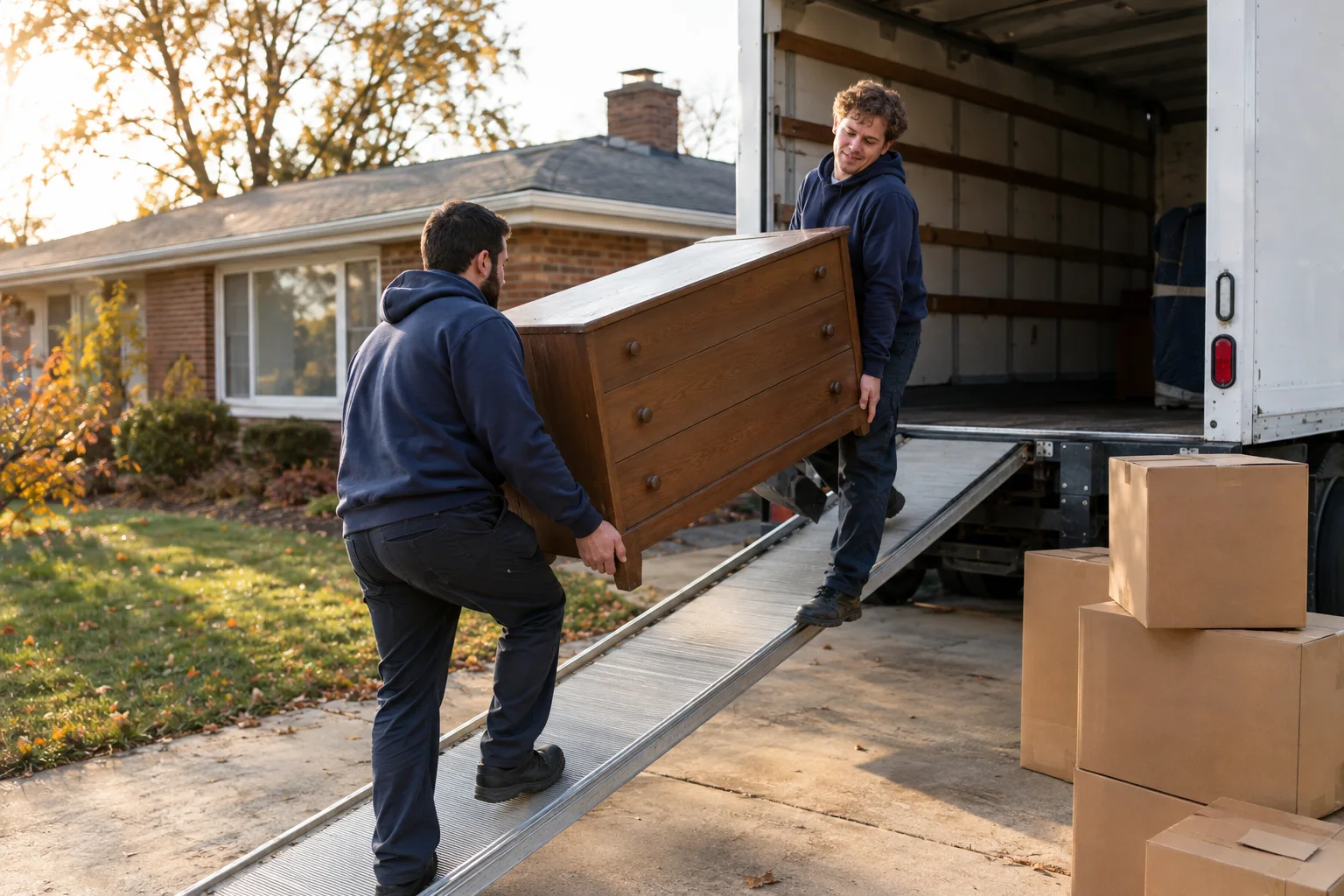
Professional crews lift as a team every day, with dollies, straps, padding and practiced stair technique, and they know when to take a bed apart or a door off its hinges so a couch clears the frame. Friends are generous, but they get tired, arrive late and leave early, and nobody is paid to be careful with your walls.

How long each option takes
A DIY move takes longer than most people plan for, because the same few people pack, load, drive, unload and return the truck. Count the hours honestly: truck pickup, loading, any second trip, the drive, unloading and the return. Stairs, long carries from the door to the truck, and furniture that has to come apart stretch a moving day for crews and families alike, but a trained crew keeps a steady pace while a group of tired friends slows down as the afternoon wears on.
Heavy and specialty items
Pianos, safes and hot tubs are where do-it-yourself risk is highest. An upright piano is top-heavy, Amenity puts gun safes in roughly the 300 to 2,000 pound range, and a hot tub needs draining, disconnecting and a clear path to the truck. Plenty of people who rent a truck for everything else still book piano movers or gun safe movers for those pieces.
Ready for a straight answer on your move?
Book a free, no-obligation in-home estimate with Amenity’s Plainfield team.
Protection when something breaks
When you drive the truck, you are the carrier. Damage to your own furniture is yours to absorb, or your homeowner’s or renter’s policy’s, depending on its terms. Damage to the truck falls under the rental agreement and whatever protection you buy or already carry. Read both documents before moving day, not at the counter.
When you hire a licensed mover, the mover takes on liability for your goods under its tariff. For interstate moves, the federal Your Rights and Responsibilities booklet makes Full Value Protection the default level unless you waive it in writing. The alternative, released value, costs nothing extra but is minimal protection: no more than 60 cents per pound per article. FMCSA’s own example is a 10-pound stereo component worth $1,000, which would bring no more than $6.
Illinois moves start from the same 60-cents-per-pound baseline unless you pay for a higher valuation, and the ICC reminds consumers that a carrier’s liability and insurance are not the same thing. Amenity offers optional liability valuation coverage on items its crews pack. Compare the levels in our guide to full value protection vs. released value.
Driving, parking and permits
Before you book a truck, check where the federal commercial line sits. FMCSA’s commercial driver’s license classes start at a single vehicle with a gross vehicle weight rating of 26,001 pounds or more (Class B), or a combination of 26,001 pounds or more towing a unit rated over 10,000 pounds (Class A). The rating appears on the truck’s door-jamb label and in the rental agreement; also check the rental company’s own age and license rules.
Then there’s parking. A box truck needs room at both ends, and city streets, condo loading docks and apartment elevators may need reservations. In Chicago, the Department of Transportation’s permit portal lists an Occupy the Public Right-of-Way permit for moving-van parking. Suburban villages and homeowner associations set their own rules for trucks and containers, so ask before moving day. Our apartment and condo moving page covers elevators and docks, and moving from Chicago to the western suburbs walks through the city end of the trip.
Driving a loaded box truck is its own skill. It is tall, heavy and slow to stop, and it won’t clear every overpass, drive-through canopy or parking garage. Plan the route on major roads, avoid tight cul-de-sacs where you can, and use a spotter whenever you back up.
Long-distance moves: one-way rentals vs. a van line
Distance shifts the comparison more than anything else. A one-way rental means driving a loaded truck for days, buying fuel across several states, booking hotels, and unloading at the far end, often without friends nearby to help. The rental company sets the pickup and drop-off locations, the days allowed and the miles included, so ask what any change will cost.
With a van line, a crew loads, a driver hauls and a destination crew unloads. Interstate movers must be registered with FMCSA and hold a USDOT number, which you can check with FMCSA’s registered mover search. Amenity handles long-distance moves as an authorized agent of Wheaton World Wide Moving; interstate shipments travel under the authority of Wheaton Van Lines, Inc. (USDOT 70719, MC-87113). Amenity’s crew inventories your items and their condition on moving day for you to review and approve, loads the truck item by item, and the driver and Wheaton dispatch stay in contact through delivery. Amenity notes that the Wheaton network connects customers to more than 300 Wheaton agents across the U.S.
Hunting for the lowest out-of-state price is the wrong first step. FMCSA’s red flags list includes estimates given by phone or online sight unseen and demands for cash or a large deposit, and a deliberately low estimate is one of the moving-fraud patterns the agency describes. Compare written estimates based on a survey of your goods, and read our guide to moving scam red flags before you pay anyone.
The middle options: containers and labor-only help
Two hybrids sit between full do-it-yourself and full service. With a portable container, a company drops a container at your home, you pack and load it on your own schedule, and the company transports it. With labor-only help, you rent the truck and hire people by the hour to load and unload it.
Portable containers
Containers suit people who want to pack slowly or need a place to keep things between homes. They shift the loading work and the loading risk to you, and they need somewhere to sit: a driveway usually works, while a street space or condo lot may need permission from the village or association. Goods inside a container you loaded are only as protected as your packing and bracing.
If the real need is storage between closings, compare a container with moving-company storage. Amenity’s moving and storage service uses a 12,000-square-foot warehouse in Plainfield where furniture is wrapped and sealed in wooden crates, every item goes into an inventory database, and only Amenity personnel have access. It is not drive-up self-storage. You don’t get a key or a unit; the inventory list you receive is how you keep track of what’s stored.
Labor-only loaders
Hiring loaders for a rental truck takes care of the heavy lifting but leaves the driving, the truck costs and much of the risk with you. Ask any labor-only company who pays if a loader damages a wall or drops a dresser, and get the answer in writing. Amenity doesn’t list labor-only loading among its services; its local moves include the truck, sized to keep trips to a minimum.
Decision table: which option fits your move
Most moves sort themselves out once you match the situation to the option. Use the table as a starting point, then let the written numbers decide.
| Your situation | Usually the better fit | Why |
|---|---|---|
| Studio or one-bedroom, same town, helpers available | Rental truck | Small volume, short drive, few heavy pieces |
| Two-bedroom, second-floor walk-up | Movers, or a truck plus paid loaders | Stairs multiply lifting time and injury risk |
| Three or more bedrooms with a basement or garage | Movers | Volume means a long day or several truckloads for amateurs |
| Piano, gun safe or hot tub in the move | Specialty movers for those items | Weight and equipment needs exceed rental gear |
| Fixed closing date or lease end | Movers | A scheduled crew and truck; volunteers and rentals can fall through |
| Out of state on a schedule | Van line | No multi-day drive; inventory and liability under federal rules |
| Gap between move-out and move-in | Movers with storage, or a container | Belongings need a secure place to wait |
| Want to pack slowly over several weeks | Container, or movers with partial packing | Spreads the work without a truck sitting idle |
When two rows apply, the harder one usually wins. A one-bedroom with a piano is a specialty move, and a small move on an immovable closing date is a scheduled move. A rental truck is the clear choice mainly when every row points the same way: small, close, flexible and light.
How to price both options side by side
A fair comparison takes about an hour of homework. Do it before you reserve a truck or sign with a mover.
- Get a written mover's estimateAsk a licensed mover for an in-home or video survey. The ICC’s consumer guide says licensed Illinois movers must give a free, written estimate, and FMCSA requires one for interstate moves. Show the estimator every room, closet, basement and garage.
- Get the rental quote in writingInclude taxes, fees, mileage, extra-day and late-return charges, and the protection plan you will buy.
- Add fuel, equipment and materialsUse the fuel formula above, then price dollies, pads, straps, boxes and tape.
- Count the hoursEstimate packing, loading, driving, unloading and returning the truck, then multiply by everyone involved, including you.
- Price the what-ifsA second day, a second trip, a strained back, a dented door frame. Decide what each would cost you.
- Compare totals, not ratesPut the full do-it-yourself total next to the written estimate. Tipping a crew is optional: the ICC’s Smart Tips say tipping is not required, and our guide on how much to tip movers covers common practice.

Keep reading
- How to Pack for a Move
- Moving Scam Red Flags
- Moving From Chicago to the Western Suburbs
- How Long Does a Local Move Take?
Browse the full moving guide library or see every moving service.
Frequently asked questions
What's the lowest-cost way to move your stuff?
For a small load over a short distance, a rental truck with volunteer help usually costs the least in cash. Moving less helps every option, so sell or donate what you won’t use. For larger homes, compare a written mover’s estimate against a fully priced rental, including mileage, fuel, equipment, coverage and your time.
What day or time of year costs less to move?
It varies by mover, so ask each one which dates on its calendar are least in demand. Mid-week and mid-month dates are worth asking about, and a flexible date gives you more choices. In the Chicago area, winter dates add weather to plan around. Our guide to when to move in the Chicago suburbs covers season, weather and school calendars.
Do you have to tip movers?
No. The Illinois Commerce Commission’s Smart Tips say tipping is not required, and that if a crew demands a tip you should call the company right away. Many people still tip a crew that works carefully. Our guide on how much to tip movers covers common approaches for local and long-distance moves.
Will movers move a safe?
Not every mover will, so ask before you book. Amenity moves gun safes, which it notes weigh roughly 300 to 2,000 pounds, including brands such as Stack-On, Browning and Liberty ProVault, using power dollies, and it can store them. Empty the safe before moving day and tell the estimator its size, weight and where it sits.
How can I move a piano without overpaying?
Get a piano-specific written estimate that names the piano type, the stairs and the path out of the house, so nothing changes on moving day. Booking it with the rest of the household avoids a separate trip. Skip the rental-truck approach: uprights are top-heavy, and grands need a piano board and partial disassembly.
Is a moving container cheaper than hiring movers?
A container often costs less than full service because you do the packing and loading, but it has its own extras: delivery and pickup, storage time, and any village or HOA permission for where it sits. If you’ll also hire loaders, add their hours. Compare the container’s full quote with a written mover’s estimate.
Do I need a special license to drive a rental moving truck?
Check the truck’s rating. FMCSA’s commercial driver’s license classes begin at a single vehicle with a gross vehicle weight rating of 26,001 pounds or more. The rating is on the door-jamb label and in the rental agreement. Rental companies also set their own age and license requirements, so confirm those when you book.
What is the lowest-cost option for an out-of-state move?
There isn’t one answer; volume, distance and timing decide it. Compare written estimates based on a survey of your goods, and be wary of a quote far below the rest. FMCSA lists sight-unseen phone or online estimates and demands for cash or large deposits among the red flags of moving fraud.
Sources
- Household Moves in Illinois: A Consumer's Guide (rev. 3/2026) — Illinois Commerce Commission
- Appendix A to Part 375 — Your Rights and Responsibilities When You Move — Electronic Code of Federal Regulations (FMCSA)
- Drivers (Commercial Driver's License classes) — Federal Motor Carrier Safety Administration
- Applications Manual for the Revised NIOSH Lifting Equation — National Institute for Occupational Safety and Health (CDC)
- Gasoline and Diesel Fuel Update — U.S. Energy Information Administration
- Spot the Red Flags — Federal Motor Carrier Safety Administration
Who handles your move
Local Moving Specialists is operated by Amenity Moving & Storage Inc., 10028 Mandel St, Plainfield, IL 60585 — a family-run Illinois mover since 1986. Illinois household goods license ILCC 73744 MC-C. Interstate moves are transported under the authority of Wheaton Van Lines, Inc. (USDOT 70719, MC-87113), for which Amenity is an authorized agent. See licenses & disclosures.
Last reviewed November 11, 2026 against Amenity Moving & Storage’s published service details and the public sources listed above.
Ready for a straight answer on your move?
Book a free, no-obligation in-home estimate with Amenity’s Plainfield team.