How Long Does a Local Move Take?
Most local moves fit in one working day, but stairs, unpacked rooms and heavy pieces can stretch it. Here is what sets the clock and how to shorten it.
- ILCC 73744 MC-C
- Free in-home estimates
- One customer per truck
- Multiple truck sizes

How long does it take movers to move a house locally?
Most local moves finish within one working day. A This Old House moving guide puts loading a one-bedroom apartment at about two to three hours and says a three-bedroom house may take up to seven, with the drive and unloading on top. Stairs, elevators, long carries, unpacked rooms and heavy specialty items add time; a larger crew and a ready house take it away.
Get your free moving quote
Tell us where and when. Amenity’s Plainfield office replies directly.
On this page
The short answer, and why ranges are so wide
A local move usually takes part of a day for an apartment and most of a day for a family house. Published figures are useful as a starting point: the This Old House guide to moving timelines (updated June 2026) estimates about two to three hours of loading for a one-bedroom apartment and up to seven hours for a three-bedroom house, and notes that a larger home can take an entire day to load and unload.
Those numbers cover loading. Your total also includes the crew’s arrival and walk-through, the drive, unloading, placing furniture and paperwork at the end. That is why two moves of the same size can finish hours apart: one has a driveway and boxes taped and stacked by the door, the other has a third-floor walk-up and a kitchen still in the cabinets.
Home size varies more across the Chicago area than most people expect. Census figures for 2020–2024 put the median number of rooms at 4.7 in Chicago, 5.1 in Lisle, 7.3 in Naperville and 10.0 in Hinsdale. The typical Hinsdale home has roughly twice the rooms of the typical Chicago home, and every room is furniture to wrap, carry and place.
| Home | What the crew is handling | What usually adds time |
|---|---|---|
| Studio or one-bedroom apartment | A bed, a sofa, a table, a few dressers and boxes | Stairs or a shared elevator; distance from the unit to the truck |
| Two-bedroom apartment or condo | Two bedrooms of furniture, more boxes, often a storage locker | Elevator reservations, building move hours, parking |
| Three-bedroom house | Bedrooms, living and dining sets, kitchen, garage | Basement and garage contents, patio furniture, items not yet packed |
| Four or more bedrooms | Multiple living areas, finished basement, attic storage | Heavy pieces such as pianos or safes; more than one truckload |
Seven factors that set the clock on moving day
The length of a move comes down to how much there is, how far each item has to travel to the truck and how many hands are carrying it. These are the factors an estimator weighs.
- Volume. Rooms, furniture and box count. A finished basement or a full garage can add as much as another bedroom.
- Access. Stairs, elevators, long hallways and the distance from the door to where the truck can park. A crew carrying down three flights moves slower than one rolling a dolly across a driveway.
- Packing status. Taped, labeled boxes load quickly. Loose items, half-packed rooms and full dresser drawers of heavy things slow everything.
- Specialty items. Pianos, safes and hot tubs need equipment and planning. Amenity notes that gun safes alone weigh roughly 300 to 2,000 pounds and are moved with power dollies.
- Distance and traffic. A move across Naperville and a move from the city to Plainfield are both local, but the drive between them is very different.
- Crew size and truck count. More movers can load in parallel, and a larger truck can save a second trip.
- Weather. Rain and snow mean more floor protection, more careful footing and slower carries. Amenity lays floor runners in winter.
Most of these are set before the truck arrives. Access and volume are what the estimator measures; packing status and box readiness are mostly up to you.
Two more things stretch a day without making the home any bigger: extra stops and waiting. Picking up a few pieces from a storage unit, dropping furniture at a relative’s house on the way, or waiting for a closing to fund before keys are released all add time. Tell the estimator about every stop and about your closing time so the schedule allows for them.
A sample moving-day timeline
A local moving day follows the same order whatever the size of the home. The illustration below is for a packed three-bedroom house moving a few suburbs away; your own written estimate will show the hours planned for your move.
- Morning: arrival and walk-throughThe crew lead walks every room with you, confirms what is going and what stays, and notes fragile or high-value pieces. If you asked for an inventory form, it is filled out now.
- Protection and disassemblyFloors and door frames are protected where needed, and bed frames, table legs and other pieces that come apart are taken down.
- LoadingHeavy furniture and appliances go on first, then boxes, then items that need to come off first at the new home. This is usually the longest stretch of the day.
- Final sweepClosets, the attic, basement, garage and yard are checked once more before the truck doors close.
- The driveDrive time depends on distance and traffic; leave keys, garage openers and access codes for the new home ready.
- Unloading and placementFurniture goes to the rooms on your floor plan and boxes to the rooms on their labels. Tell the crew which rooms you need working tonight, such as bedrooms.
- Wrap-upYou check the items, note any concern on the paperwork and settle the bill under the terms of your written estimate.

Ready for a straight answer on your move?
Book a free, no-obligation in-home estimate with Amenity’s Plainfield team.
How long it takes to unload a moving truck
Unloading time depends less on the truck and more on decisions at the new house. A crew that knows exactly where each piece goes can roll straight from the ramp to the room; a crew waiting while you decide which bedroom gets the dresser cannot.
Three things speed up the unload. First, tape a simple floor plan by the front door with room names that match your box labels. Second, have the new home empty and open: old furniture out, the garage cleared and the driveway free for the truck. Third, be ready to answer placement questions, or put one person in charge of answering them.
Access matters at this end too. A ground-level ranch house unloads quickly; a second-floor condo with a shared elevator or a townhouse with tight stairs does not. If the new place has an elevator, book it for the arrival window and add a buffer for the drive.
Packing time is the part people underestimate
Packing usually takes far longer than the move itself, and it is the part you control. A home that is packed and labeled before the crew arrives loads in a fraction of the time of one that is still being boxed up.
Work backward from moving day. Start with rooms and storage you rarely use about three to four weeks out, keep packing a few boxes a day, and leave the kitchen, bathroom and daily clothes for the last two or three days. Our packing guide covers box sizes, labeling and what to pack first.
- Every box taped, labeled with its destination room and stacked near the door
- Dresser drawers emptied of heavy, fragile or valuable items
- Beds stripped and bedding packed in a labeled box
- Lamps, mirrors and artwork boxed or set aside for wrapping
- Outdoor items gathered from the yard, shed and patio
- Hazardous items such as fuel, propane and paint set aside, since they do not go on the truck
If packing is running behind, it is better to say so before moving day than during it. Amenity offers full or partial packing and, subject to availability, last-minute packing help when time slips.
How hourly local moves are estimated in Illinois
In Illinois, a written estimate for an hourly move has to state how many hours the move is expected to take. Section 1457.610 of the Illinois Administrative Code requires the estimate to list the equipment and personnel and, for hourly-rated shipments, the number of hours including travel time, along with the total estimated cost.
Which moves are hourly? The Illinois Commerce Commission’s consumer guide says moves under 50 miles, or entirely within Cook, DuPage, Kane, Kendall, Lake, McHenry and Will counties, may be charged by the number of workers and hours. It also warns that the lowest hourly rate does not necessarily produce the lowest bill, because charges are based on actual time and the number of workers.
Two more rules matter when a day runs long. The ICC guide says that if you are billed by the hour, you may pay for the time an inventory takes. And if final charges exceed the written estimate by more than 10%, the mover must release your goods once you pay 110% of the estimate and give you 30 days to pay the rest. Our guide to how moving costs are calculated in Illinois goes further into rates and tariffs.
Ask for the hours in writing
When you compare estimates, compare the hours and crew size, not only the rate. An estimate with three movers for five hours and one with two movers for eight hours describe very different days.
How Amenity sizes the crew and truck
Amenity plans the time on a local move by sizing the crew and trucks to the home, after a free, no-obligation in-home visual estimate. The estimator sees the volume and access in person, which is what drives the hours.
- Multiple truck sizes so the load fits in as few trips as possible, and full semi trailers when a single trip makes more sense than several
- One customer per truck on local moves, so the truck is not stopping for another household’s goods and your belongings are never mixed with anyone else’s
- Specialty equipment for pianos, gun safes and hot tubs, planned into the schedule rather than discovered on the day
- Winter preparation, including floor runners, and the option to change dates when the weather turns, subject to availability
Some moves work better as two shorter days than one long one. Packing can happen the day before loading, and when a closing gap means your goods go into Amenity’s Plainfield warehouse, delivery becomes its own day, scheduled once you have keys. Storage runs from one day to several years, and everything stored is entered on a formal inventory with a detailed list for you.
If the move includes a piano, mention it at the estimate. Our piano moving page covers how Amenity plans those moves; brands it names include Steinway, Baldwin, Kawai, Young Chang and Yamaha. The same goes for a safe or a spa: these items change both the crew and the time. For everyday moves, see local moving services.
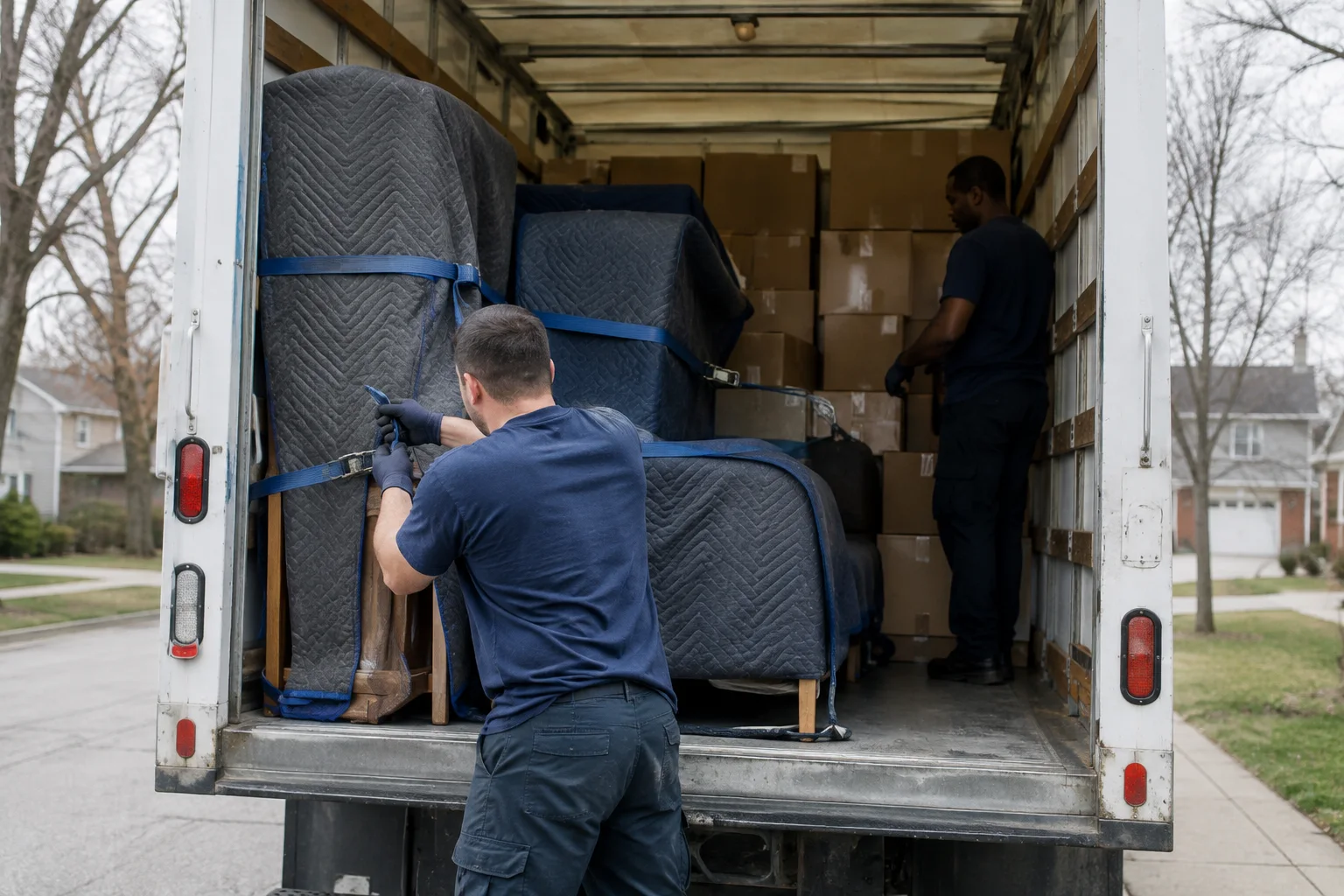
Ways to shorten your moving day
The quickest moves are the ones where the crew never has to wait. Everything on this list removes a reason to stop.
- Finish packing the night before, including the kitchen
- Reserve elevators at both buildings and confirm truck parking
- Clear a straight path from each room to the door, and prop or remove storm doors
- Disconnect washers, dryers and electronics in advance, and empty the refrigerator
- Keep pets and young children in a separate room or with a sitter
- Set aside a box of essentials, documents and medications that rides with you
- Have the new home’s keys, codes and garage openers in hand before the truck leaves
- Decide where every large piece goes at the new home and label the rooms
Timing helps too. If your dates are flexible, ask which days the mover has open for a morning start, since an early start leaves daylight for the unload. The ICC recommends starting your search for a mover at least six weeks ahead, which also gives you time to book a morning start. See how far in advance to book movers for planning around peak season.
Keep reading
- What Happens During an In-Home Moving Estimate
- Downsizing Checklist for Seniors
- Office Move Checklist
- How Far in Advance to Book Movers
Browse the full moving guide library or see every moving service.
Frequently asked questions
How long does it take movers to move a three-bedroom house?
Loading alone can take up to seven hours, according to a This Old House moving guide, and the total day adds the drive, unloading and placement. A packed house with driveway access at both ends finishes much faster than one with stairs, a full garage and rooms still being packed. Your Illinois written estimate will state the hours planned for your move.
How long does it take to unload a moving truck?
It depends mostly on access and decisions at the new home. A ground-level house with labeled rooms and a clear driveway unloads quickly, while a condo with a shared elevator or tight stairs takes longer. Tape a floor plan by the door and have someone ready to answer placement questions.
Can a local move be done in one day?
Most local moves are. Very large homes, homes with heavy specialty items, or moves that include a stop at storage can run long or be split across two days. If your estimate shows a long day, ask about adding crew members or a larger truck so the load fits in one trip.
Do I have to tip movers for a long moving day?
No. The Illinois Commerce Commission’s Smart Tips for hiring a mover state that tipping is not required, and that if a crew demands a tip you should call the company right away. Many people still offer something for a long or difficult day; our guide on how much to tip movers covers common approaches.
How many days before moving should you start packing?
Start about three to four weeks ahead with storage areas and rooms you rarely use, then pack a few boxes a day. Leave the kitchen, bathroom and everyday clothes for the final two or three days. Larger homes, or homes being downsized, need more lead time because sorting takes longer than packing.
Does a winter move take longer?
It can. Snow and ice mean more floor protection, careful footing on steps and driveways and slower carries, and short daylight leaves less margin. Amenity lays floor runners in winter and can change dates when weather turns, subject to availability. Clear and salt walkways at both homes before the crew arrives.
Why did my hourly move take longer than the estimate?
Usually because the move changed: more items than were shown, unpacked rooms, extra stops or access problems such as a blocked driveway or an unreserved elevator. In Illinois, if charges exceed the written estimate by more than 10%, you can pay 110% at delivery and the mover must give you 30 days to pay the balance.
Does a piano or gun safe add time to a local move?
Yes. Heavy specialty items need extra planning, equipment and often extra crew. Amenity moves gun safes, which it says weigh roughly 300 to 2,000 pounds, with power dollies, and handles pianos from makers such as Steinway, Baldwin and Yamaha. Mention them at the estimate so the time is built into the plan.
Sources
- How Long Does It Take To Move — This Old House
- Household Moves in Illinois: A Consumer's Guide (rev. 3/2026) — Illinois Commerce Commission
- Section 1457.610 Estimate of Charges, 92 Ill. Adm. Code 1457 — Illinois General Assembly (JCAR)
- ICC Smart Tips for Hiring a Household Goods Mover — Illinois Commerce Commission
- Hinsdale village, Illinois profile (American Community Survey 2020–2024) — U.S. Census Bureau
Who handles your move
Local Moving Specialists is operated by Amenity Moving & Storage Inc., 10028 Mandel St, Plainfield, IL 60585 — a family-run Illinois mover since 1986. Illinois household goods license ILCC 73744 MC-C. Interstate moves are transported under the authority of Wheaton Van Lines, Inc. (USDOT 70719, MC-87113), for which Amenity is an authorized agent. See licenses & disclosures.
Last reviewed November 11, 2026 against Amenity Moving & Storage’s published service details and the public sources listed above.
Ready for a straight answer on your move?
Book a free, no-obligation in-home estimate with Amenity’s Plainfield team.