Moving From Chicago to the Western Suburbs: What Actually Changes
Walk-up stairs and street permits give way to driveways, garages and bigger floor plans. Here is how the move itself changes, with Census data for eight suburbs.
- ILCC 73744 MC-C
- Free in-home estimates
- One customer per truck
- Plainfield warehouse storage
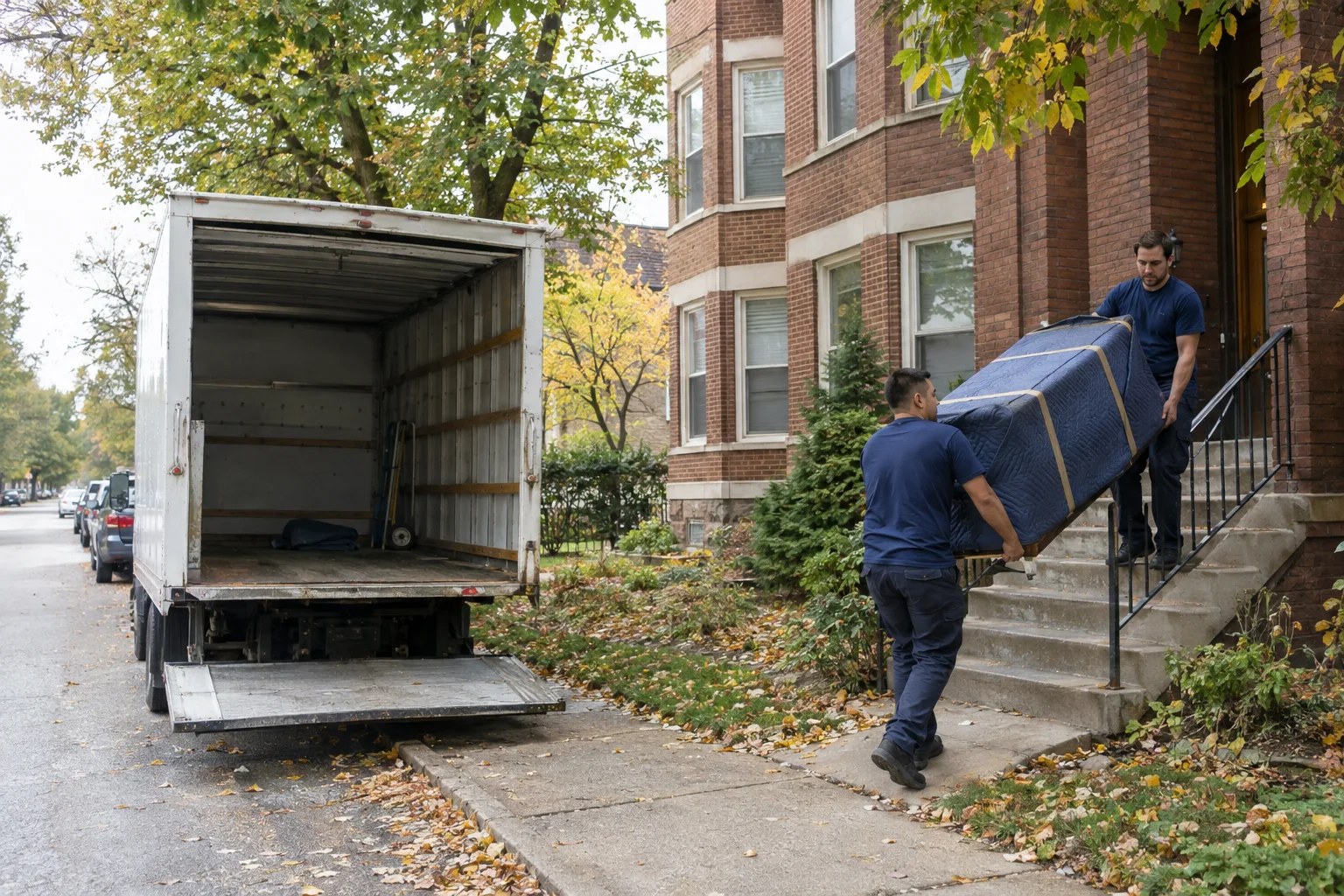
What changes when you move from Chicago to the western suburbs?
Mostly access and volume. About 70.6% of Chicago’s housing units sit in buildings with two or more units, so the pickup usually means stairs, elevators and a street permit for the truck. In suburbs such as Naperville or Plainfield most homes are single-family houses with driveways, and they hold more rooms. Expect a slower load in the city and more furniture to place at the new house.
Get your free moving quote
Tell us where and when. Amenity’s Plainfield office replies directly.
On this page
What changes when a city apartment becomes a suburban house
The biggest change is at the curb, not on the expressway. According to the Census Bureau’s 2020–2024 American Community Survey, only 25.6% of Chicago’s housing units are single-family detached homes, while 39.0% are in buildings with two to nine units and 31.6% are in buildings with ten or more. Those are the two-flats, courtyard walk-ups and high-rises that make a city pickup slower than the suburban drop-off.
The suburbs flip those numbers. In Plainfield, 79.6% of homes are single-family detached and only 5.3% are in buildings of ten or more units. In Naperville the single-family share is 62.8%. Homes also get bigger: the median Chicago home has 4.7 rooms, against 7.3 in Naperville and 7.7 in Plainfield. A household that fit in a city two-bedroom often ends up buying furniture for the rooms it never had, and that shapes how the move should be planned.
| Moving-day factor | Typical Chicago pickup | Typical western-suburb delivery |
|---|---|---|
| Where the truck parks | On the street, often needing a city permit and signs | Usually in the driveway or at the curb in front of the house |
| Getting things out | Interior stairs, back porches, shared hallways or a reserved elevator | Front door or garage, sometimes a basement stair |
| Building rules | Move hours, elevator booking and insurance paperwork set by management | Homeowners association rules in some subdivisions; check your HOA documents |
| Volume | Median of 4.7 rooms citywide | Median of 5.7 to 7.7 rooms in the eight suburbs compared below |
| What slows the day | Carry distance from unit to truck | Placing furniture across more rooms and floors |
For you, that means two different crews’ worth of problems in one day. The city end is about access: how fast items can travel from your unit to the truck. The suburban end is about placement: getting a sectional into a finished basement or a bed frame up a turned staircase. Your in-home estimate should cover both addresses, not just the apartment you are leaving.
Getting the truck parked on a Chicago street
In Chicago, enforceable moving-van parking is handled by the Chicago Department of Transportation (CDOT) as an “Occupy the Public Right of Way” permit, filed through the city’s online permit portal at ipi.cityofchicago.org. CDOT’s permits page lists a training guide for the “Moving Van Parking” activity, and that guide asks for the start and end dates, the number of vehicles parked at one time, the block range and the mover’s ICC vehicle number.
Because the application asks for an Illinois Commerce Commission vehicle number, it is built for licensed moving companies rather than residents. Ask your mover early who files the permit and how many days of lead time it needs. CDOT’s guide also notes that a permit on an arterial street requires a work zone sketch or traffic plan, so a move on a busy street can take more paperwork than one on a side street.
Aldermanic offices offer a different kind of sign. The 44th Ward office, for example, hands out free courtesy signs that it describes as non-enforceable, asks that they go up at least 48 hours before the move and notes that street-cleaning signs take precedence. Courtesy signs can help, but they do not let anyone ticket or tow a car parked in your spot.
Building rules before you book a date
High-rise and managed buildings usually have their own move policy, and it can decide your moving date for you. Ask management for it in writing and look for these items:
- Whether the freight or passenger elevator must be reserved, and for how many hours
- Allowed move days and hours, including weekend restrictions
- Whether the building needs a certificate of insurance (COI) from the mover, and the exact names it must list
- Any move-out deposit and how it is returned
- Where the truck may load: a dock, an alley or the street out front
- Whether hallway and elevator padding is required
Send the policy to your mover before the estimate is finalized. Elevator time that ends at 4 p.m. or a dock shared with another move changes how the crew and truck should be scheduled. Our apartment and condo moving page covers more of the building-side detail.
Comparing suburbs with Census numbers
The fastest way to compare suburbs for a move is to look at what kind of homes they have, how old those homes are and how long residents commute. The table below uses the same Census survey for Chicago and eight western and southwestern suburbs on our service map. It does not rank them; each number cuts both ways depending on what you need.
| Place | Single-family detached | 10+ unit buildings | Built before 1960 | Built 2010 or later | Median rooms | Mean commute (min) | Metra line |
|---|---|---|---|---|---|---|---|
| Chicago | 25.6% | 31.6% | 58.0% | 6.3% | 4.7 | 33.1 | Many lines |
| Elmhurst | 72.0% | 18.2% | 43.0% | 11.3% | 6.5 | 29.1 | UP-W |
| Glen Ellyn | 62.9% | 19.6% | 30.5% | 4.4% | 7.0 | 29.1 | UP-W |
| Wheaton | 58.0% | 18.4% | 24.6% | 4.8% | 6.4 | 25.7 | UP-W |
| La Grange | 67.7% | 15.6% | 64.0% | 6.4% | 6.9 | 28.5 | BNSF |
| Downers Grove | 62.0% | 22.6% | 24.5% | 6.7% | 6.5 | 27.8 | BNSF |
| Naperville | 62.8% | 13.0% | 5.8% | 8.0% | 7.3 | 30.5 | BNSF |
| Aurora | 58.7% | 11.8% | 24.9% | 5.1% | 5.7 | 27.2 | BNSF |
| Plainfield | 79.6% | 5.3% | 4.7% | 15.1% | 7.7 | 33.3 | None |
Housing age. La Grange (64.0% built before 1960) and Elmhurst (43.0%) have older housing stock than Naperville (5.8%) or Plainfield (4.7%). Older homes can mean narrower stairways, tighter basement access and doorways that were never sized for today’s sectionals, so measure before you buy furniture for the new place. Newer subdivisions trade that for longer drives and, in some cases, HOA move rules.
Commute. Mean travel time to work ranges from 25.7 minutes in Wheaton to 33.3 minutes in Plainfield, against 33.1 for Chicago residents. Those are averages for everyone who works, not just downtown commuters, so treat them as a rough signal of how far residents typically travel.
Apartments in the suburbs. If you want to rent first, buildings with ten or more units still make up 22.6% of Downers Grove’s housing and roughly 18% to 20% in Elmhurst, Glen Ellyn and Wheaton. A suburban apartment move brings back some of the city issues, such as elevators and shared entrances, on a smaller scale. Each town page links to its full Census profile.

Ready for a straight answer on your move?
Book a free, no-obligation in-home estimate with Amenity’s Plainfield team.
Metra lines and where they run
Five Metra lines cover most of the western and southwestern suburbs Amenity serves, and the station you want often narrows the house hunt more than any other factor. Station lists below come from Metra’s schedule pages.
- BNSF runs from Chicago Union Station to Aurora, with stops in La Grange, Western Springs, Hinsdale, Clarendon Hills, Westmont, Downers Grove, Lisle, Naperville and Aurora’s Route 59 station.
- Union Pacific West (UP-W) runs from Ogilvie Transportation Center to Elburn, through Elmhurst, Villa Park, Lombard, Glen Ellyn, Wheaton, Winfield, West Chicago and Geneva.
- Rock Island runs from LaSalle Street Station to Joliet, passing through Tinley Park, Mokena and New Lenox.
- Heritage Corridor runs from Union Station to Joliet through Lemont, Romeoville and Lockport.
- SouthWest Service runs from Union Station to Manhattan, with three Orland Park stations and a New Lenox stop.
None of these lines stops in Plainfield, which also has the longest mean commute in the table above. If you plan to keep a downtown job, put the station on your short list before the house: walking distance to a BNSF or UP-W stop is a different daily routine than a drive to a park-and-ride lot.
Station location can also change moving day. If the home you pick near a downtown station is a condo building or sits on a busy street, plan for an elevator reservation, a loading spot and building paperwork, much like the city end. A detached house on a quiet residential street usually needs none of that.
Timing the move around two school calendars
Families leaving Chicago Public Schools for a suburban district can get a shorter summer than they expect, because some suburban districts start earlier in August. Compare the two calendars before you set a closing date.
Here is one real example. The CPS 2026–27 family calendar has the last day of classes on Friday, June 11, 2027, and the 2027–28 year starting Monday, August 23, 2027. Naperville Community Unit School District 203 lists 2027–28 classes beginning Wednesday, August 18, 2027. A family moving from a CPS school to a District 203 school therefore has about ten weeks between the last city school day and the first suburban one, five days less than the CPS calendar alone suggests.
Inside that window, late June and July are the obvious targets, but they are also when demand for movers is high. The Illinois Commerce Commission’s Smart Tips for hiring a mover recommend starting your search at least six weeks ahead; for a summer move from the city, earlier is safer. Other districts publish their own calendars, so check the one for your new address. Our guide to choosing a season to move in the Chicago suburbs covers weather and demand month by month.
Registration needs proof of address
Districts verify where a student lives before enrollment. District 203, for example, publishes separate proof-of-residency forms for homeowners, renters and families living with someone else. If you close in August, ask the new district what it accepts before the closing so enrollment does not wait on the move.
Packing a city apartment for a bigger house
Pack for the house you are moving into, not the apartment you are leaving. City apartments push you toward compact, multi-purpose furniture and storage tucked into every closet; a suburban house with a basement and garage changes what is worth taking.
What usually is not worth moving
- Furniture you bought to fit a small room, such as apartment-size sofas, narrow bookcases or a drop-leaf table, if you already plan to replace it
- Window coverings and curtain rods measured for city windows
- Duplicate kitchen gear, expired pantry food and cleaning products
- Space-saving gear you will not need with a garage, such as wall-mounted bike hooks or over-door organizers
- Flammable or hazardous items, such as paint thinner and propane tanks, that movers generally exclude from the truck
Clothes travel well in wardrobe boxes for hanging items and medium boxes for folded ones. Bags tear, crush and are easy to mistake for trash, so use them only for soft items like pillows and bedding. Start with the rooms you use least, such as storage closets and the back of the pantry, three to four weeks out, and leave the kitchen and bathroom for the final days.
Label boxes by the room they will go to in the new house, not the room they came from. A box marked “office” tells the crew nothing if your new office is a basement bedroom; a box marked “lower level, bedroom 4” goes straight there. If you would rather hand that work off, Amenity offers full or partial packing services and brings the right materials in the right quantities.

When the lease and the closing do not line up
A gap between a city lease ending and a suburban closing is common, and storage with your mover is the simplest bridge. Amenity stores household goods in its 12,000-square-foot warehouse in Plainfield for anything from one day to several years.
This is not a self-storage unit. Furniture is wrapped in pads and cardboard and sealed in wooden crates measuring 8′ x 7.5′ x 5′, sofas sit on sofa racks, and every item is entered in an inventory database with a detailed list given to you. Only Amenity personnel access the warehouse, which has an alarm system, an outdoor security camera, a well-lit yard and climate-controlled space.
The practical benefit is one handoff instead of three. The crew that loads your apartment can take everything to the warehouse, and the same company delivers it to the new house when you get the keys. Read more about how moving and storage works, including pickup, crating and delivery.
How Amenity plans a Chicago-to-suburbs move
Amenity Moving & Storage, which operates this site from Plainfield, plans a city-to-suburb move around the harder end first: the Chicago pickup. Here is how the process usually runs.
- Free in-home visual estimateAn estimator sees everything that is moving, including storage lockers, bike rooms and anything in a parking space, and notes stairs, elevators and loading access. Amenity’s estimates are free and carry no obligation.
- Building and permit detailsYou share the building’s move policy and any COI requirements. Ask who files the CDOT van parking permit and how far ahead it is needed.
- Truck and crew sizingAmenity uses multiple truck sizes to minimize trips and has full semi trailers available when a single trip makes more sense. On local moves there is one customer per truck, so your belongings are never mixed with another household’s.
- Written estimateIllinois rules require the estimate on an “Estimate of Charges” form showing the crew, equipment and, for hourly moves, the estimated hours including travel time.
- Moving dayThe crew loads room by room and works to the building’s elevator or dock window. In winter, the crew lays floor runners to protect the floors.
- Delivery and placementBoxes and furniture go to the rooms named on your labels and on any floor plan you tape up by the front door, so nothing piles up in the garage.
A move from Chicago to the western suburbs usually stays inside the counties where Illinois allows hourly billing. The Illinois Commerce Commission’s consumer guide says moves under 50 miles, or entirely within Cook, DuPage, Kane, Kendall, Lake, McHenry and Will counties, may be charged by the number of workers and hours. That makes access at the Chicago end the biggest variable you can control: every extra flight of stairs or wait for an elevator shows up in the hours.
Keep reading
- How Long Does a Local Move Take?
- What Happens During an In-Home Moving Estimate
- Downsizing Checklist for Seniors
- Office Move Checklist
Browse the full moving guide library or see every moving service.
Frequently asked questions
Do I need a permit to park a moving truck in Chicago?
For a spot that can actually be enforced, yes. CDOT handles moving-van parking as an Occupy the Public Right of Way permit through the city’s online portal, and the application asks for the mover’s ICC vehicle number, so it is set up for licensed moving companies. Ward offices offer free courtesy signs, but at least one ward office describes them as non-enforceable.
What should I throw away before moving from an apartment to a house?
Start with expired food, old paint and chemicals, broken electronics and anything you already plan to replace. Small-room furniture and curtains sized for city windows rarely suit a bigger house. Sort the least-used spaces first, such as storage lockers and closets, and decide on large pieces early so the estimate reflects what is really moving.
Is it better to put clothes in bags or boxes when moving?
Boxes are safer. Wardrobe boxes keep hanging clothes on the hanger, and medium boxes hold folded clothes without crushing. Bags tear, slide off stacks and can be mistaken for trash on a busy moving day. Save bags for soft items like pillows and comforters, and label every bag with its destination room.
How many days before moving should you start packing?
For a typical city apartment, start three to four weeks out with storage areas and rooms you rarely use, then work toward the kitchen and bathroom in the final days. If you are moving into a much bigger house, use the extra time to decide what not to take. Hiring packers for some or all rooms shortens that stretch considerably.
Where can I store my things between a lease ending and a closing?
Mover storage avoids an extra load and unload. Amenity keeps goods in sealed wooden crates in a climate-controlled Plainfield warehouse for one day to several years, with an itemized inventory. Self-storage gives you your own key and access, but you or a crew must load and unload the unit yourselves each time.
Which western suburbs have Metra service to downtown Chicago?
The BNSF line serves La Grange, Western Springs, Hinsdale, Westmont, Downers Grove, Lisle, Naperville and Aurora. The UP-W line serves Elmhurst, Villa Park, Lombard, Glen Ellyn, Wheaton, Winfield, West Chicago and Geneva. The Heritage Corridor and Rock Island lines reach Lemont, Romeoville, Lockport, Tinley Park, Mokena, New Lenox and Joliet. Check metra.com for current schedules.
What is the most forgotten thing when moving out of a Chicago apartment?
Shared spaces. Storage lockers, bike rooms, laundry rooms and garage or parking spaces are easy to miss because they are not inside the unit. Show them to the estimator, empty them before moving day and return building keys, fobs and garage remotes so a deposit is not held up.
Are suburban homes harder or easier to move into than city apartments?
Usually easier to reach and harder to finish. A driveway and front door make loading and unloading quicker, but suburban homes in the comparison above have 5.7 to 7.7 median rooms against 4.7 in Chicago, so there is more furniture to place, more stairs between floors and often a basement to fill.
Sources
- Chicago city, Illinois profile (American Community Survey 2020–2024) — U.S. Census Bureau
- CDOT Permits — City of Chicago Department of Transportation
- Train Schedules — Metra
- Chicago Public Schools District Calendar — Chicago Public Schools
- District 203 Calendar — Naperville Community Unit School District 203
- Household Moves in Illinois: A Consumer's Guide (rev. 3/2026) — Illinois Commerce Commission
Who handles your move
Local Moving Specialists is operated by Amenity Moving & Storage Inc., 10028 Mandel St, Plainfield, IL 60585 — a family-run Illinois mover since 1986. Illinois household goods license ILCC 73744 MC-C. Interstate moves are transported under the authority of Wheaton Van Lines, Inc. (USDOT 70719, MC-87113), for which Amenity is an authorized agent. See licenses & disclosures.
Last reviewed November 11, 2026 against Amenity Moving & Storage’s published service details and the public sources listed above.
Ready for a straight answer on your move?
Book a free, no-obligation in-home estimate with Amenity’s Plainfield team.